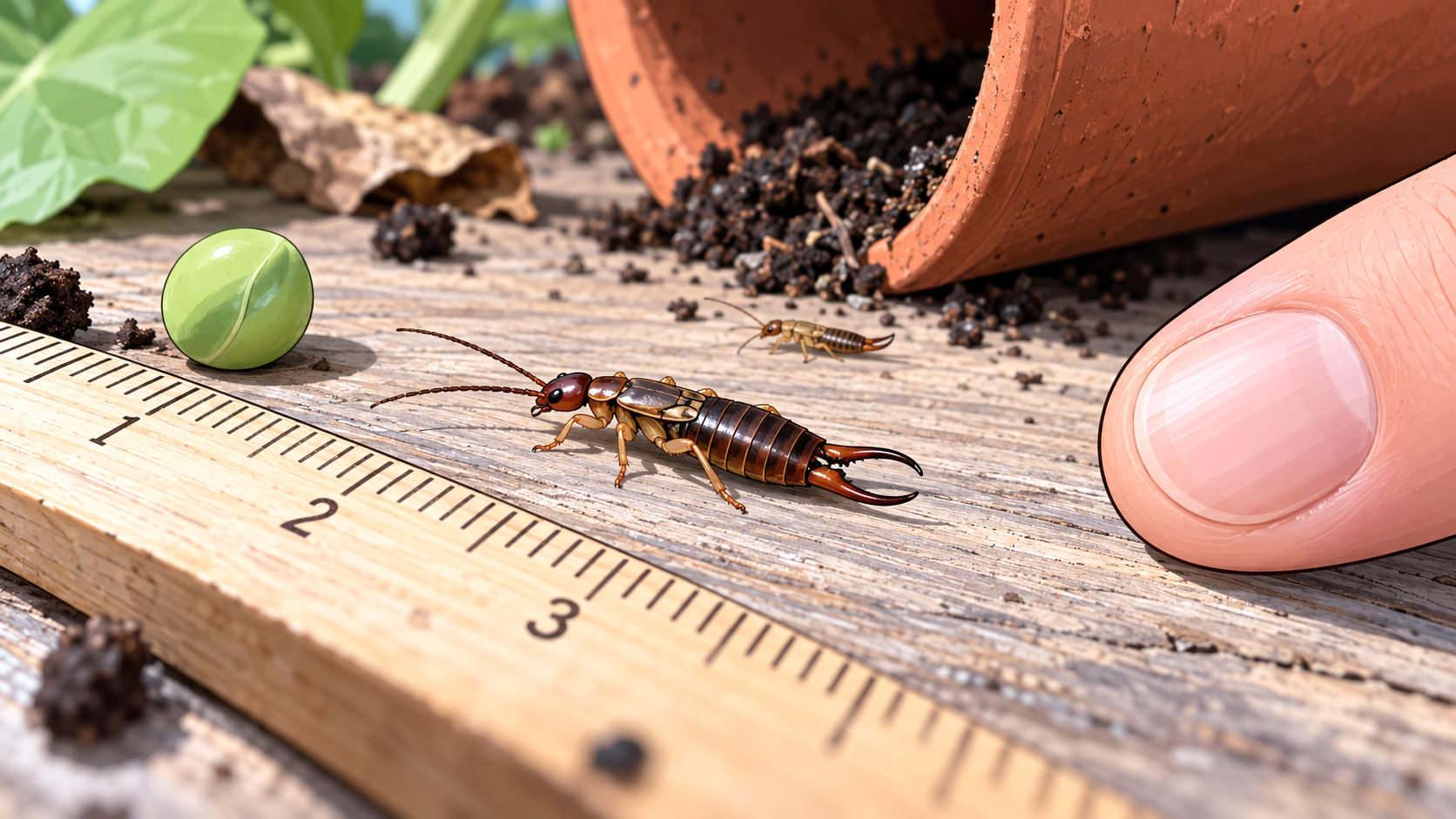
Most adult European earwigs are about 1/2 to 3/4 inch long, or roughly 13 to 19 millimeters. They are relatively small insects, although their long antennae and rear pincers can make them look larger at a glance. Young earwigs start at only a few millimeters long and gradually reach adult size as they molt through their nymph stages.
If you’re trying to judge the size of an earwig you’ve found, concentrate on the body rather than its total reach from antenna tip to pincer tip. Those projecting appendages can add considerably to its apparent length, particularly in adult males with large forceps.
How Big Is a Full-Grown Earwig?
The European earwig, Forficula auricularia, commonly reaches around 1/2 to 3/4 inch in body length. Around 5/8 inch, or 16 millimeters, is a useful reference point for a typical adult, but individual earwigs naturally vary. That puts the insect comfortably below an inch before its projecting appendages are taken into account.
Close-up photographs can give a very different impression. Earwigs are often photographed at macro scale because their forceps, wing covers, antennae, and body segments are difficult to appreciate otherwise. Without a ruler or familiar object in the photograph, there’s little visual context to show that the insect you’re looking at may be barely more than half an inch long. This is one reason people sometimes describe an earwig they encountered as much larger than the measurements suggest.
How Big Are Baby Earwigs?
Baby earwigs are considerably smaller than adults. European earwigs develop through four nymphal stages, with the nymphs ranging from roughly 4 to 11 millimeters long as they grow. The earliest stages are therefore tiny, while later nymphs become progressively closer to adult size.
Unlike insects that begin life as grubs or caterpillars, young earwigs already have the basic shape of an adult. They grow by molting, becoming larger and more developed with each stage until the final molt produces the adult. Their smaller size is accompanied by other differences, particularly lighter coloration and immature wings, which we cover more closely in what baby earwigs look like.
Why Some Earwigs Look Much Bigger Than Others
The pincers are responsible for much of the size difference you notice between individual adult earwigs. Male European earwigs generally have larger, more curved forceps than females, and the length of those male forceps can vary substantially. A male with particularly long pincers can therefore look much larger overall without having a correspondingly enormous body.
This is also why total length isn’t particularly useful for determining whether an earwig is male or female. The shape of the forceps tells you more than body length does. Females usually have relatively straight, slender pincers, while males tend to have thicker, more strongly curved ones. You can compare those differences directly in our guide to male vs. female earwigs.
Do All Earwig Species Reach the Same Size?
Earwig isn’t the name of a single species. It refers to insects belonging to the order Dermaptera, so size varies depending on which earwig you’re looking at. The European earwig is particularly relevant around North American homes and gardens, but other species can have different adult sizes and proportions.
That variation is important when you’re using size for identification. An insect shouldn’t be ruled out as an earwig simply because it doesn’t land exactly at 5/8 inch. Size is most useful when combined with the other characteristics of the insect, particularly its elongated body and paired rear forceps. If identifying the specimen is your main concern, what earwigs look like gives you a more complete set of features to compare.
When Does an Earwig Reach Full Size?
Earwigs grow during the immature portion of their life cycle. Each molt allows a nymph to become larger until the final molt produces the adult. Once that happens, the earwig has reached its adult body size and doesn’t continue getting larger throughout the rest of its life.
This means size can give you a rough indication of developmental stage when comparing a tiny nymph with an adult, but it can’t tell you the exact age of a mature earwig. Two adults may naturally differ in size, while a later-stage nymph can already be approaching adult dimensions. The sequence makes more sense when viewed as part of the complete earwig life cycle.
How to Measure an Earwig Correctly
If you find an earwig and want to compare it with published size ranges, measure from the front of the head to the end of the body. Don’t stretch out the antennae and count them as part of the body length. The rear forceps can also affect your estimate, especially on a male with unusually long pincers, so a photograph beside a ruler is often more useful than trying to judge the insect while it’s moving.
You don’t need to handle a live earwig to get a reasonable measurement. A dead or safely contained specimen can be photographed directly from above with a ruler beside it. Even then, size should remain supporting evidence rather than your entire identification. Many insects fall within the same general length range, while the earwig’s distinctive anatomy provides much stronger evidence of what you’ve actually found.
Other Questions About Earwig Size
Can an earwig be an inch long?
A European earwig’s body is normally below an inch long. However, an adult male with long forceps can appear substantially longer when those pincers are included in the visual estimate. Other earwig species also differ in size, so measurements for the European earwig shouldn’t be treated as a maximum for every earwig species.
How small are earwigs when they hatch?
Newly hatched earwigs are only a few millimeters long. They emerge as tiny nymphs and increase in size through successive molts rather than hatching anywhere close to their eventual adult dimensions.
Does a large earwig mean it’s old?
Not necessarily. A nymph becomes larger as it progresses toward adulthood, but adult earwigs naturally vary in size. Once an earwig has completed its final molt, getting older doesn’t cause it to keep growing.
Does finding a large earwig mean there are more nearby?
No. The size of one earwig doesn’t indicate the size of the surrounding population. A particularly large specimen may simply be a mature adult. If you’re trying to determine whether you’re dealing with a larger problem, repeated sightings and other signs of earwig activity are much more useful than the size of a single insect.
2 thoughts on “How Big Do Earwigs Get?”