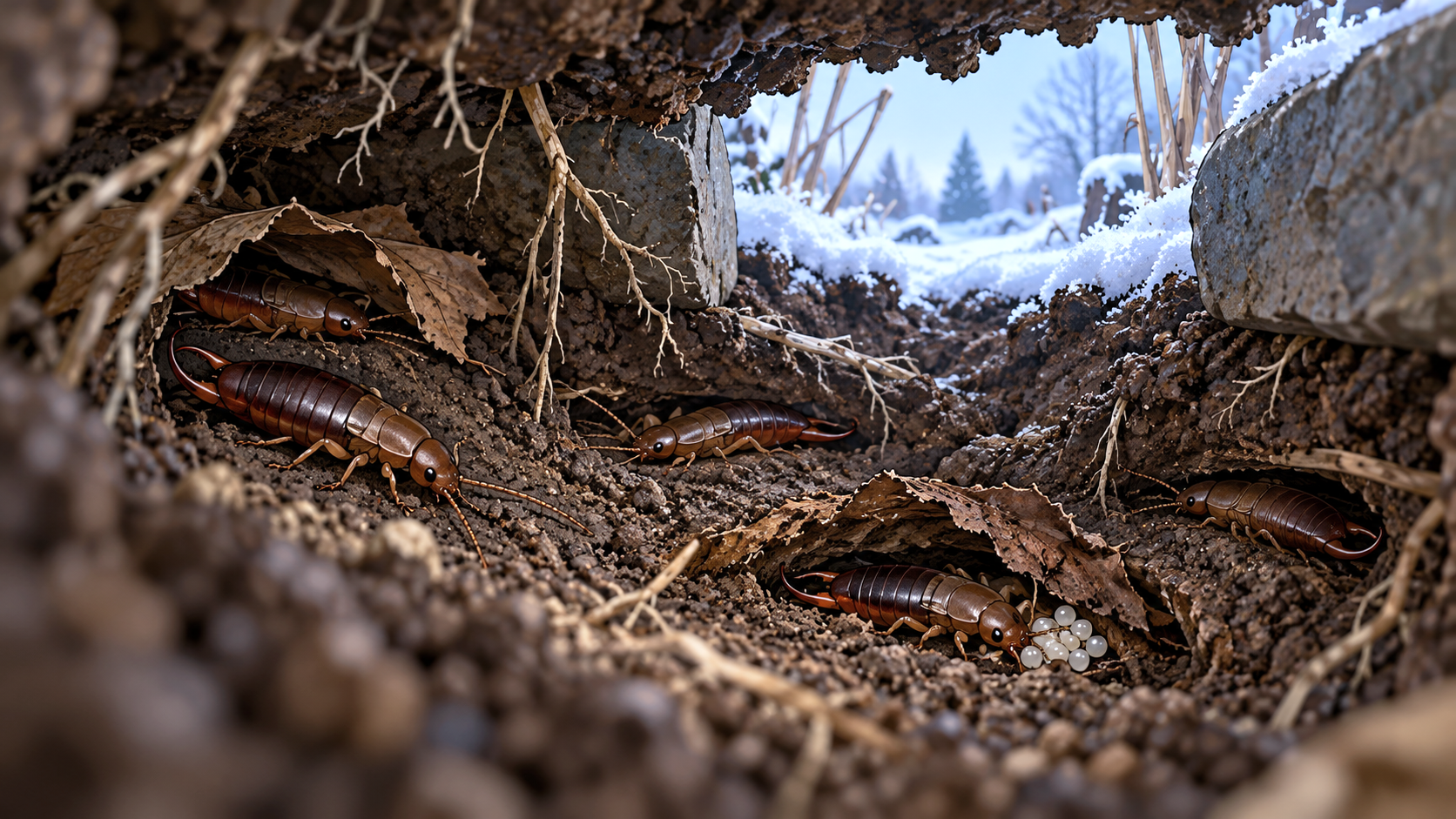
Earwigs can seem to disappear once cold weather arrives, then suddenly turn up again when temperatures rise. They have not necessarily died off. Adult European earwigs can survive winter in protected locations, particularly in soil, where they remain largely inactive until conditions become favorable again.
Earwigs are commonly described as hibernating or overwintering during winter. European earwigs usually overwinter as adults in protected soil nests or aboveground shelters. However, their winter inactivity is more precisely described as quiescence rather than a full diapause. In mild climates, some earwigs can remain active throughout the year.
Earwigs Overwinter as Adults
For the European earwig, Forficula auricularia, winter survival is built directly into the adult stage of the earwig life cycle. Adults mate during late summer and fall, then survive the colder months before reproduction continues.
Most earwig species overwinter as adults, and the European earwig follows that general pattern. This is an important distinction because winter does not normally reduce the population to a collection of dormant eggs waiting for spring. Living adults can make it through the cold season.
In the western United States, European earwigs overwinter underground as brooding pairs or aboveground in aggregations. That second option fits with their tendency to gather together rather than live strictly alone, although these gatherings are not permanent colonies.
Their winter survival strategy also helps explain the seasonal pattern homeowners notice. Earwigs can become far less visible during cold periods without disappearing from the surrounding environment.
Earwigs Spend Winter in Protected Places
Soil provides one of the most important winter shelters. Adult male and female European earwigs can spend winter together in specially constructed nests, and females prepare underground nesting sites during the colder part of their reproductive cycle.
These protected sites are more than ordinary daytime hiding places. European earwigs mate before establishing subterranean nests, and males and females typically spend winter together. As spring approaches, the male leaves or is driven from the nest, while the female remains and begins caring for her eggs.
Aboveground shelter can also be used. In western populations, adults may overwinter in aggregations rather than underground. That means there is no single winter location that applies to every earwig you encounter.
What matters is protection. Earwigs already prefer dark, tight and moist hiding places during their normal daytime routine. Winter makes protected sites even more important because exposed insects must contend with much harsher temperatures.
Earwig “Hibernation” Is Better Described as Quiescence
This is where the everyday word hibernation becomes a little imprecise.
European earwigs do become inactive during cold winter conditions, but their winter state is not the same as the programmed diapause used by some other insects. Research on insect winter survival describes earwigs as entering quiescence rather than full diapause. Quiescence is a direct response to unfavorable environmental conditions, so activity can resume when conditions improve.
That distinction sounds technical, but it explains something practical. An overwintering earwig is not locked into an internal biological timetable that absolutely prevents activity until a predetermined developmental process has finished. Temperature matters directly.
We prefer “overwinter” when describing this behavior because it says exactly what we need without implying a particular dormancy mechanism. An earwig survives the winter in a protected state and becomes more active when conditions allow it.
So, while saying that an earwig “hibernates” is understandable in ordinary conversation, overwintering in a quiescent state is the more precise description.
Winter Does Not Look the Same for Every Earwig
Climate changes the picture considerably.
In colder regions, winter drives earwigs into protected overwintering sites and makes them much harder to encounter. However, mild climates can support activity for much longer. Some earwigs in milder parts of California remain active throughout the year.
European earwigs in some California agricultural settings can also be active in orchards year-round. Consequently, a blanket claim that all earwigs disappear into dormancy every winter would be wrong.
The better way to think about winter activity is as a response to local conditions. A cold continental winter and a mild coastal California winter create very different environments for the same insect.
That also means the time of year when earwigs are most noticeable can vary by region. Calendar dates matter less than the temperatures and conditions the insects actually experience.
Winter Is Closely Connected to Earwig Reproduction
For European earwigs, overwintering and reproduction overlap in an unusual way.
Adults pair before winter, and the female prepares an underground nest. When spring approaches, the male leaves the nesting site. The female then remains with her eggs and provides the unusually extensive maternal care for which earwigs are known.
She gathers the eggs together, guards them and continues caring for the young after hatching. Our guide to how earwigs care for their young covers that behavior in detail.
This makes the winter nest more interesting than a simple hole where an insect waits for warm weather. It connects one generation of adults with the beginning of the next generation.
By late spring and early summer, young earwigs begin leaving their nests and becoming increasingly independent. Populations then become much more noticeable as the warmer season progresses.
Finding an Earwig Indoors During Winter Does Not Mean It Is Hibernating There
A winter earwig inside a house can easily lead to the assumption that it moved indoors specifically to hibernate. That conclusion is not necessary.
Earwigs can seek shelter inside buildings, and they are capable of entering through gaps and other openings. However, their normal overwintering biology does not depend on establishing themselves inside heated homes.
A stray indoor earwig is therefore better treated as an entry issue than evidence of a hidden winter colony. European earwigs do not establish reproducing indoor populations in the way some household pests do. Our guide to why earwigs get inside houses covers those entry conditions separately.
For homeowners, that changes the response. There is little reason to tear into walls looking for a winter nest because one earwig appeared in January. Remove the insect and check obvious gaps around doors, windows and other exterior openings. Where sightings keep occurring, preventing earwigs from entering is more useful than trying to locate a supposed indoor hibernation site.
Other Questions About Earwigs in Winter
Can freezing temperatures kill earwigs?
Yes. European earwigs are freeze-intolerant, so sufficiently severe exposure can kill them. Their use of protected overwintering sites helps reduce exposure to extreme conditions, particularly when they shelter in soil.
Can you find earwigs under snow?
Earwigs can overwinter in soil beneath areas protected by snow cover. Snow can insulate the soil from more extreme air temperatures, which helps explain why protected underground sites can support winter survival even when conditions above ground are severe.
When do overwintering earwigs become active again?
Activity increases when environmental conditions become favorable. Because earwigs overwinter in a quiescent state rather than a fixed diapause, warming conditions can allow them to resume activity without waiting for a separate diapause-development process to finish.
Are baby earwigs active during winter?
European earwigs typically overwinter as adults. The young stages become prominent later, after females lay eggs and the baby earwigs develop through their nymph stages.
Do earwigs come back to the same winter shelter every year?
A particular protected location may continue to provide suitable shelter, but European earwigs have an annual life cycle. Finding earwigs repeatedly in the same area does not mean the same individual insects are returning to a permanent hibernation nest year after year.