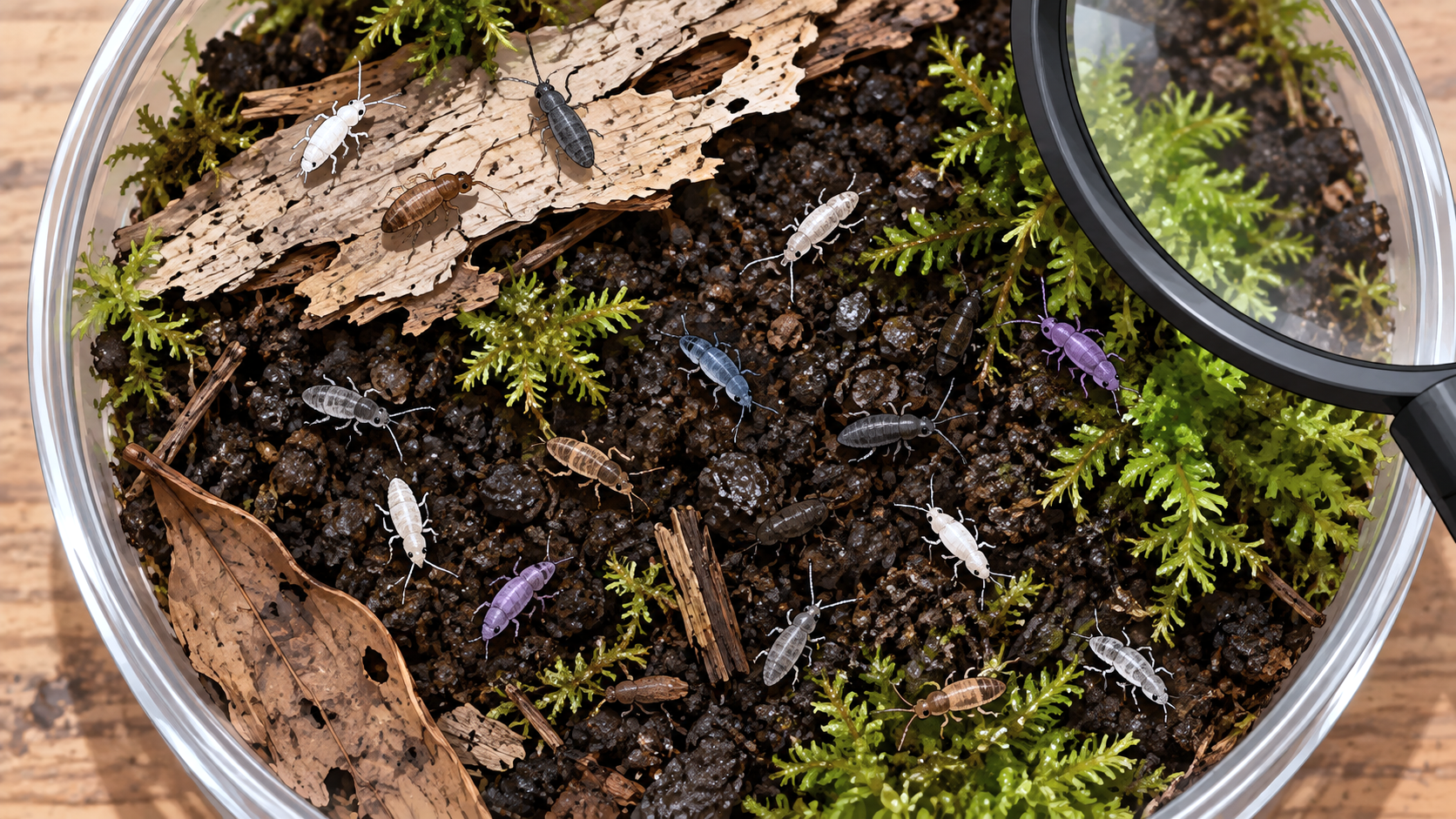
Seeing a tiny black speck jump across a sink might make you picture every springtail as black. Then you look in a plant pot and find something almost white doing the same thing. Both can be springtails. Color varies considerably across this large group of tiny arthropods. Springtails can be white, cream, gray, brown, black, purple, red, orange, or yellow. Some species are also mottled or patterned with more than one color. Dark brown, gray, and black are common among springtails found around homes, but color alone is not reliable enough to identify one.
Springtails Come in a Surprisingly Wide Range of Colors
The color range within Collembola is broader than their tiny size might suggest. Documented springtail colors range from white through black, with purple, red, orange, gray, yellow, and multicolored forms also occurring.
However, you are not equally likely to encounter every color. Many springtails seen around homes are dark. Brown, gray, and black are especially common, while some species are white or brightly colored.
Other springtails fall somewhere between those extremes. Cream and pale brown occur, as do purplish-gray forms. Agricultural springtails, for example, include purplish gray, cream, and brown individuals.
This variation is one reason we would never identify a springtail from color alone. Color can support an identification, but it works much better when paired with body shape and movement.
Black, Gray, and Brown Springtails Are Common
A dark springtail is probably the version most people imagine after finding them indoors. Brown, gray, and black are common springtail colors, and some dark individuals can look almost like pepper flakes until they move.
The surface beneath them changes how obvious that color appears. A black or dark gray springtail stands out sharply on a white bathtub, windowsill, sink, or tile floor. The same animal can be much harder to distinguish against damp soil or dark organic debris.
Dark color therefore tells you very little by itself. Fleas, mites, tiny beetles, and other arthropods can also appear as dark specks at this scale. When the identification is uncertain, compare the animal against other bugs that look like springtails rather than treating black coloration as proof.
White and Cream Springtails Are Normal Too
White springtails can look so different from dark ones that it is easy to assume they belong to an entirely different group. Pale coloration is well documented in springtails, including white and cream forms.
Houseplant owners may be especially familiar with this version. Springtails associated with indoor plants are often described as slender and white or gray. They become easier to notice against dark potting mix, particularly when movement draws your eye to them.
Cream-colored springtails also occur. Some springtails associated with soil and crops have cream-colored bodies, so a pale animal in damp soil should not be ruled out simply because it lacks the familiar dark appearance.
Color still needs context. A white speck in a plant pot could be something else entirely, which is why our guide to springtails in potted plants focuses on the complete identification rather than whiteness alone.
Purple Springtails Can Be So Dark They Look Black
Purple is one of the more surprising springtail colors. It is also an easy color to miss without a close view.
Many springtails are gray or purplish. Depending on the species, lighting, and viewing distance, a deep purple individual may simply register as a dark speck to your eye. Magnification can make the underlying coloration much easier to see.
This creates an important identification problem. “Black springtail” and “purple springtail” do not necessarily describe sharply separated visual categories when you are looking at an animal only a few millimeters long. What appears black across a bathroom floor can reveal a purplish tone under a hand lens or macro photograph.
For that reason, we would not put much weight on subtle differences between black, charcoal, dark gray, and deep purple when identifying an unknown springtail with the naked eye.
Springtails Can Also Be Red, Orange, and Yellow
Bright springtails are less consistent with the dark household image, but these colors are part of the group’s natural variation. Springtail species can be red, orange, or yellow, alongside the more familiar white, gray, brown, purple, and black forms.
Some springtails also occur from white and pale brown through red and purple. Finding a reddish or brightly colored specimen therefore does not automatically rule out Collembola.
Still, unusual color is a good reason to inspect other characteristics carefully. Tiny red arthropods, for example, are not automatically red springtails. Several unrelated arthropods can appear red, and color overlap becomes especially misleading when the animal is too small for you to see its anatomy clearly.
The better question is whether the animal also matches the traits described in our guide to what springtails look like.
Some Springtails Are Mottled or Patterned
Springtail coloration is not limited to a single solid shade. Some species are mottled, meaning multiple colors or tones form visible markings across the body.
These patterns can be much easier to appreciate under magnification. In fact, many springtails show patterned coloration when examined microscopically. In some species, protective scales covering the body contribute to the visible coloration.
That means the tiny dot you see with your naked eye may contain considerably more visual detail than you can resolve. A springtail that looks uniformly gray from standing height could reveal contrasting markings when photographed closely.
This is another reason enlarged springtail photographs can be deceptive. Macro images reveal colors and patterns that may be nearly impossible to distinguish when the same animal is crawling across your floor at its actual tiny size.
Young Springtails Can Be Lighter Than Adults
Color can also change with developmental stage. Immature springtails generally resemble the adults in overall form, but they can be smaller and lighter in color.
For some springtails, immature individuals are lighter than the adults. As a result, individuals from the same population do not necessarily look identical.
This can be confusing when several springtails occupy the same patch of damp soil. You might notice darker individuals alongside much paler ones and assume that two unrelated pests are present.
Color differences alone cannot establish that conclusion. Developmental stage and species variation both have to be considered. Our guide to the springtail life cycle covers how their appearance changes as they mature.
Color Is a Supporting Clue, Not the Best Way to Identify a Springtail
Springtails give us an unusually good example of why pest identification should not depend on color. A white springtail and a black springtail can look dramatically different, while an unrelated tiny arthropod can share either color.
Instead, use color as one piece of the identification. Look at the animal’s general body form, antennae, lack of wings, and movement. Many springtails also make their identity much more obvious when disturbed because they can suddenly propel themselves away using the furcula beneath the abdomen.
That characteristic movement is often more informative than whether the animal looks brown, gray, or black. The distinction becomes especially useful when comparing springtails with fleas, since both can be tiny and dark but have very different bodies.
You can also check whether the animal jumps like a springtail. Color narrows what you are seeing. It should not make the final decision.
Other Questions About Springtail Colors
Can springtails be completely black?
Springtails can appear black, and black is among the documented colors within the group. At their tiny size, very dark gray or purple individuals may also look black without magnification, so an exact shade can be difficult to judge by eye.
Are there green springtails?
Springtail coloration is extremely diverse, but the authoritative references used for this guide document white, cream, brown, gray, black, purple, red, orange, yellow, and mottled forms. Color should not be used as the sole basis for identifying an unusual specimen.
Why do springtails look shiny?
The visible surface differs among springtail groups, and some species have scales covering the body. Lighting and magnification can therefore change how strongly their coloration and surface detail appear.
Can springtails change color after feeding?
Springtail color varies by species and developmental stage. Color changes after feeding should not be used as an identification rule. If an individual appears different after feeding, rely on its structural characteristics rather than assuming the color shift confirms a springtail.
Can different-colored springtails live in the same area?
Yes. Springtail communities can contain multiple species, and individuals can also differ in appearance with developmental stage. Finding pale and dark springtails in the same moist habitat does not by itself mean one of them has been misidentified.
2 thoughts on “What Colors Do Springtails Come In?”