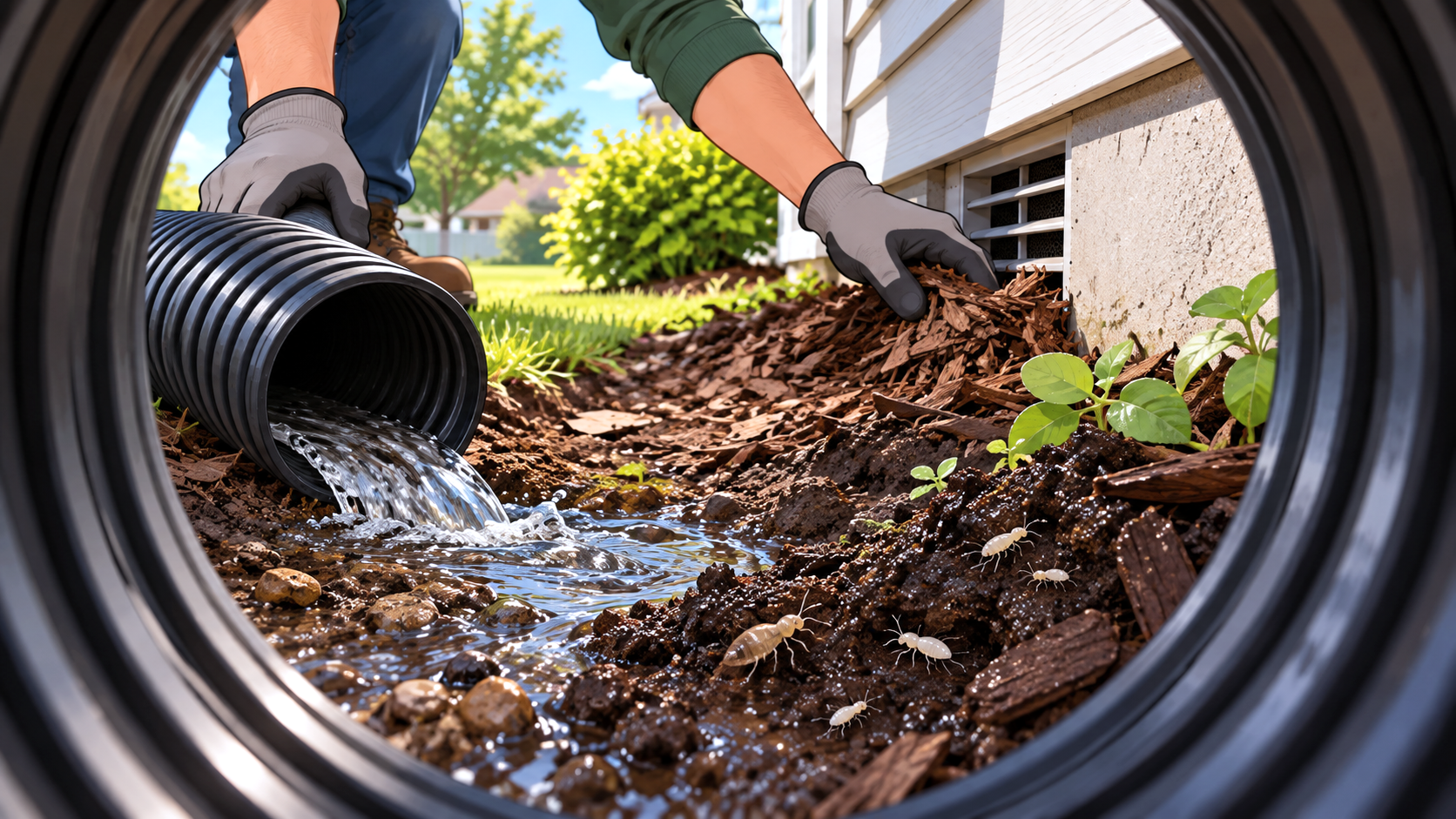
Trying to kill every springtail in the yard is the wrong target. Springtails naturally live outdoors, often in enormous numbers that stay hidden in soil, mulch, leaf litter, and other damp organic material. The problem starts when those populations concentrate beside the house or repeatedly migrate toward it. To get rid of springtails outside the house, reduce the damp habitat supporting them near the foundation. Remove excessive mulch and wet leaves, correct drainage problems, reduce unnecessary irrigation, and let persistently wet soil dry somewhat between waterings. Then seal exterior openings that allow migrating springtails indoors. Insecticides usually provide only temporary relief unless those conditions change.
That approach is less dramatic than spraying the entire perimeter, but it targets the reason springtails are there. Our broader guide to getting rid of springtails covers the complete indoor-and-outdoor strategy. This guide stays focused on populations around the exterior of the house.
First, Find Where the Springtails Are Concentrated
Before changing the yard, figure out which parts of the property are actually supporting the problem. Springtails need moisture and commonly inhabit soil, leaf litter, organic mulch, decaying wood, and other damp material. Large numbers can also occur in turf and landscaped areas.
Walk the foundation and look closely at the places where springtails are most numerous. Pay particular attention to deep mulch, piles of wet leaves, consistently damp planting beds, low areas that retain water, and soil receiving frequent irrigation. The distribution matters more than simply finding a few springtails. Outdoors is their normal habitat, so isolated springtails throughout a healthy yard generally do not need control.
This is where the distinction between an outdoor population and an actual nuisance becomes useful. Our guide to springtails outside the house explains why finding them outdoors is normally expected. For this article, the important question is whether conditions immediately around the building are supporting enough springtails to cause repeated problems.
Pull Excessive Mulch Away From the Foundation
Mulch deserves an early look because it combines moisture, organic material, and shelter. Springtails can occur abundantly in mulch, especially where it remains consistently damp. Reducing excessive mulch around a home’s foundation is a recommended part of springtail management.
You do not need to remove every piece of mulch from the property. Instead, concentrate on heavy or persistently wet layers immediately beside the building. Remove excessive material and accumulated wet leaves rather than repeatedly treating the insects living in them. Reducing excess organic matter and moisture around foundations removes the conditions that allow large populations to persist.
We think this is a better first move than reaching for a perimeter spray. A chemical treatment can affect springtails present during application, but wet habitat can continue producing or attracting more. Changing that habitat gives you a chance to reduce the population feeding the recurring problem rather than repeatedly attacking the insects after they appear.
Reduce Excess Water Around the House
Water management is the most important part of getting rid of springtails outside the house. Excessive irrigation, poor drainage, and landscapes that direct water toward a building can all contribute to moisture conditions associated with large springtail populations.
Start with irrigation. Mulched landscape plants should not be overwatered, and soil can be allowed to dry somewhat between waterings where the plants themselves tolerate that schedule. Reducing excessive irrigation and improving drainage are especially useful when springtails are concentrated in landscaped or garden areas.
Then look beyond sprinklers. Downspouts that release water too close to the foundation, landscaping that slopes toward the building, and drainage systems that are not functioning properly can keep the perimeter wetter than it needs to be. Correcting those conditions tackles a larger moisture problem, with springtails serving as one visible clue that the area deserves attention.
Our guide to what attracts springtails goes deeper into why moisture has such a strong influence on where these arthropods accumulate.
Do Not Try to Dry the Entire Yard
Moisture control can be misunderstood as a demand to make the landscape dry. That is neither realistic nor necessary. Springtails are natural members of soil ecosystems, where most species feed on fungi, algae, bacteria, pollen, and decaying organic material.
The useful target is excessive or persistent moisture in the problem zone beside the house. A damp mulch bed touching the foundation deserves more attention than ordinary moist soil twenty feet away. Likewise, an irrigation head soaking the same foundation-side bed every day is more relevant than normal watering elsewhere in the garden.
That distinction also prevents unnecessary disruption of areas where springtails are doing nothing problematic. As our guide to springtails in soil explains, their presence in soil is usually normal. The objective here is not an outdoor springtail-free property. It is a house perimeter that no longer supports a recurring nuisance population.
Remove Wet Leaves and Decaying Material Near the Foundation
Organic debris can turn a shaded strip beside the house into excellent springtail habitat. Wet leaves, decaying plant material, and similar debris hold moisture while also supporting the fungi and decomposing material many springtails feed on. Removing excessive mulch and moist leaves around the foundation is therefore part of recommended outdoor management.
Rake out accumulations trapped against foundation walls, beneath dense plants, around exterior utilities, and in other places where material stays damp. Decaying wood near the building also deserves attention because springtails commonly inhabit moist areas under bark and rotting wood.
This does not mean ordinary garden organic matter is inherently bad. Location changes the calculation. A decomposing layer farther out in the landscape can be part of a normal soil ecosystem, while the same persistently wet material pressed against the building can support springtails exactly where you do not want a large population.
Springtails May Move Toward the House When the Ground Dries
Finding springtails beside a house does not always mean that spot is excessively wet. This is one of the more important exceptions to the usual moisture advice.
Springtails can migrate when their outdoor habitat becomes too dry. Hot, drying conditions can push them out of lawns, mulch, and soil as they search for more favorable moisture. Large migrations may then bring them toward shaded buildings and other humid areas. Overcrowding and drying soil can trigger springtail movement.
Saturated soil can also drive springtails from their habitat. Extended drought and prolonged saturating rain are both associated with nuisance invasions.
That is why blindly watering or drying an area can miss the point. Look at what happened before the springtails appeared. A sudden mass after a sharp weather change may be a temporary migration. A population that remains concentrated in the same wet mulch bed week after week points more strongly toward persistent habitat.
Seal the House After Addressing the Outdoor Source
Habitat reduction lowers the pressure around the building, but exclusion makes it harder for the remaining springtails to become an indoor problem. These arthropods are tiny enough to enter through small exterior openings around doors, windows, screens, vents, utility penetrations, siding, and other gaps.
Repair damaged screens and close appropriate gaps with materials suited to the opening, such as caulk, weather stripping, fine-mesh screen, or other exclusion materials. Sealing cracks and crevices used by springtails is especially useful when an outdoor migration is repeatedly reaching the building.
Do the moisture work first rather than treating exclusion as the entire solution. Sealing a door gap can stop one route, but it does nothing about thousands of springtails continuing to gather against the foundation. Combining habitat correction with exclusion tackles both sides of the problem.
For a closer look at the routes involved, see how springtails get into a house.
Be Careful About Relying on Outdoor Sprays
A large black or gray mass of springtails on a patio can make spraying feel like the obvious response. However, insecticides are not the foundation of springtail management. Their effectiveness during migrations can be limited because new individuals may continue moving into the treated area.
More importantly, pesticides do not correct the conditions producing the population. Outdoor insecticide treatments can provide only temporary relief when excessive moisture and favorable organic habitat remain.
Some pesticide labels do include springtails among their target pests, and exterior foundation treatments may be an option in particular situations. Any pesticide used around a home must be specifically labeled for the pest, site, and intended application. Local availability and legal uses can also differ. We would treat chemical control as a later option, not a substitute for fixing moisture, drainage, mulch, and exclusion problems.
This is also why a product-specific question belongs in its own evaluation. Our guide to the best sprays for springtails examines that choice separately rather than turning an outdoor habitat guide into a pesticide roundup.
What to Do With Springtails on Patios, Driveways, and Concrete
Springtails sometimes become much easier to see after leaving the soil. Large numbers may crawl across concrete surfaces, including patios and sidewalks, even though the hard surface itself is not necessarily where the population developed. Springtails are naturally numerous in soil and turf and are frequently observed crawling on concrete.
Instead of treating the slab as the source, inspect its borders. Damp soil, mulch, turf, leaf litter, or vegetation immediately beside the concrete is more likely to explain where the insects originated. Their location can help narrow your search, particularly when one edge of a patio has far heavier activity than the others.
For visible springtails that need immediate removal, sweeping or rinsing a hard outdoor surface can clear them away. However, repeated appearances mean the adjoining habitat still deserves attention. Killing one visible group will not stop another migration from the surrounding soil.
Give Habitat Changes Time to Work
Outdoor springtail control is not always an instant disappearance. A yard can contain very large populations, and migrating individuals may continue appearing after you start changing the conditions around the house. This is particularly true during a weather-driven movement when new springtails keep arriving from surrounding areas.
Watch the pattern instead of judging the result from the first day. After correcting excessive irrigation, clearing wet organic debris, reducing heavy foundation mulch, and fixing drainage issues, check whether concentrations around the building decline. Also watch whether fewer springtails reach doors, windows, siding, and other entry points.
That trend tells you more than whether a few springtails remain outdoors. Complete elimination from the property is neither a realistic nor useful goal. What you want is a substantial reduction in nuisance activity around the structure and fewer insects making their way inside.
When the Problem Extends Beyond the Yard
Sometimes springtails outside are only one part of the problem. If large numbers are also appearing in bathrooms, basements, kitchens, or other damp indoor locations, check the building for moisture rather than assuming every individual is simply wandering in from the lawn. Persistent indoor populations can be associated with leaks, high humidity, damp structural areas, or mold-supporting moisture.
The pattern matters here as well. A brief indoor appearance during a large outdoor migration is different from springtails remaining in the same damp basement for weeks. Our guide to the signs of a springtail infestation can help separate a recurring moisture-associated problem from an isolated sighting.
When drainage, water intrusion, or another building problem is keeping the foundation area wet, fixing that condition may require more than pest control. Likewise, persistent springtail activity after obvious habitat problems have been corrected can justify professional identification and assessment. Our guide to whether pest control can get rid of springtails covers that decision separately.
Other Questions About Getting Rid of Springtails Outside
Should I get rid of springtails in my entire lawn?
No. Springtails naturally occur in soil and turf and are part of outdoor decomposition processes. Control makes more sense when unusually large populations are creating a nuisance around the house, invading indoors, or concentrating in another problem area.
Why are there suddenly thousands of springtails outside?
Large populations can build unnoticed in moist soil and organic material before environmental changes trigger movement. Both drying habitat and water-saturated soil can cause springtails to migrate in search of more favorable conditions, making a previously hidden population suddenly conspicuous.
Will springtails outside damage my foundation?
Springtails do not damage buildings or household property. Finding large numbers beside a foundation is more useful as a clue to examine moisture, mulch, drainage, and possible entry routes than as evidence that the insects are damaging the structure.
Why do springtails keep appearing after I remove them?
Visible springtails may represent only a small part of a much larger population living in surrounding soil, mulch, turf, or organic debris. During a migration, new individuals can also keep moving into the same area. Repeated removal therefore has limited value until the nearby habitat or migration pressure changes.
Make the Foundation Perimeter the Priority
For a recurring outdoor problem, start with the few feet of landscape closest to the house rather than trying to overhaul the entire yard. Follow the springtail concentrations and look for the wettest mulch, leaf buildup, drainage problems, and unnecessary irrigation. Correct those conditions, then seal the nearby routes leading indoors.
Afterward, monitor the same spots. A few springtails remaining in the yard are normal. Success means the heavy concentrations around the building decline and springtails stop becoming a recurring household nuisance.
3 thoughts on “How to Get Rid of Springtails Outside the House”