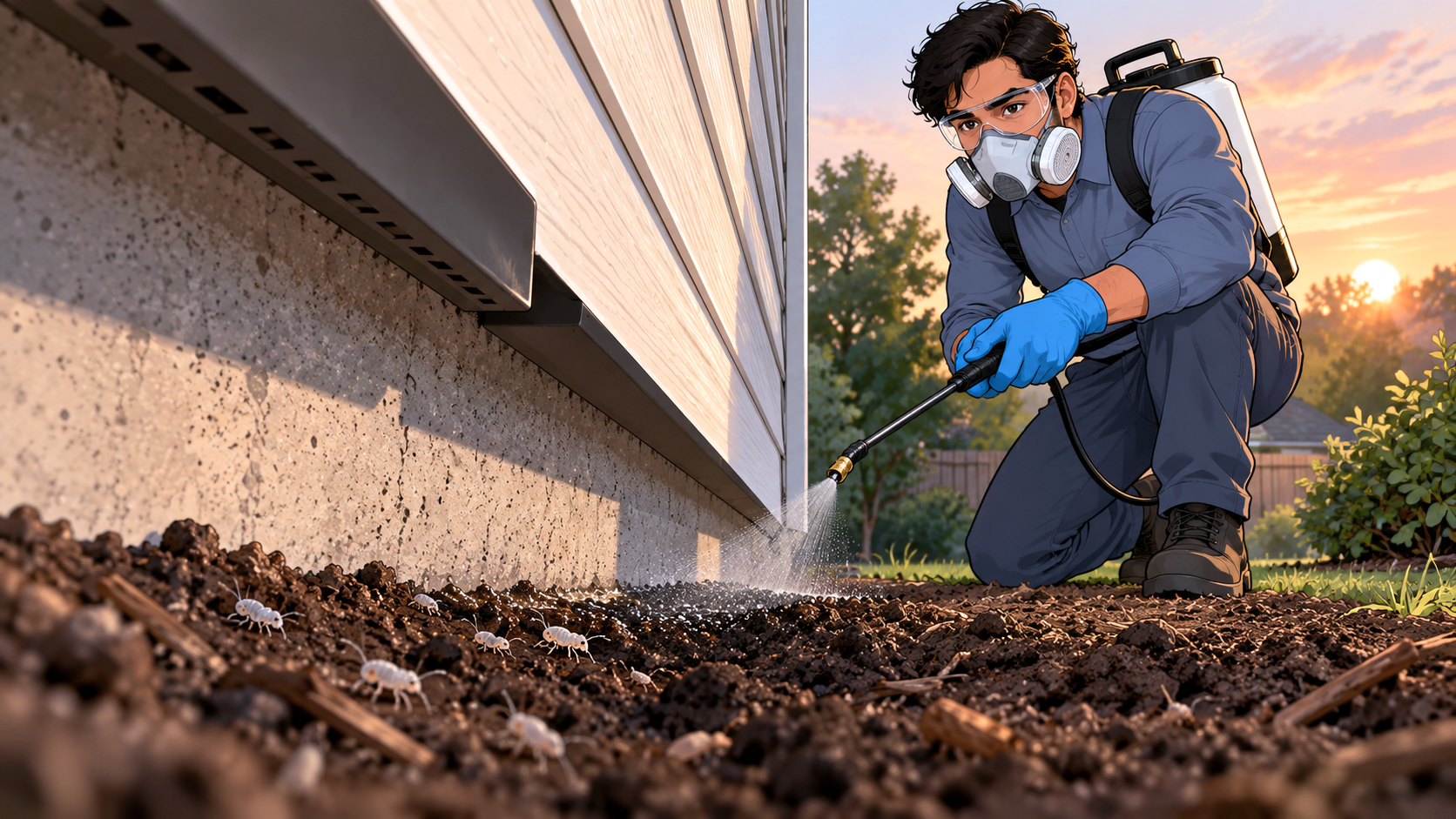
Bifenthrin has something that many supposed springtail remedies do not: pesticide labels that actually name springtails. That gives us a much firmer starting point than we have with vinegar, peppermint oil, bleach, or another household substance. Several EPA-registered bifenthrin products include springtails among their target pests, although the locations and directions for using those products are not identical. Bifenthrin can kill springtails. EPA-registered bifenthrin products exist with springtails specifically listed on their labels. Depending on the particular product, labeled uses can include exterior building surfaces, foundations, lawns, landscaping, soil, or certain structural locations. The product label, rather than bifenthrin alone, determines where and how it can legally be used.
Bifenthrin Is the Ingredient, Not the Instructions
“Bifenthrin” appears prominently on bottles, online listings, and pest-control discussions, which makes it easy to think of it as one pesticide product.
It is actually an active ingredient used in many different pesticide formulations.
One registered bifenthrin product may be intended for exterior perimeter treatment. Another may include lawns. Another may have structural uses that the first product does not. Concentrations and application directions can differ as well.
A current EPA label for Bifenthrin LT, for example, specifically lists springtails under pest control on outside surfaces and around buildings. Its labeled treatment areas include exterior siding, foundations, porches, window frames, patios, garages, lawns adjacent to residential structures, soil, and other specified exterior locations.
Another EPA-registered bifenthrin formulation includes springtails among outdoor home-invading pests. Other registered formulations have labeling that includes certain indoor springtail applications.
So “bifenthrin kills springtails” should never turn into “any bifenthrin product can be sprayed wherever I see springtails.”
The bottle in your hand decides the permitted use.
What Happens When a Springtail Encounters Bifenthrin?
Bifenthrin belongs to the pyrethroid class of insecticides. Pyrethroids act on the nervous system of susceptible arthropods, and bifenthrin can provide residual control on treated surfaces rather than functioning only during the instant the spray leaves the nozzle.
That residual property helps explain why bifenthrin is used for perimeter treatments.
Instead of trying to locate and individually spray every springtail, an appropriately labeled product can be applied to specified areas where pests congregate, travel, or enter. The current Bifenthrin LT label, for example, describes residual treatment of outside building surfaces and surrounding areas for springtails and numerous other pests.
This is a very different use case from pouring something directly onto a cluster of springtails just to see whether they die.
If all you want is to remove twenty springtails currently hopping across concrete, you do not need residual chemistry to prove that you can kill them. Bifenthrin becomes more relevant when there is an ongoing pest problem in an area where a particular bifenthrin product is labeled for use.
The Best Place for Bifenthrin Is Often Between the Outdoor Population and the House
Imagine hundreds of springtails gathering through damp landscaping beside a foundation. Some are appearing around the siding and foundation edge, and others are making their way indoors.
That scenario fits bifenthrin much better than finding six springtails beside a bathtub.
Some bifenthrin labels specifically provide for exterior structural or perimeter applications. Bifenthrin LT, for example, includes springtails in its outside-surface directions and provides instructions for treating areas around structures.
This allows the treatment to be aimed at the zone where the outdoor population and the building meet.
It is also why our article on springtails outside the house is relevant before automatically treating indoors. If the insects are originating in wet mulch, soil, vegetation, or another exterior habitat and continually moving toward the structure, the visible springtails inside may represent only a fraction of the activity.
Bifenthrin can reduce springtails contacting a properly treated area. It cannot prevent new springtails from existing in favorable habitat elsewhere on the property.
Heavy Springtail Movement Can Make a Successful Treatment Look Unsuccessful
Springtails sometimes occur in extraordinary numbers.
Colorado State University notes that springtails tend to be fairly resistant to many insecticides and that migrations can involve a continuous supply of new individuals, even though some yard and garden insecticides specifically claim springtail control.
That creates an unusual treatment problem.
Suppose a labeled bifenthrin application kills springtails entering the treated zone tonight. More springtails move out of nearby wet landscaping tomorrow. Then another wave arrives after that.
Seeing springtails again does not automatically prove the active ingredient had no effect. The surrounding population may simply be replenishing them.
This is especially worth considering during large outdoor migrations. Springtails can become conspicuous around homes during environmental extremes, including prolonged wet periods and hot, dry conditions that encourage movement from their usual habitats.
In a situation like that, the number of springtails arriving can matter almost as much as the number dying.
Where Bifenthrin Becomes the Wrong Tool
Now move the springtails from the foundation to a flowerpot.
They are hopping over damp potting mix around a houseplant.
Buying a bifenthrin concentrate simply because the active ingredient kills springtails would be the wrong way to choose a treatment. You would first need a product whose label permits the intended application to that site and plant. More importantly, springtails in pots are often associated with persistently moist growing media, making watering and soil conditions central to the problem.
That situation belongs in our guide to springtails in potted plants.
Move them again, this time onto a bathroom floor, and the decision changes once more.
Repeated indoor springtails can point toward excessive moisture somewhere in or around the structure. Treating a visible floor without investigating why they keep appearing can leave the underlying problem untouched. Our guide to getting rid of springtails in bathrooms is built around that particular setting.
The fact that some bifenthrin products have indoor uses does not make indoor bifenthrin treatment the default response to every springtail sighting. The exact label and the source of the infestation still govern the decision.
Do Not Borrow a Mixing Rate From Another Bifenthrin Bottle
This deserves its own section because bifenthrin concentrates can look deceptively interchangeable.
They are not.
The current Bifenthrin LT label contains specific dilution rates and application directions for its formulation and particular uses. Those numbers belong to that registered product and those labeled applications.
A different product may contain a different concentration of bifenthrin or provide different directions.
That is why we are not giving one universal “bifenthrin-to-water ratio for springtails.” Such a number would encourage readers to treat the active ingredient as though it were the complete pesticide label.
EPA maintains its Pesticide Product Label System specifically so registered product labels and their histories can be checked.
Find the EPA registration number on your product, read its current label, confirm that springtails and your intended treatment site are covered, and use only the rate and method specified there.
Rain, Runoff, and the Driveway Matter Too
Where the spray goes after application deserves as much thought as where it lands initially.
EPA has required mitigation measures for pyrethroids, including bifenthrin, to reduce ecological risks associated with runoff and spray drift. Product labels contain the restrictions that apply to the individual formulation.
That matters around foundations because hard surfaces, gutters, drains, slopes, and nearby water can create routes for pesticide movement.
A wide exterior spray is not automatically a better treatment. Coverage should follow the product’s labeled directions rather than an assumption that more treated ground means fewer springtails.
The same principle applies to retreatment. A current bifenthrin label allows repeat applications for renewed pest activity under specified restrictions, but that is not permission to keep spraying whenever another springtail appears.
What We Would Expect From Bifenthrin
We would expect a properly selected and correctly applied bifenthrin product labeled for springtails to kill springtails that receive the relevant exposure.
We would not expect it to make every springtail on the property disappear permanently.
Those are very different expectations.
If an exterior population is being supported by saturated mulch, persistent irrigation, wet leaf litter, poor drainage, or another favorable habitat, pesticide treatment does not physically remove those conditions. If springtails are entering because moisture inside the building provides somewhere suitable to persist, an exterior application does not dry the building.
This is why what attracts springtails and how springtails get into a house can become more important than choosing a stronger insecticide.
For a large outdoor invasion, bifenthrin may be one component of control. For a small indoor nuisance, it may be unnecessary. For a recurring infestation with an unresolved moisture source, killing today’s springtails does not guarantee that another population will not occupy the same favorable environment.
If you are comparing bifenthrin with other labeled options rather than deciding whether to use an insecticide at all, see our review of the best sprays and insecticides for springtails.
Questions Worth Asking Before Using Bifenthrin
Does bifenthrin kill springtails on contact?
Bifenthrin is an insecticidal active ingredient, and registered bifenthrin products specifically label springtails for control. The exact exposure, application method, and permitted treatment area depend on the individual product rather than on a universal rule for every bifenthrin formulation.
Will bifenthrin stop springtails from coming back?
Not necessarily. Residual treatment can continue affecting springtails that encounter a treated area, but new individuals can continue arriving from surrounding habitat. Large springtail migrations can involve continuous movement of new animals.
Can I spray bifenthrin inside my house for springtails?
Do not decide this from the active ingredient alone. Some registered bifenthrin formulations include certain indoor springtail uses, while other products and directions are centered on exterior applications. Check the exact label for your product, pest, site, and application method before using it.
Is stronger bifenthrin better for springtails?
A higher concentration is not automatically a better choice. The correct product and application are determined by its registered label. Increasing a concentration beyond labeled directions is not an appropriate way to improve springtail control.
Should I use bifenthrin if springtails are only appearing occasionally indoors?
Usually, the first useful step is determining where the springtails are coming from and whether excess moisture is allowing them to persist. Occasional individuals can simply be physically removed. Our broader guide to getting rid of springtails covers when a larger control response makes sense.
2 thoughts on “Does Bifenthrin Kill Springtails?”