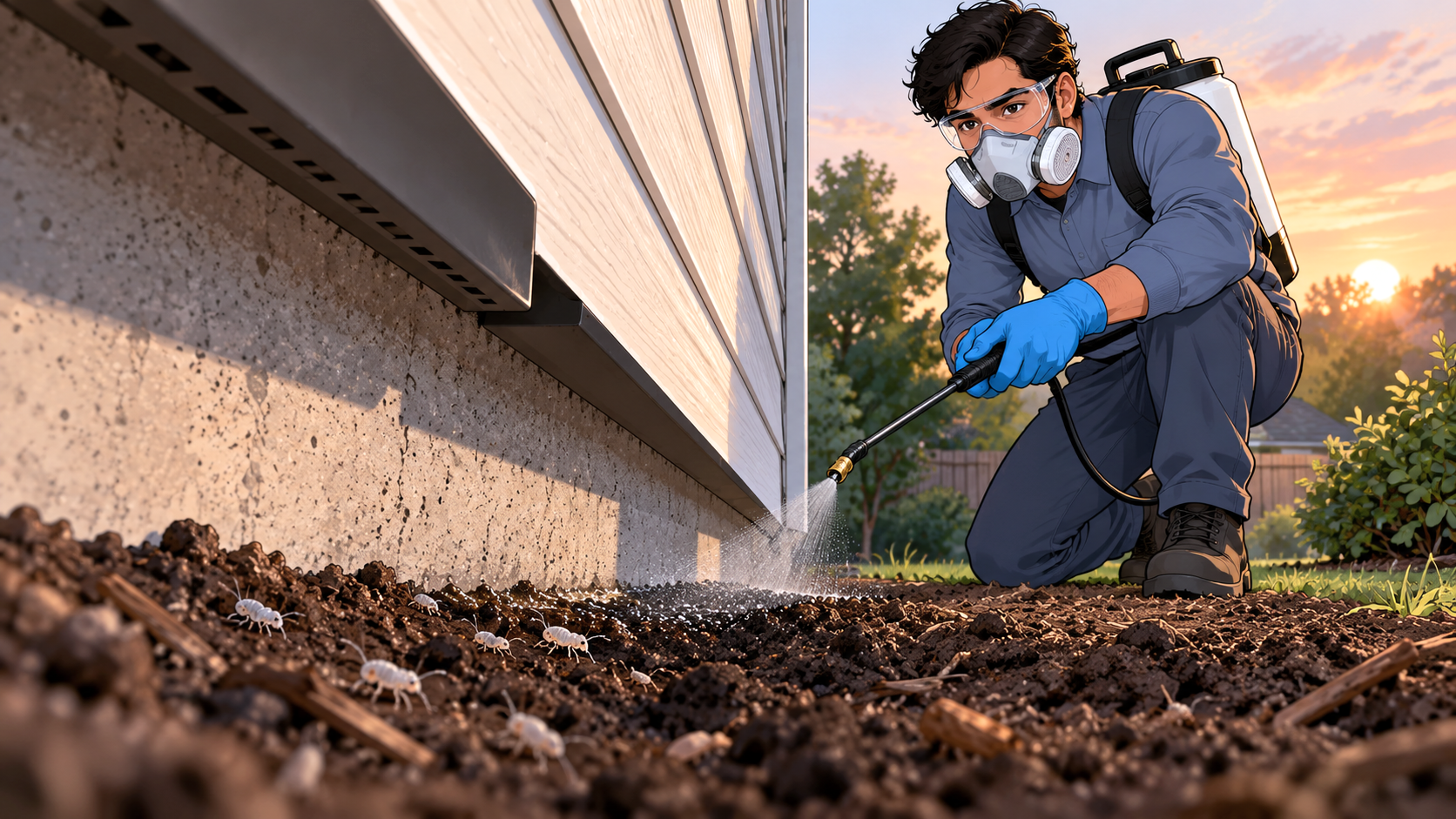
Bifenthrin can kill springtails. It is a synthetic pyrethroid insecticide that affects the nervous systems of susceptible arthropods, and some EPA-registered bifenthrin products specifically list springtails among the pests they control. However, killing exposed springtails does not necessarily eliminate an infestation, especially when damp soil, mulch, or other favorable habitat continues supporting large populations.
Whether bifenthrin is appropriate depends on the exact pesticide product, treatment location, and applicable regulations. Products containing the same active ingredient can have different approved uses, application restrictions, and safety precautions. Indoor springtail problems are generally better addressed by correcting moisture conditions than by relying on insecticides.
Bifenthrin Is an Active Ingredient, Not a Universal Treatment
Bifenthrin appears in several pesticide formulations, including concentrates and ready-to-use products intended for different treatment sites. Although these products contain the same active ingredient, their labels are not interchangeable. Some US-registered bifenthrin formulations list springtails and provide directions for particular outdoor structural or perimeter applications. Others may have different permitted treatment sites, concentrations, application methods, or restrictions.
The distinction matters because a product intended for lawns cannot automatically be assumed suitable for indoor floors, houseplant soil, or every surface around a building. In the United States, the EPA’s Pesticide Product and Label System allows consumers to research registered formulations and their labeling. Readers in Canada must instead consult Health Canada’s pesticide label search, because US registration does not authorize a product’s use in Canada.
There is also an important distinction between a pesticide’s listed pests and its legal conditions of use. Under certain circumstances, Section 2(ee) of the US Federal Insecticide, Fungicide, and Rodenticide Act permits treatment of a pest not expressly named on a product label, provided the treatment site is authorized and no applicable restriction prohibits that use. State requirements may impose additional limitations.
That exception does not mean every insecticide is suitable for every pest. For a homeowner choosing a springtail treatment, selecting a product that specifically identifies springtails and the intended treatment site is the more straightforward approach.
How Does Bifenthrin Kill Springtails?
Bifenthrin belongs to the pyrethroid family of insecticides. It interferes with normal nerve signaling by affecting voltage-gated sodium channels in susceptible arthropods. Sufficient exposure can cause impaired movement, paralysis, and death.
Unlike substances that act only while directly contacting an insect, bifenthrin formulations can also provide residual insecticidal activity on treated surfaces. Springtails encountering an appropriately treated area may therefore be affected after the initial application.
The degree of control depends on the product formulation, exposure, environmental conditions, and the susceptibility of the springtails involved.
Residual activity should not be confused with permanent control. Springtails can occupy extensive populations in damp soil, decaying vegetation, leaf litter, and other protected environments. Killing individuals that cross a treated surface does not eliminate springtails living elsewhere.
Can Bifenthrin Control Springtails Around a House?
Bifenthrin may be useful in some outdoor springtail situations where an appropriately registered product permits the intended treatment.
Consider a property where numerous springtails regularly emerge from moist landscaping near a foundation. Some gather around exterior walls and openings, while others enter the building.
Certain bifenthrin formulations are intended for exterior structural or perimeter pest management. Where the applicable label permits springtail treatment, such products may reduce the number of exposed individuals moving through treated areas.
However, the location of springtail activity does not automatically establish that pesticide treatment is necessary.
Springtails often develop in wet mulch, leaf litter, irrigated soil, and decomposing organic material. Reducing excessive moisture and addressing favorable habitat can be more useful than treating the visible insects.
Understanding how to get rid of springtails outside the house helps distinguish persistent habitat-related activity from temporary movement toward a building.
Any exterior pesticide treatment must also comply with the product’s restrictions concerning application sites, runoff, weather, and nearby water.
Why Springtails May Return After Bifenthrin Treatment
A pesticide can kill springtails that encounter it while leaving the surrounding population largely unaffected.
This is particularly important during large springtail migrations. Populations can become extremely numerous in suitable habitats, and changing environmental conditions may cause substantial numbers to move toward buildings.
Colorado State University Extension explains that springtails can be relatively resistant to many insecticides and that migrations may involve a continuing supply of new individuals.
Imagine springtails emerging from damp landscaping over several consecutive days. An authorized insecticide treatment might affect individuals crossing a treated area, but additional springtails could arrive from the surrounding habitat.
Continued sightings therefore do not necessarily demonstrate complete product failure. Equally, the disappearance of visible springtails immediately after treatment does not prove the underlying population has been eliminated.
Persistent moisture, favorable shelter, and accessible entry points can allow the problem to continue regardless of how many individual springtails are killed.
When Bifenthrin Is Not the Right Choice
Not every springtail sighting requires an insecticide. The environment where the insects are found often determines the most appropriate response.
Springtails in Potted Plants
Springtails frequently occur in damp potting soil, where many species feed on fungi, microorganisms, and decomposing organic material.
Their presence does not automatically indicate that a plant is damaged or needs pesticide treatment. Reducing unnecessary watering and allowing the soil surface to dry somewhat between waterings, where the plant tolerates it, can make conditions less favorable.
Applying a bifenthrin product simply because springtails are present would be difficult to justify without first considering the plant’s condition and whether the particular product is authorized for that use.
The appropriate approach to springtails in potted plants depends more on soil moisture and plant health than on immediate insect elimination.
Springtails in Bathrooms and Other Indoor Areas
Indoor springtails frequently appear around sinks, bathtubs, basements, plumbing fixtures, and other moist locations.
Repeated sightings can indicate excessive humidity, condensation, water intrusion, or a nearby outdoor population entering the building.
Although some pesticide formulations may permit particular indoor applications, this does not make indoor bifenthrin spraying the preferred response.
For most household springtail problems, repairing leaks, improving ventilation, reducing excess humidity, and physically removing visible insects are more useful first steps.
A recurring problem involving springtails in the bathroom should prompt an investigation of moisture conditions before any pesticide is considered.
Why You Should Never Use a Universal Bifenthrin Mixing Ratio
Bifenthrin concentrates can differ in active-ingredient concentration, formulation, authorized uses, and application directions. A mixing ratio appropriate for one registered product or treatment site may be inappropriate for another. The same applies to application frequency, equipment, and permissible treatment areas.
For this reason, there is no responsible universal bifenthrin-to-water ratio that can be recommended for every springtail infestation. In the United States, the product’s registration number can be used to locate relevant information through the EPA’s pesticide labeling database. In Canada, the applicable Pest Control Product registration and label requirements must be checked independently.
Readers should use only products they are legally permitted to apply, follow the applicable directions and restrictions, and avoid assuming that increasing the concentration will improve control. Professional-use products may also have restrictions that prevent their use by unqualified consumers.
Environmental Risks Matter Around Foundations and Lawns
Bifenthrin can present significant environmental hazards, particularly to aquatic organisms. Outdoor applications near foundations, driveways, patios, gutters, storm drains, and drainage channels deserve careful attention because these surfaces can create pathways for pesticide movement.
The EPA’s pyrethroid labeling guidance addresses runoff and spray drift associated with outdoor pesticide applications. Restrictions vary by product and formulation. A wider treatment area does not automatically provide better springtail control. Unnecessary applications may increase environmental exposure without addressing the moisture conditions supporting the infestation.
Bifenthrin can also harm non-target arthropods. For that reason, treatment decisions should consider the broader environment rather than focusing exclusively on the springtails visible around a structure. Application restrictions, protective equipment, reentry directions, weather limitations, and retreatment intervals must all be determined from the applicable product label.
What Works Better Than Relying on Bifenthrin Alone?
Long-term springtail management usually starts with identifying why the insects are abundant.
Springtails thrive in moist environments, so correcting persistent dampness can reduce the conditions supporting their populations. That may involve repairing plumbing leaks, improving drainage, adjusting irrigation, reducing excessive mulch near foundations, or addressing moisture accumulating inside a building.
Physical removal can handle springtails already present on accessible indoor surfaces without introducing unnecessary pesticide exposure.
Understanding what attracts springtails to a house and how springtails get indoors can help identify the source of repeated sightings.
Bifenthrin may have a role when outdoor activity is substantial, treatment is genuinely justified, and a suitable product is legally available for the intended use. Even then, it should complement environmental management rather than replace it.
For readers comparing chemical options, the best sprays and insecticides for springtails should be evaluated according to their current product labels, permitted treatment sites, and potential environmental effects.
Questions About Using Bifenthrin for Springtails
Does bifenthrin kill springtails on contact?
Yes. Sufficient exposure to bifenthrin can kill susceptible springtails. However, contact does not guarantee immediate death, and the effectiveness of a particular formulation depends on exposure and application conditions.
Will bifenthrin prevent springtails from coming back?
Not necessarily. Residual insecticidal activity may affect additional springtails entering a treated area, but populations can continue developing in surrounding moist habitats. Lasting control usually requires addressing the conditions attracting or supporting them.
Can you spray bifenthrin indoors for springtails?
Only where the exact product and applicable regulations permit the intended indoor use. Some formulations have authorized indoor applications, while others are restricted to particular outdoor locations. Indoor moisture management is generally the preferred starting point for springtails.
Is bifenthrin safe around pets?
Pet exposure risks depend on the formulation, application method, and circumstances. Products may specify restrictions on keeping pets away during treatment and when treated areas may be reentered. Follow the actual label rather than assuming that a surface is safe merely because a spray has dried.
Is stronger bifenthrin more effective against springtails?
A higher concentration does not automatically produce better infestation control. Using more than the permitted amount can increase exposure risks and violate product directions without addressing the habitat supporting the springtails.
Should you use bifenthrin for a few springtails indoors?
Usually not. A small number of springtails can generally be removed physically while investigating excessive moisture or possible entry points. The broader approach to getting rid of springtails is more useful when sightings become persistent.
2 thoughts on “Does Bifenthrin Kill Springtails?”