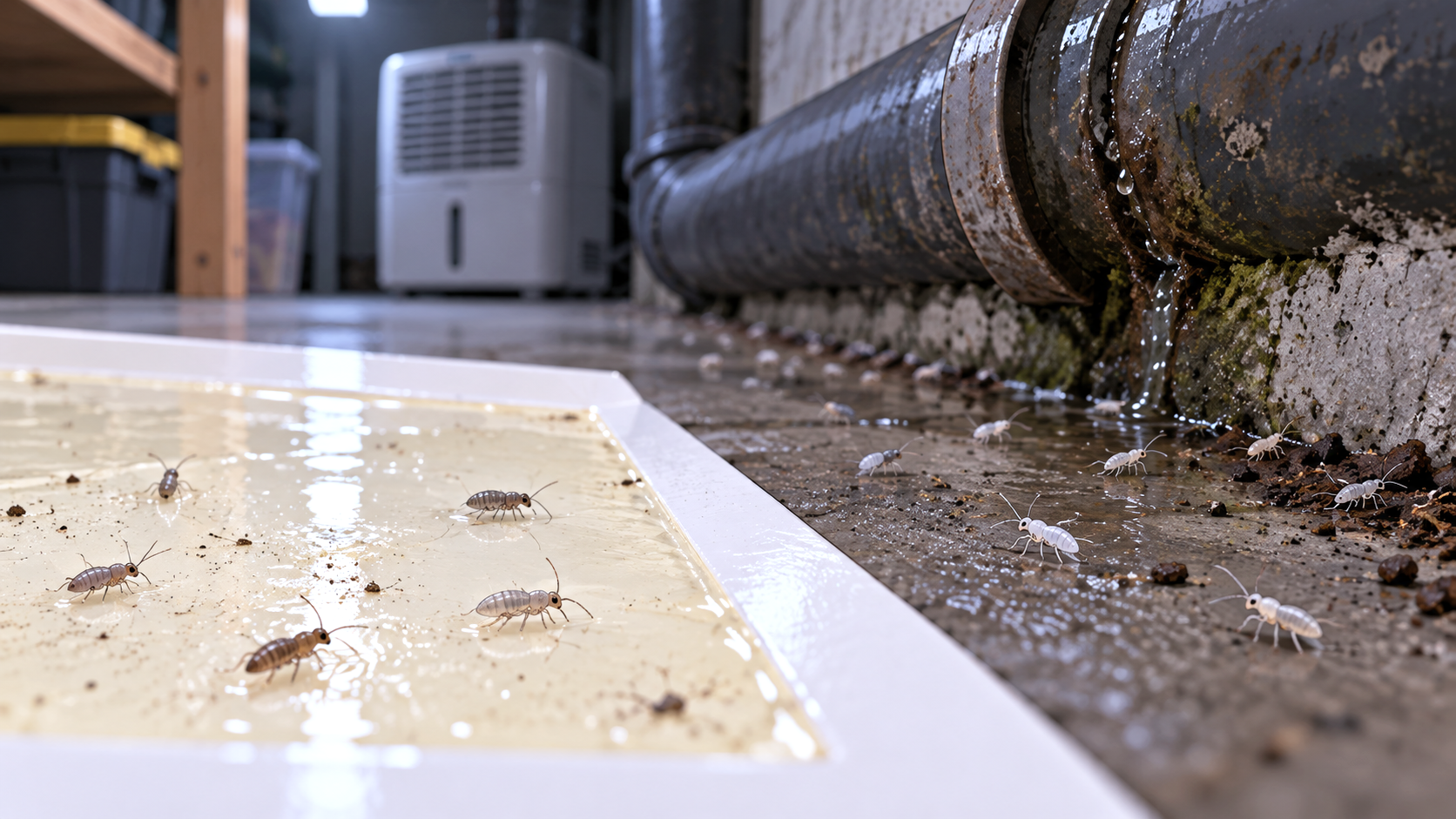
A glue trap left beside a damp basement wall may look almost empty the next morning. Then you lean closer and notice several tiny dark specks stuck near one edge. If those specks are springtails, the trap has already told you something useful, but probably not what you first bought it to do.
It has shown you where springtails are moving. Sticky traps and glue traps can catch individual springtails that crawl or jump onto the adhesive, but they are not a dependable way to eliminate a springtail infestation. Their better use is as a simple monitoring tool. Trap location and catch patterns can help narrow down where springtails are traveling while you correct the moisture conditions supporting them.
Think of a Glue Trap as a Footprint in Wet Cement
A glue board cannot draw springtails out of damp soil, kill a population hidden behind a wall, or change the conditions allowing them to survive. It simply catches an animal that reaches its adhesive surface.
That limitation can become useful.
Place several traps in different locations and they begin acting like crude traffic counters. One trap beside a basement window catches springtails while another five feet away remains empty. A board beneath a utility sink catches more than the one beside the doorway. Those differences can help direct your attention toward one part of the room.
Sticky trapping is widely used in pest monitoring because catches can reveal areas of greater pest activity and changes in activity over time. However, common colored sticky cards used around plants are primarily designed for flying pests such as fungus gnats, thrips, whiteflies, and winged aphids. Sticky-trap monitoring guidance explains how trap location and repeated counts can be used to compare pest activity.
Springtails require a slightly different mindset because they are wingless. They crawl and, in many species, jump with the forked structure beneath the abdomen called the furcula. Springtail identification and jumping behavior confirms both characteristics.
A glue board therefore has to intersect their movement. Hanging one from a plant like a fungus-gnat card makes much less sense than positioning a flat trap where the springtails are already traveling.
The First Springtail on the Trap Matters More Than the Fiftieth
We would pay closest attention to where the first catches occur.
Springtails depend heavily on moist environments and can become extremely numerous in suitable habitat. Indoors, repeated activity can be associated with plumbing leaks, excessive irrigation near a foundation, inadequate drainage, wet wood, or another persistent source of moisture.
That means trap placement can become a small experiment.
Suppose you keep seeing springtails in a basement but cannot tell where they are entering. Put one glue board along the foundation wall, one beside the window, one near the floor drain, and another farther into the room. You are not building a wall of death around the basement. You are comparing routes.
If one location repeatedly catches substantially more springtails, inspect the surrounding area closely. Check for damp material, condensation, openings to the exterior, plumbing, or another feature that could explain why activity is concentrated there.
Our guide to signs of a springtail infestation goes further into reading those patterns. If the insects appear to be moving indoors from outside, how springtails get into a house is the more useful next investigation.
The trap has done its job once it tells you where to look.
A Full Glue Board Can Be Strangely Misleading
Catching a large number of springtails feels like control because the evidence is sitting right there on the cardboard.
A hundred trapped springtails are unquestionably a hundred springtails no longer moving around the room. That still tells you very little about the size of the population supplying them.
Springtails can occur in enormous numbers in moist soil and organic material. During migrations, new individuals can continue arriving from surrounding habitat. This continuous movement is one reason springtail infestations can be frustrating even when individual animals are easily removed. Current springtail management guidance specifically notes that migrations can involve a continuing supply of new springtails.
A glue board positioned in their path can therefore keep filling while the population behind it remains largely unaffected.
Picture a wet mulch bed supporting thousands of springtails beside the foundation. A trap catches 60 that cross one basement threshold overnight. Replacing that trap every morning may produce an impressive stack of dead springtails without changing the mulch bed at all.
This is why we would never measure glue-trap success simply by how crowded the board becomes.
Empty Traps Can Tell You Something Too
An empty glue trap is not proof that springtails are gone.
Placement matters enormously. Springtails may be concentrated in cracks, moist soil, wall voids, plumbing areas, or other routes that never bring them across the adhesive. A board six inches away from an active route may catch nothing.
Still, comparing traps over time can be useful after you make a change.
Imagine three boards consistently catch springtails along one damp basement wall. You repair a leak and begin drying the area. Over subsequent checks, catches decline along with the visible activity.
The trap is not responsible for that result, but it gives you another way to observe it.
Monitoring works best when trap placement and checking intervals remain consistent. Changing the trap location every day makes comparisons harder because you no longer know whether the population changed or the trap simply moved into a better route.
We like this use far more than trying to turn glue boards into a primary treatment. It gives them a specific job they can actually perform.
Houseplants Are Where Sticky Cards Cause the Most Confusion
A sticky yellow card standing above a flowerpot can catch fungus gnats. That sometimes leads people to assume it should also solve springtails in the same pot.
The two pests do not use the card in the same way.
Adult fungus gnats fly and are routinely monitored with yellow sticky cards. Springtails live primarily in the damp growing medium and become especially noticeable after watering. Current indoor-plant guidance recommends checking the soil itself for springtails rather than using sticky cards to detect them. It also recommends allowing the surface soil to dry as much as the plant can tolerate between waterings. Indoor plant pest guidance separates these two monitoring approaches clearly.
A springtail can certainly end up stuck to a card near the soil. That catch does not transform the card into a springtail-control system.
For a pot where springtails are the actual problem, follow the conditions in the growing medium. Our guide to springtails in potted plants deals with that situation directly. If the tiny insects around the pot are flying rather than jumping, it is worth checking springtails versus fungus gnats before changing anything.
The Trap Layout We Would Use
There is no need to carpet the room with adhesive.
For monitoring, several strategically separated traps tell you more than a pile of traps clustered where you already know springtails are present. Place flat glue boards against walls or edges near suspected travel routes, while keeping them away from children, pets, and places where adhesive can contact skin, hair, or furnishings.
Then resist the urge to move them immediately.
Check the boards at consistent intervals and compare locations. A trap that repeatedly catches springtails while neighboring boards remain nearly empty deserves attention. Shift your inspection to the building materials, plumbing, exterior conditions, or other features around that location.
Once you identify an obvious route, the next action depends on what is there. Springtails beside an exterior foundation call for a different response from springtails centered around a bathtub. Our guides to springtails outside the house and getting rid of springtails in a bathroom keep those situations separate for that reason.
The trap is essentially helping you choose which investigation to conduct.
Why Moisture Eventually Wins the Argument
Springtail control keeps circling back to moisture because moisture is fundamental to where these animals can persist.
Household management guidance identifies moisture control as the most effective option. For small indoor numbers, springtails can simply be physically removed. Larger problems call for drying wet areas, correcting leaks or structural moisture issues, and reducing damp organic material around the foundation.
A glue board changes none of those conditions.
It cannot dry a wall cavity. It cannot stop excessive irrigation. It cannot remove saturated mulch. It cannot change the water sitting in an overwatered planter.
This is why a $3 trap can sometimes be useful without ever becoming a $3 solution.
When humidity is keeping an indoor area damp, our article on using a dehumidifier for springtails covers the drying side of control. Larger infestations with several possible sources belong in the complete springtail removal guide.
When We Would Stop Replacing the Glue Boards
There is a point where monitoring becomes procrastination.
If one trap has repeatedly identified the same wet corner, replacing it for another month does not produce much new information. The springtails have already shown you where they are moving. Investigate and correct the conditions around that location.
Likewise, a trap that catches springtails pouring in from an exterior doorway does not need to capture every future arrival before you act. Inspect the outdoor side, reduce favorable habitat where appropriate, and examine the entry route.
Glue boards earn their keep by turning scattered sightings into a pattern.
Once you can see the pattern, move on.
What Else Glue Traps Can Tell You About Springtails
Can springtails jump over a glue trap?
Springtails can jump, so a glue board should not be treated as a physical barricade that every individual must cross. Some may land on it, some may crawl onto it, and others may move around or past it. That is another reason to use traps for sampling movement rather than trying to seal a room with adhesive.
Are yellow sticky traps better than plain glue boards for springtails?
Yellow sticky cards are specifically useful for attracting and monitoring several flying plant pests. Springtails are wingless, so there is no reason to assume the yellow color gives the same monitoring advantage. For springtails, placement along their existing travel route is more relevant than selecting a card because it attracts flying insects.
Could glue traps help confirm that the tiny bugs are springtails?
They can preserve specimens that may be examined more closely, although adhesive can make identification awkward. Springtails are very small and can resemble other household arthropods. Our guide to bugs that look like springtails covers the main look-alikes.
Should glue traps be placed outdoors for springtails?
Ordinary exposed glue boards are poorly suited to wet, dirty outdoor environments because dust, debris, moisture, and non-target animals can interfere with adhesive trapping. Outdoor springtail problems are better investigated by examining where moist habitat and movement are concentrated rather than distributing household glue boards across the yard.
Can sticky traps tell whether springtail control is working?
They can provide a rough comparison when traps remain in the same locations and are checked consistently. Falling catches can support what you are already seeing after habitat changes, but trap counts alone do not measure the entire hidden population.
Sticky traps work best when you stop asking them to exterminate springtails. Give them the narrower job of showing you where the insects are moving, and they become much more useful.