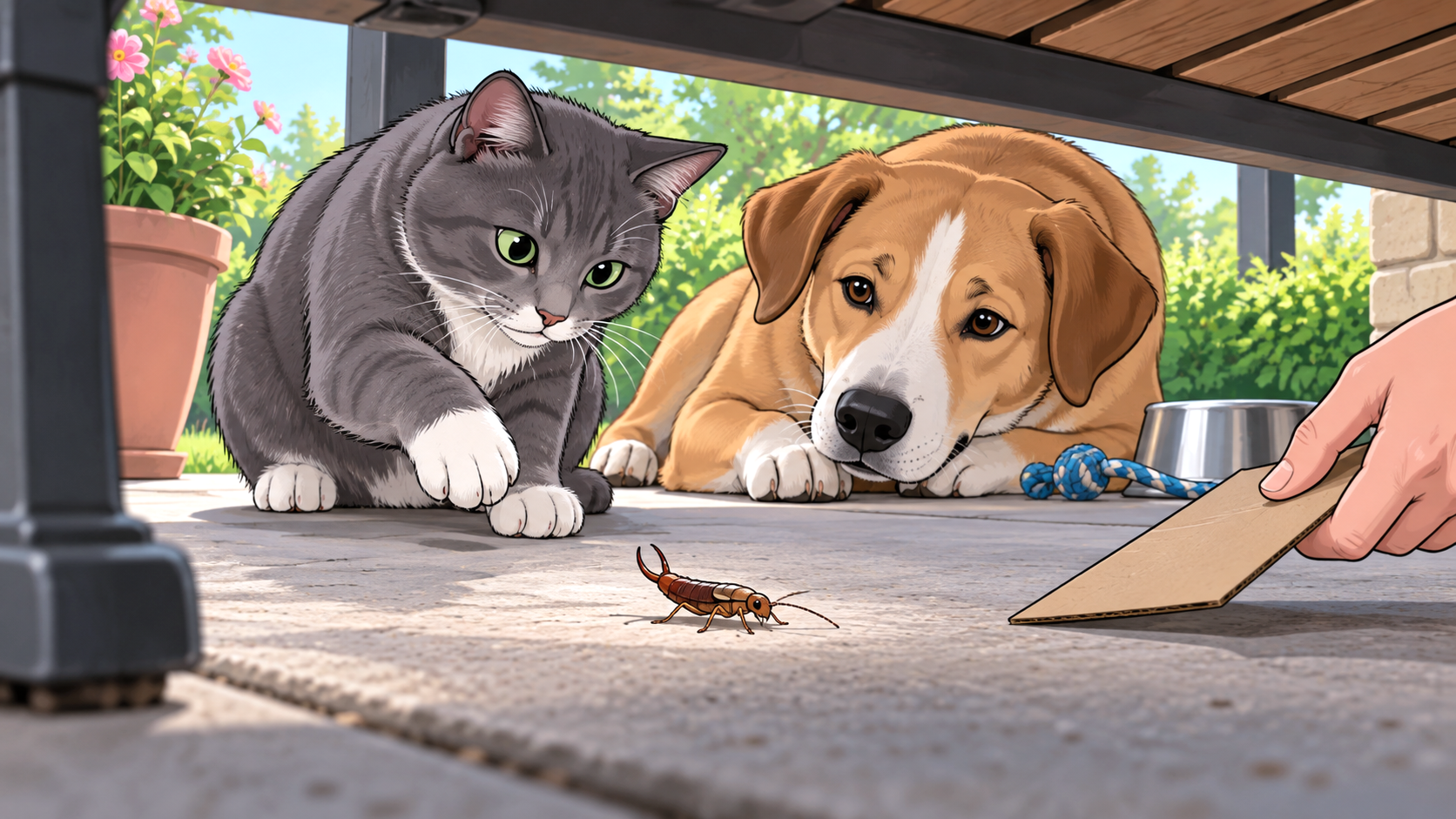
A dog snapping at an earwig in the yard or a cat batting one across the floor can look more alarming than the encounter really is. Earwigs are not considered dangerous pests to cats or dogs. They are not venomous, do not sting, and are not known to cause health problems in pets. Their pincers are primarily defensive structures, not specialized weapons for attacking animals.
The earwig itself is therefore rarely the part of the situation that deserves the most attention. Earwig-control products can pose a separate risk to pets, and that distinction matters if you are trying to remove the insects from a home or yard.
Are Earwigs Dangerous to Cats?
Earwigs do not hunt, feed on, or parasitize cats. A cat is far more likely to encounter one while exploring the house or yard than because the insect has any interest in the animal.
The intimidating feature is the pair of forceps at the rear of the earwig’s body. These structures, called cerci, are used for defense and other behaviors. Earwigs can use their pincers to grab, but they cannot squeeze very hard. A scientific review of earwig biology likewise reports that earwigs are not known to cause health problems in pets, livestock, or humans.
That makes the pincers look considerably worse than the risk they normally represent. A curious cat may paw at an earwig and provoke a defensive response, but this is not the same as the insect attacking the cat.
Are Earwigs Dangerous to Dogs?
Dogs face essentially the same situation. Earwigs are not parasites of dogs, and they do not seek dogs as a source of food. European earwigs are omnivores that consume plant material, fungi, decaying organic matter, and small organisms. Dogs and cats are simply not part of that feeding relationship.
A dog investigating an earwig with its nose or paw could disturb the insect enough for it to use its forceps defensively. However, earwig pincers do not deliver venom, and the insect does not have a stinger.
The prominent pincers therefore should not be confused with the defenses of genuinely venomous animals. Whether earwigs are poisonous explains that distinction, while whether earwigs are dangerous to humans addresses the same concern in people.
What If Your Cat or Dog Eats an Earwig?
A pet catching an earwig is believable behavior, especially for a cat that hunts moving insects or a dog that investigates things with its mouth. Earwigs themselves are not known as poisonous or venomous animals, and the scientific literature does not identify them as a recognized cause of health problems in pets.
Still, that general fact should be separated from diagnosing an individual animal. A dog or cat that becomes ill after eating something outdoors may have encountered more than the insect you happened to see. The surrounding area can contain pesticides, plants, fertilizers, baits, and other substances with very different safety profiles.
Symptoms therefore matter more than trying to prove that a swallowed earwig caused them. If your pet develops persistent vomiting, marked drooling, tremors, seizures, weakness, breathing difficulty, or other concerning changes after eating an insect or something found nearby, contact a veterinarian or animal poison-control service. Veterinary poison guidance recommends professional advice when a pet may have consumed a potentially harmful substance.
Do not give a home antidote or induce vomiting unless a veterinary professional specifically instructs you to do so.
Can an Earwig Pinch a Cat or Dog?
An earwig can use its rear forceps defensively, so contact with a pet is physically possible. However, these pincers are much less formidable than their appearance suggests.
A cat swatting an earwig or a dog pressing one against the ground creates the kind of direct contact in which the insect may try to defend itself. That does not mean earwigs normally chase pets or initiate attacks.
The forceps do not inject venom. Earwigs use them for several purposes, including defense, handling prey, and behaviors associated with mating. Their function is covered in more detail in what earwig pincers are actually for.
For a pet, the practical point is that an earwig’s defensive pinch is fundamentally different from a venomous bite or sting.
Earwig Pesticides Can Be More Dangerous to Pets Than Earwigs
This is the part that deserves much closer attention in a home with cats or dogs. The safety of an earwig and the safety of a product designed to kill earwigs are two completely different questions.
Pesticide labels may require pets to stay away from treated areas during application or until specific conditions have been met. Health Canada specifically advises keeping children and pets away from earwig baits and following precautions for products used around the home. The exact requirements depend on the product, so the current label determines how and where it should be used.
Cats deserve particular care around insecticides. Some pyrethroid exposures can be highly toxic to cats. Veterinary toxicology guidance identifies permethrin as toxic to cats, while significant pyrethrin or pyrethroid exposure can cause neurological and other signs depending on the chemical, dose, concentration, and animal involved.
This does not mean every product labeled for earwig control presents the same risk. It means that because an earwig itself poses little danger to a pet, you should not assume that a pesticide used against it is equally harmless.
Read the complete product label before using an insecticide anywhere a cat or dog can access. Follow its instructions for placement, application, re-entry, storage, and disposal rather than relying on general claims that a treatment is “pet safe.”
What to Do When Your Pet Keeps Finding Earwigs
One earwig carried across the floor by a cat does not require an aggressive pesticide response. If earwigs keep appearing, it makes more sense to address why they are reaching the places your pet uses.
Earwigs favor protected locations and often hide in dark, damp spaces during the day. Around a home, reducing favorable shelter and blocking entry can lower the number wandering indoors. Removing debris near the foundation and addressing excessive moisture can also make the immediate area less favorable.
For indoor stragglers, physical removal avoids unnecessary chemical exposure around pets. Repeated sightings deserve a broader look at the property rather than an immediate escalation to sprays or baits. Conditions that encourage activity are covered in what attracts earwigs to begin with, while keeping earwigs out of the house focuses on preventing entry.
If control products become necessary, keep the pet-safety question separate from the pest-control question. A product can be effective against earwigs while still being inappropriate for a location where a cat or dog can reach it.
Other Questions About Earwigs, Cats and Dogs
Can earwigs live in a cat’s or dog’s fur?
Earwigs are not external parasites of cats or dogs and do not live in their fur the way fleas do. An earwig could accidentally crawl onto an animal, especially outdoors, without establishing itself on the pet.
Can cats bring earwigs into the house?
An earwig could accidentally be carried indoors on an animal, just as one can be carried inside with objects or enter through openings around the building. That does not mean the earwig is living on the cat.
Should I stop my cat or dog from playing with earwigs?
It is reasonable to remove the earwig when practical. Although earwigs are not considered dangerous to pets, preventing repeated mouthing or pawing avoids unnecessary defensive contact and makes it easier to recognize when a pet has encountered a different insect or another substance.
Should I call a veterinarian if my pet ate an earwig?
Eating an earwig by itself is not generally identified as a poisoning emergency. Contact a veterinarian if your pet develops concerning symptoms, you are unsure what it swallowed, or the insect may have been contaminated with pesticide or another potentially harmful substance.
Can earwig treatments hurt pets even when the earwigs cannot?
Yes. Pest-control products have their own ingredients, exposure risks, and safety requirements. Never judge a pesticide’s safety from the pest it targets. Follow the current label exactly and seek veterinary advice if you suspect an unsafe exposure.