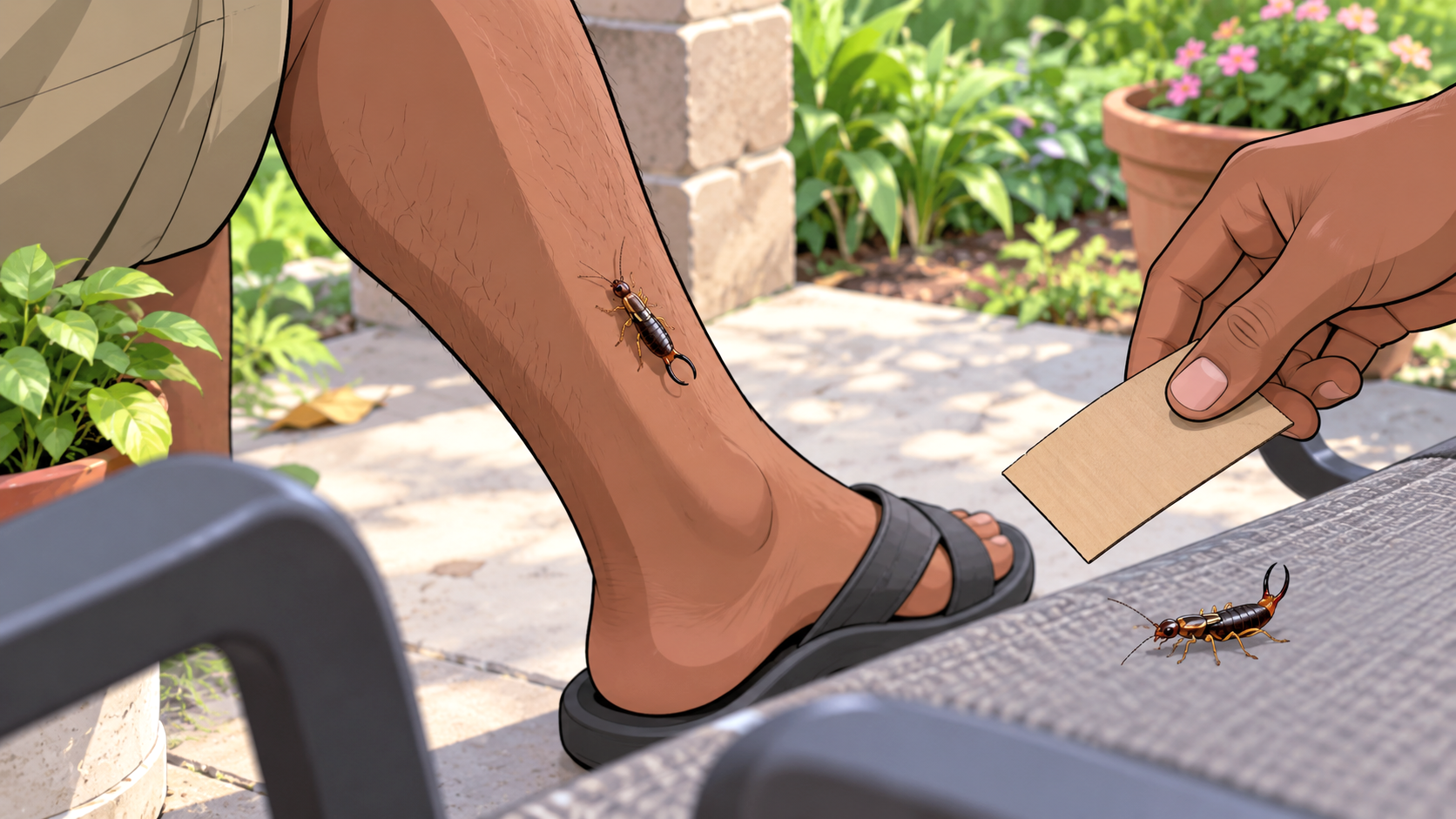
Those pincers make earwigs look considerably more threatening than they are. Earwigs are not considered dangerous to humans. They are not poisonous or venomous, and their pincers are not powerful enough to cause serious injury under ordinary circumstances. An earwig can occasionally pinch or bite a person when handled or trapped against the skin, but it does not seek people out to attack or feed on them.
For most homeowners, an earwig indoors is a nuisance rather than a medical threat. The important distinction is between what the insect looks capable of doing and what it actually does around people.
Why Earwigs Are Not Considered Dangerous to Humans
Earwigs have a pair of conspicuous forceps called cerci at the rear of the abdomen. These pincers are one reason people are wary of them. However, earwigs use the structures for functions such as defense and handling prey rather than hunting people. They can grab objects with the pincers but cannot squeeze very hard.
Other university guidance similarly describes earwigs as insects that may pinch human skin but are not poisonous. Their forceps can therefore make contact with you without making the insect a significant human-health threat.
Earwigs are also not parasites of humans. Their diet includes plant material, decaying organic matter, fungi and other small organisms. The European earwig, Forficula auricularia, is an omnivore that consumes detritus, fungi, plants and insects. Human blood is not part of its normal diet.
That distinction is worth remembering when you find an earwig indoors. Its presence can be unpleasant, but the insect is not there looking for a human host.
Can Earwigs Bite or Pinch People?
Yes, but neither behavior is normally an attack on people. Earwigs use the forceps on their abdomen partly for defense, and those structures can deliver a mild pinch to humans.
There is also a difference between biting and pinching. A bite involves the mouthparts at the front of the insect, while a pinch comes from the forceps at the rear. A mildly painful bite can occur when an earwig is handled or accidentally trapped against the body.
That makes accidental or defensive contact possible without making earwigs aggressive toward humans. Our guide to whether earwigs bite or pinch explains the distinction in more detail.
If you already have an unexplained spot on your skin, be careful about identifying its cause from appearance alone. An earwig bite or pinch mark does not have a distinctive appearance that reliably proves an earwig caused it.
Are Earwigs Poisonous or Venomous?
No. Earwigs are not poisonous or venomous, and their pincers are not venom-delivery structures.
This is another case where appearance creates the wrong impression. The curved forceps of some adult male earwigs can look almost scorpion-like, particularly when the insect raises its abdomen defensively. However, earwigs do not have a stinger and do not inject venom through their forceps.
Earwigs can also produce a noticeable odor when disturbed. Some species have abdominal scent glands that release defensive secretions. That chemical defense should not be confused with venom being injected into a person.
Our dedicated guide to whether earwigs are poisonous or venomous covers that distinction more closely.
Do Earwigs Carry Diseases That Harm Humans?
Earwigs are not recognized as important human disease vectors in the way mosquitoes and ticks are. Finding an insect around soil, decomposing vegetation or other damp organic material does not automatically mean it transmits disease to people.
For homeowners, the practical concern with indoor earwigs is usually nuisance and repeated entry rather than infection. The University of Minnesota Extension describes earwigs as harmless to people and property, even though they can become unwanted household visitors.
It is also important not to confuse an insect’s ability to encounter microorganisms in its environment with established disease transmission. Those are not the same thing. Our dedicated article on whether earwigs carry disease examines that question without assuming that a dirty environment automatically makes an insect a disease vector.
Can Earwigs Crawl Into Human Ears?
An individual earwig can accidentally enter a person’s ear, but this is not normal earwig behavior. The much older claim that earwigs deliberately crawl into sleeping people’s ears and burrow toward the brain is folklore.
Published medical cases have documented earwigs inside the external ear canal, so saying it is completely impossible would also be inaccurate. The important distinction is intent and normal behavior. A wandering insect accidentally entering an ear is very different from a species that routinely seeks human ears.
If this actually happens, treat the insect as a foreign body in the ear rather than as an earwig attack. Our guide to whether earwigs can crawl into your ear explains what to do and when medical attention is appropriate.
The related story that earwigs use human ears for reproduction is also false. Females normally make protected nests for their eggs rather than using people as hosts. We address that myth separately in whether earwigs lay eggs in your ear.
Why Earwigs in Your House Are Still Worth Dealing With
Calling earwigs harmless does not mean you have to tolerate them crawling around your home. Repeated indoor sightings can indicate that the insects have easy entry points or that conditions around the property are attracting them.
Earwigs are nocturnal and commonly spend daylight hours in dark, protected spaces. They can move indoors through small openings and end up in bathrooms, basements, kitchens and bedrooms. Once inside, their presence is generally a nuisance rather than evidence that they are reproducing on people or looking for someone to bite.
Physical exclusion can help prevent that movement. Recommended measures include sealing openings around doors, windows and other potential entry points. It can also help to examine the conditions immediately outside the building rather than focusing exclusively on the insects already indoors.
If sightings are becoming frequent, our guide to why earwigs get into houses can help identify what is drawing them close to the structure.
Treat Repeated Earwigs as a Pest Problem, Not a Medical Threat
For most people, seeing an earwig does not call for a health response. Avoid deliberately handling the insect, remove indoor stragglers, and pay attention to repeated sightings.
If they continue appearing, look for entry points and favorable hiding conditions rather than worrying that the insects are becoming aggressive. Persistent problems can then be addressed with the appropriate exclusion and control measures covered in our guide to how to get rid of earwigs.
Actual physical symptoms should be handled separately from the pest problem. If you experience a significant or worsening reaction after contact with any insect, seek appropriate medical advice instead of assuming the reaction is harmless simply because an earwig was nearby.
Other Questions About Earwigs and Human Safety
Will an earwig attack you while you sleep?
No. Earwigs do not hunt sleeping people. They are nocturnal, which means they may be active while you are asleep, but nighttime activity should not be confused with an attempt to find or attack a human host.
Are earwigs more dangerous to children?
Earwigs are not considered dangerous human pests simply because a child is present. However, children should avoid deliberately picking up or squeezing unfamiliar insects. An earwig that is handled or restrained may attempt to defend itself.
Should you pick up an earwig with your bare hands?
There is little reason to handle one directly. Capturing or removing an indoor earwig without bare-handed handling avoids giving the insect an opportunity to pinch or bite defensively.
Are earwigs dangerous if you find a lot of them?
Large numbers can make an earwig problem more unpleasant, but they do not transform the insects into a greater human-health threat. Frequent sightings are more useful as evidence that earwigs have favorable conditions around the property or easy routes indoors.
Can an earwig pinch seriously injure you?
An earwig can grip skin with its rear forceps, but the pincers cannot squeeze very hard and are generally described as producing a mild pinch. Our guide to whether an earwig pinch actually hurts covers the severity of that contact in more detail.
5 thoughts on “Are Earwigs Dangerous to Humans?”