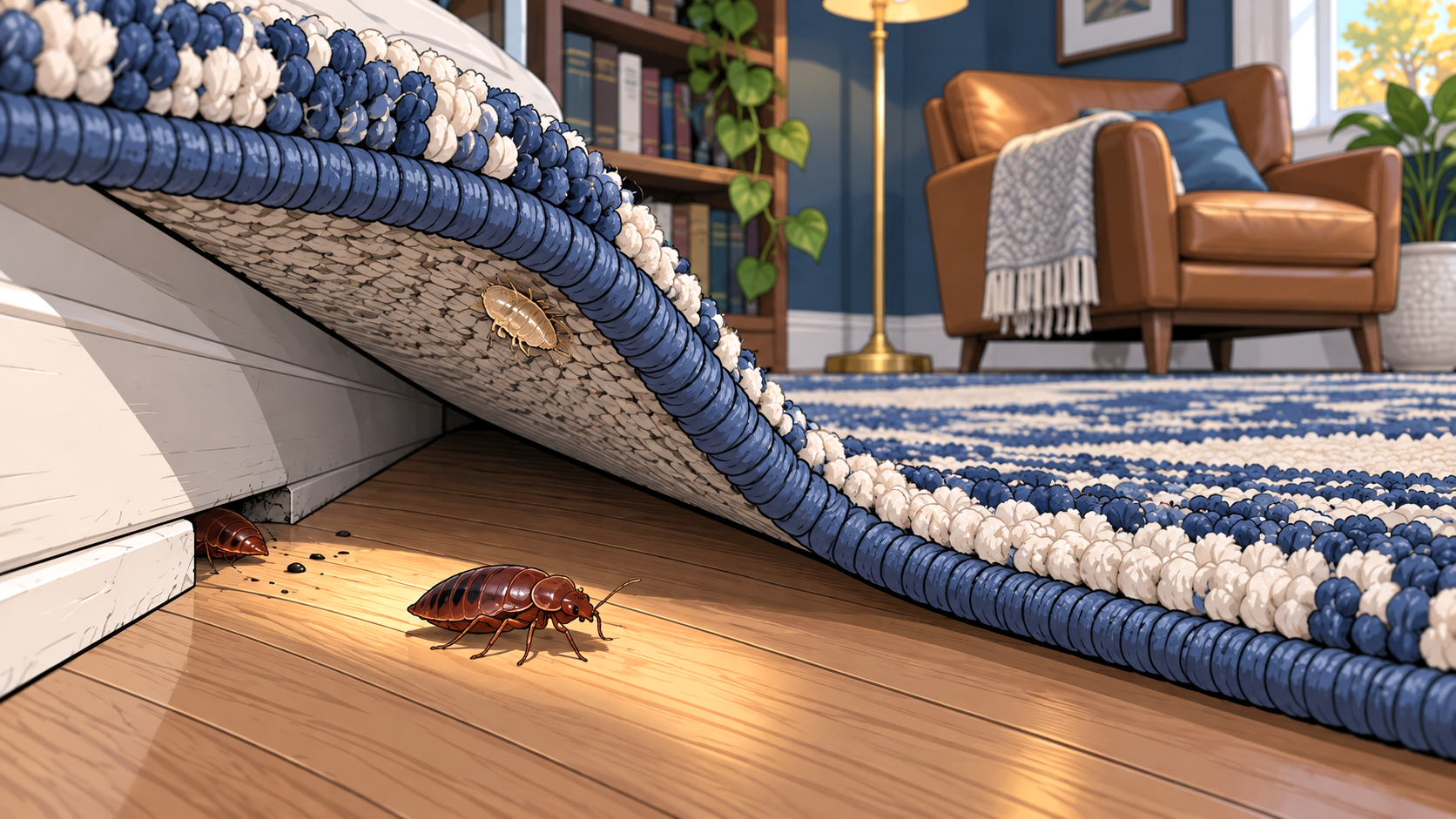
Bed bugs can live in carpet and rugs, especially around edges, baseboards, and other protected areas near where people sleep or rest. Carpet isn’t usually the first place to inspect, but it can provide hiding places and shouldn’t be ignored during an infestation. Bed bugs don’t burrow into carpet the way some pests burrow into soil or fabric. They are more likely to use protected edges, folds, gaps, and nearby cracks where their flat bodies can remain concealed between blood meals.
Check Carpet Near the Bed and Baseboards First
If you’re inspecting carpet for bed bugs, start around the perimeter of the room and areas close to beds or upholstered furniture rather than concentrating on the open middle of the floor.
Purdue University recommends inspecting carpeting and baseboards nearest the bed, along with mattress seams, headboards, nearby furniture, cracks, and crevices.
Pay particular attention to where carpet meets the baseboard, gaps beneath molding, loose carpet edges, and the edges or folds of area rugs. Bed bugs can also hide behind the baseboard itself, so apparent activity along a carpet edge may actually originate from an adjacent crack or crevice.
That overlap matters because bed bugs can hide around baseboards without spending most of their time in the carpet itself.
Bed Bug Eggs Can Be Difficult to Vacuum Up
Vacuuming can physically remove exposed bed bugs, shed skins, debris, and some eggs, but it shouldn’t be expected to remove everything.
Bed bug eggs are attached to surfaces, which can make them difficult to dislodge with suction alone. Using a crevice attachment helps reach carpet edges, gaps around baseboards, and other narrow spaces where a standard vacuum head may miss bugs.
The EPA recommends thorough vacuuming during bed bug preparation and control, followed by immediately sealing the vacuum bag in plastic and placing it in outdoor trash.
Vacuuming is useful for reducing the number of bugs present, but vacuuming alone won’t eliminate an established bed bug infestation.
Steam Can Be Used on Carpets
Steam is another nonchemical option for suitable carpeted areas. The EPA specifically lists carpets and baseboards among the surfaces that steam cleaners can treat.
The EPA recommends steam at a temperature of at least 130°F (about 54°C) and warns against forceful airflow because it can scatter bed bugs. A diffuser can reduce that risk.
Steam still has to reach the insects and eggs to work. Moving quickly over the visible carpet surface while missing the perimeter, baseboards, furniture, and nearby harborages won’t eliminate an infestation.
For more detail on using this method safely and effectively, steam treatment for bed bugs covers its strengths and limitations.
Treat More Than the Carpet
Finding bed bugs in carpet doesn’t mean the carpet is the source of the infestation. Bed bugs commonly hide in mattresses, box springs, bed frames, headboards, upholstered furniture, baseboards, and other cracks and crevices near resting areas.
That means replacing or cleaning the carpet while ignoring the rest of the room can leave the infestation intact. The EPA recommends an integrated approach that combines appropriate inspection, physical controls, monitoring, and other treatment methods as needed.
A confirmed infestation needs to be addressed throughout the affected area rather than as a carpet problem alone. Getting rid of bed bugs covers the broader treatment process.
Questions About Bed Bugs in Carpet
Can bed bugs live under carpet?
They can use protected gaps around carpet edges, baseboards, and flooring. If carpet can be lifted safely during a thorough inspection, the perimeter and adjoining cracks deserve attention.
Can vacuuming carpet get rid of bed bugs?
Vacuuming can remove exposed bugs and reduce their numbers, but it isn’t reliable as a standalone treatment. Eggs and bugs hidden in inaccessible cracks or elsewhere in the room can remain.
Can bed bugs live in area rugs?
Yes. Check the edges, folds, underside, and areas where the rug meets nearby furniture or walls. Finding bed bugs in a rug should also prompt inspection of the surrounding room.
Should you throw away carpet because of bed bugs?
Not automatically. Carpet can be vacuumed, steamed where appropriate, and incorporated into a broader treatment plan. Removing carpet without treating other harborages won’t necessarily eliminate the infestation.
One thought on “Can Bed Bugs Live in Carpet or Rugs?”