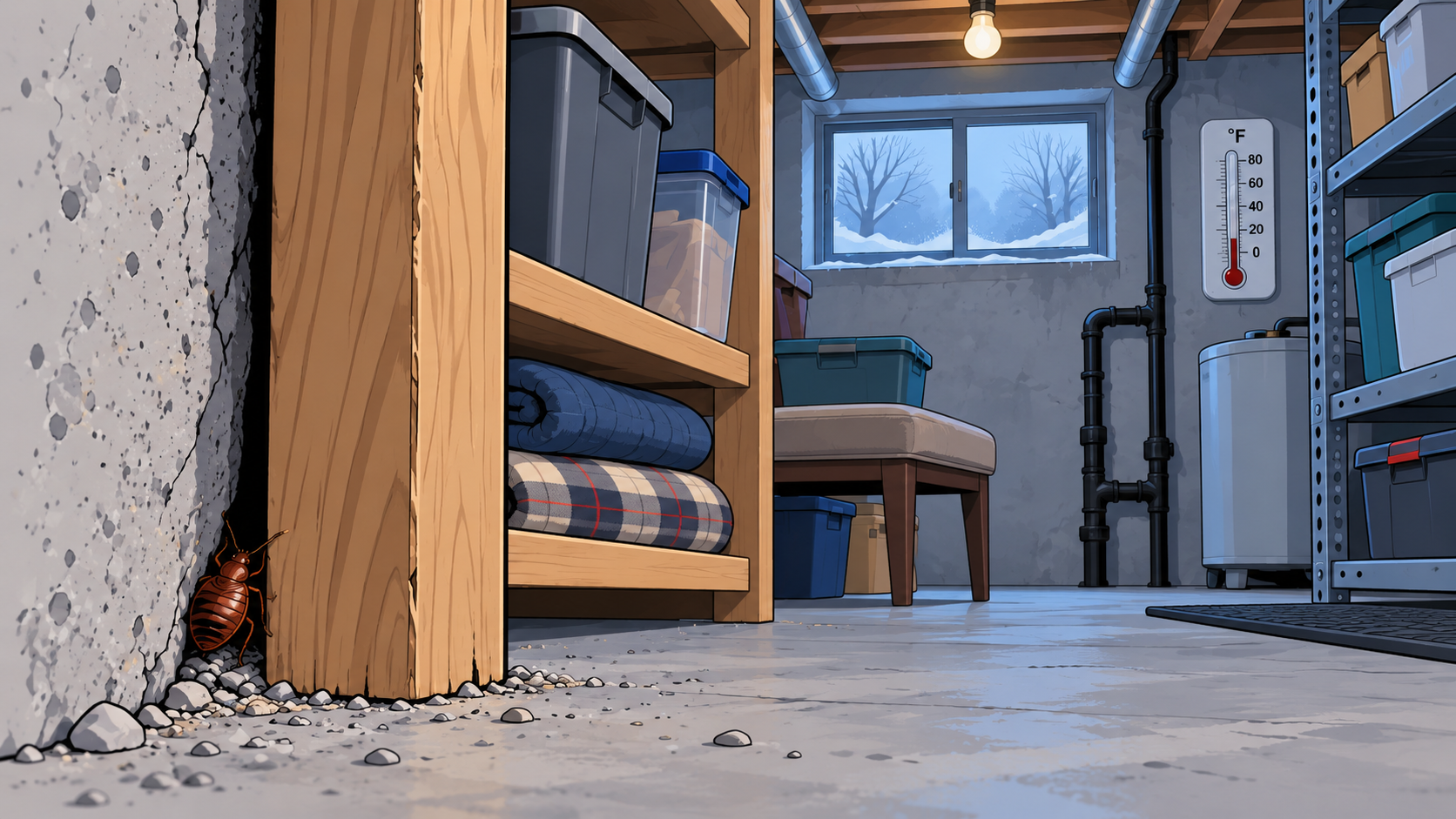
A bed bug can become so inactive in the cold that it appears dead, then start moving again after warming up. That is real. What is misleading is treating this as a predictable winter hibernation cycle in which bed bugs automatically shut down for the season and wake again in spring.
Bed bugs do not hibernate on a fixed seasonal schedule. Cold temperatures can reduce their activity and metabolism, and sufficiently cold bed bugs may enter a dormant-looking state. They can survive prolonged cold unless the temperature becomes low enough for long enough to kill them, so a quiet infestation during winter should not be assumed to be gone.
Temperature matters far more than the calendar. Bed bugs living inside a heated home may remain active throughout winter because they are not experiencing the outdoor temperatures that would produce severe cold stress.
Cold Can Make Bed Bugs Look Dormant
Bed bugs are ectothermic insects, so their body temperature and physiological activity are strongly influenced by their surroundings.
Laboratory measurements of Cimex lectularius found that metabolic rate changes substantially with temperature. Lower temperatures reduce metabolic demand, which helps explain why cold bed bugs can become far less active than bugs kept under warmer conditions.
EPA goes further in its cold-treatment guidance, warning that bed bugs exposed to cold can go dormant and appear dead for days before becoming active again after warming.
That is the practical point behind the hibernation question. A motionless bed bug is not necessarily a dead bed bug.
Cold can also affect how long bed bugs survive between meals. The relationship between temperature and starvation is covered separately in how long bed bugs can live without feeding, rather than treating long survival without food as proof of hibernation.
Bed Bugs Can Adjust to Cold Stress
Their response to cold is more complicated than simply becoming slower as the temperature falls.
Laboratory research found that adult female bed bugs exposed to 0°C (32°F) for one hour subsequently tolerated colder temperatures better than bugs without that preliminary exposure. This process is known as rapid cold hardening.
The same experiment found that keeping bed bugs at 4°C (39.2°F) for two weeks did not produce the same improvement in cold tolerance.
Longer experiments have also shown that fluctuating temperatures can affect survival differently from constant cold. In one study exposing adults and fifth-instar nymphs to temperatures between 0°C and -10°C (32°F to 14°F), mortality at intermediate temperatures was greater under constant cold than under fluctuating temperatures.
That makes real-world cold exposure harder to predict than looking at the overnight low on a weather forecast. The temperature where the bed bug is actually hiding, how long that temperature persists, and whether conditions fluctuate all matter.
Winter Outside Doesn’t Mean Bed Bugs Inside Are Freezing
Putting an infested object outdoors during winter is not equivalent to holding every bed bug inside it at a laboratory-controlled temperature.
Furniture, mattresses, walls and other materials can insulate insects from short-term changes in air temperature. Even when the outdoor air becomes extremely cold, the center of an object may cool much more slowly.
EPA therefore warns that putting infested belongings outside in freezing weather is not a reliably controlled bed bug treatment.
An occupied building creates an even clearer problem. Heating keeps bedrooms and other living areas far warmer than the winter air outside. EPA reports that bed bugs can remain active at temperatures as low as 7°C (46°F), so ordinary indoor winter conditions do not automatically force them into inactivity.
A bed bug infestation can therefore continue through winter without experiencing anything close to lethal cold.
Freezing Bed Bugs Requires Both Temperature and Time
Cold can kill bed bugs, but simply reaching the freezing point of water is not enough.
EPA’s current integrated pest management guidance says temperatures below 0°F (-19°C) maintained for at least four days can eliminate some infestations. EPA also warns that household freezers may not be cold enough and recommends checking the actual temperature with a thermometer.
Controlled research shows why duration matters. Bed bugs are freeze-intolerant, but they can survive substantial cold stress above their lethal limits. One study found that survival was possible above -12°C (10.4°F) even after a week of continuous exposure.
Another experiment exposed bed bugs to less extreme temperatures for much longer periods. Mortality increased as temperatures fell and exposure lengthened, and all tested adults and fifth-instar nymphs were dead after three weeks at -7°C (19.4°F).
There is no single cold temperature that kills every bed bug immediately. Temperature and exposure time work together.
For the treatment question specifically, whether cold weather kills bed bugs covers the lethal-temperature side without confusing it with hibernation.
A Quiet Winter Doesn’t Mean the Infestation Ended
This is where misunderstanding cold dormancy becomes a practical problem.
Reduced movement during cold conditions can make bed bugs harder to notice. Cold exposure can also leave bugs looking dead when they are not.
Neither result demonstrates eradication.
Once surviving bed bugs warm again, they can resume activity. Research examining sublethal cold exposure found that surviving bed bugs were still capable of feeding afterward.
So we would not use a winter decline in sightings or bites as evidence that an infestation has disappeared. Confirmation requires looking for the insects and the physical evidence they leave behind rather than waiting for seasonal activity to change.
Questions About Bed Bugs and Cold Dormancy
Can a frozen-looking bed bug come back to life?
A cold, motionless bed bug may not actually be dead. EPA specifically warns that cold-treated bed bugs can appear dead for days and become active again after warming. That is why movement immediately after cold exposure is not a reliable test of whether treatment worked.
Does turning off the heat in a house get rid of bed bugs?
It is not a reliable treatment. The temperature has to become sufficiently low where the bed bugs are actually hiding and remain there long enough to be lethal. Buildings, walls, furniture and other materials can prevent hidden insects from experiencing the same temperatures as the outdoor air.
Will a household freezer kill bed bugs?
It can if it maintains a sufficiently low temperature for long enough, but EPA warns that home freezers do not always reach the necessary temperature. Use a thermometer rather than relying on the freezer setting, and remember that the entire infested item has to become cold enough.
Can bed bugs survive cold transportation in a moving truck or shipping container?
Short-term cold exposure should not be treated as a reliable way to disinfect belongings. Published research shows that bed bug mortality depends strongly on both temperature and duration, with survival possible after prolonged exposure to some subfreezing temperatures.
One thought on “Do Bed Bugs Hibernate?”