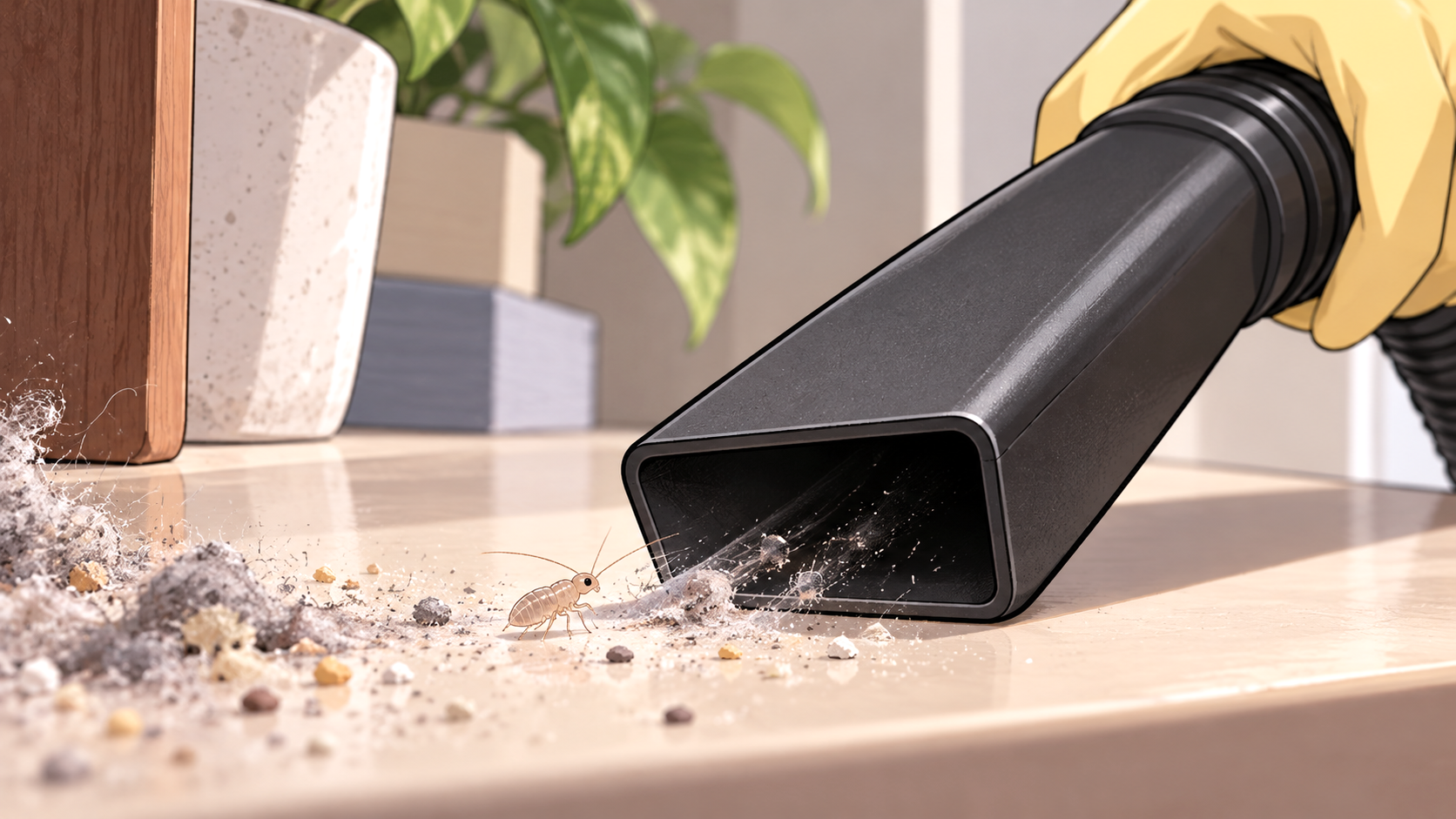
If by “instantly” you mean an exposed booklouse stops moving almost immediately, direct-contact insecticides containing pyrethrins can provide rapid knockdown when the product label specifically permits use against booklice. Vacuuming or physically removing an insect is even simpler. Neither approach instantly eliminates hidden adults, nymphs, or eggs, so rapid kill and complete infestation control are different outcomes.
Direct-Contact Pyrethrins Come Closest to an Instant Chemical Kill
Pyrethrins act on an insect’s nervous system after contact or ingestion, producing rapid paralysis followed by death. The National Pesticide Information Center describes this rapid nervous-system action, and EPA-approved pesticide labels exist for products that specifically list booklice among insects killed on contact. One such EPA-registered pyrethrum formulation explicitly lists booklice under contact kill.
The wording on the actual product label determines whether a pesticide may be used for booklice and where it may be applied. A pyrethrin product labeled for another pest or for outdoor use should not be assumed suitable for indoor booklice. Utah State recommends choosing only an insecticide labeled for booklice or the applicable crawling-insect use site. The available sprays and insecticides for booklice vary considerably in ingredients, permitted locations, and residual properties, so the label is more important than the active ingredient name alone.
Rapid contact kill also requires the spray or dust to reach the insect. A booklouse several centimeters inside a wall void, binding, cabinet joint, or cardboard fold is unaffected by a product that lands only on the exposed surface.
Vacuuming Removes Visible Booklice Immediately Without Waiting for a Pesticide
When the goal is simply to eliminate booklice crawling on a wall, shelf, windowsill, cabinet, or other accessible surface, a vacuum provides an immediate physical result. Minnesota specifically includes vacuuming as an appropriate way to remove household psocids, particularly when numbers are small.
This method avoids treating a surface simply because one or two insects are visible. It is especially useful around books, electronics, food-storage areas, and other locations where applying unnecessary liquids or pesticide residues would create additional complications. Vacuuming does not kill or collect insects that remain concealed elsewhere, however, so recurring booklice indicate a source beyond the individuals already removed.
The broader signs of a booklice infestation help distinguish an occasional visible insect from a reproducing population that requires attention to its habitat.
Heat Can Kill Booklice, but It Is Not an Instant Household Treatment
Booklice are susceptible to elevated temperatures, although scientifically supported heat treatment depends on both temperature and exposure time. Research on Liposcelis bostrychophila, L. decolor, and L. paeta found that mortality increased under approximately 45°C to 55°C heat treatments, with eggs generally proving more heat tolerant than the mobile stages. USDA guidance likewise identifies 45°C to 55°C as an effective heat-disinfestation range for psocids.
Those temperatures should not be interpreted as instant-kill numbers. Exposure requirements vary by species, life stage, and temperature, while the center of an infested object may take considerable time to reach the temperature measured in the surrounding air. The details behind using heat against booklice therefore belong to controlled heat treatment rather than a quick blast of warm air.
A hair dryer, space heater, or other improvised heat source may kill an exposed insect while leaving protected eggs and booklice untouched. Applying high heat to books, plastics, electronics, adhesives, furniture, or combustible material can also damage the object or create a fire hazard.
Diatomaceous Earth and Silica Dusts Are Not Instant
Desiccant dusts work by damaging or disrupting the insect’s protective surface and promoting water loss. Their effect depends on exposure and therefore should not be described as instantaneous. EPA pest-management guidance lists diatomaceous earth and silica-based dusts among materials capable of killing booklice and related pests, but the insect must contact an effective deposit and then lose enough water for mortality to occur.
That slower mechanism is important when evaluating diatomaceous earth against booklice. Seeing an insect walk through dust and continue moving does not prove the material has failed, nor should extra dust be applied simply to make the response look faster. Pesticidal dusts should only be used according to their label, particularly because airborne fine particles should not be inhaled.
Lowering Humidity Kills the Population Slowly, Not the Insect Instantly
Drying remains one of the most important controls for household booklice, but it is almost the opposite of an instant treatment. Booklice depend strongly on atmospheric moisture. Canadian conservation research notes that indoor Liposcelis can survive dry conditions for up to approximately three weeks by drawing on internal water reserves before prolonged dehydration becomes fatal.
Penn State recommends lowering relative humidity below about 50% because dry conditions suppress mold and booklouse development. The underlying humidity dependence of booklice makes this slower method far more important to lasting control than the speed at which an exposed adult dies.
A dehumidifier therefore should not be judged by whether insects fall dead within an hour. Its value is in preventing the habitat from supporting continued survival and reproduction.
Freezing Is a Treatment Process, Not an Instant Kill
Cold can kill booklice when sufficiently low temperatures are maintained long enough, but placing an infested object somewhere merely chilly does not provide immediate mortality. The center of the object needs time to cool, and life stages can differ in cold tolerance.
The difference between an effective freeze treatment and simply exposing insects to winter temperatures is central to whether freezing kills booklice. Freezing is therefore better viewed as a controlled treatment for suitable objects rather than a rapid response to insects crawling across an exposed surface.
Vinegar Is Not a Dependable Instant Booklice Treatment
Household liquids are often recommended online because a directly drenched soft-bodied insect may die after exposure. That observation is not equivalent to demonstrating reliable infestation control. Vinegar has no special advantage over established physical removal or appropriately labeled pest-control products, and wetting books, drywall, wood, or other porous materials can add moisture to an environment where booklice already benefit from dampness.
The evidence around using vinegar for booklice therefore does not justify treating it as an instant solution. The same caution applies to bleach, rubbing alcohol, essential oils, and improvised household mixtures when the actual breeding site has not been identified.
Killing an Adult Instantly Does Not Kill an Egg Beside It
A treatment can work perfectly on every exposed adult and still leave the infestation capable of continuing. Booklice reproduce through eggs and nymphal stages, and eggs are frequently protected in small crevices or attached to suitable substrates. USDA describes psocid eggs as small, ovoid, translucent structures glued to the substrate.
Heat research has also found eggs to be among the more treatment-tolerant stages. The booklice life cycle therefore prevents “kills on contact” from meaning “eliminates an infestation on contact.” If the breeding habitat remains humid, surviving stages can replace the insects that were killed.
Rapid Knockdown Is Most Useful After the Source Is Under Control
An exposed cluster of booklice can certainly be vacuumed or, where appropriate, treated with a pesticide whose label specifically permits that use. Those actions become much more effective once the damp environment sustaining the population has been corrected. Minnesota notes that household insecticides are generally unnecessary and often ineffective while excess moisture remains, while Penn State similarly prioritizes correction of water problems over pesticide use.
The full approach to getting rid of booklice consequently operates on two timescales: remove exposed insects when necessary, then stop the concealed population from replacing them.
Questions About Killing Booklice Quickly
Does crushing a booklouse kill it instantly?
Yes. Physical crushing kills an individual insect immediately, although it obviously has no effect on other booklice or eggs elsewhere.
Does soapy water kill booklice instantly?
Direct wetting may kill small insects, but there is little reason to rely on soapy water as a booklice treatment when physical removal is simpler. Adding liquid to porous or moisture-sensitive surfaces can also be counterproductive.
Can you spray booklice directly with insecticide?
Only use a pesticide when its label permits treatment of booklice and the intended indoor surface or location. Direct-contact pyrethrin products can provide rapid knockdown of exposed insects, but hidden stages remain unaffected unless the treatment reaches them.
What kills booklice fastest on a wall?
For a few visible insects, vacuuming is one of the fastest and simplest options. It removes the insects without adding pesticide or moisture to the wall.
Will boiling water kill booklice instantly?
Extreme heat can kill an exposed insect, but pouring boiling water onto household surfaces is unsafe and can cause burns, material damage, and additional moisture. It is not an appropriate booklice-control method.
Does alcohol kill booklice on contact?
A directly wetted insect may die, but alcohol should not be treated as a general household booklice treatment. It can damage finishes and other materials, presents flammability concerns, and does nothing to correct the habitat supporting concealed insects.
What kills booklice eggs instantly?
There is no practical household treatment that should be described as instantly killing every concealed booklice egg. Eggs can be more tolerant than exposed adults, and successful heat, cold, or pesticide treatments depend on sufficient exposure rather than momentary contact.
What is the fastest way to stop a booklice infestation from continuing?
Remove accessible insects, then eliminate the damp conditions that allow the population to reproduce. The eventual clearance time depends on how completely the breeding sites are dried, which is why getting rid of booklice can still take several weeks even when individual adults can be killed immediately.