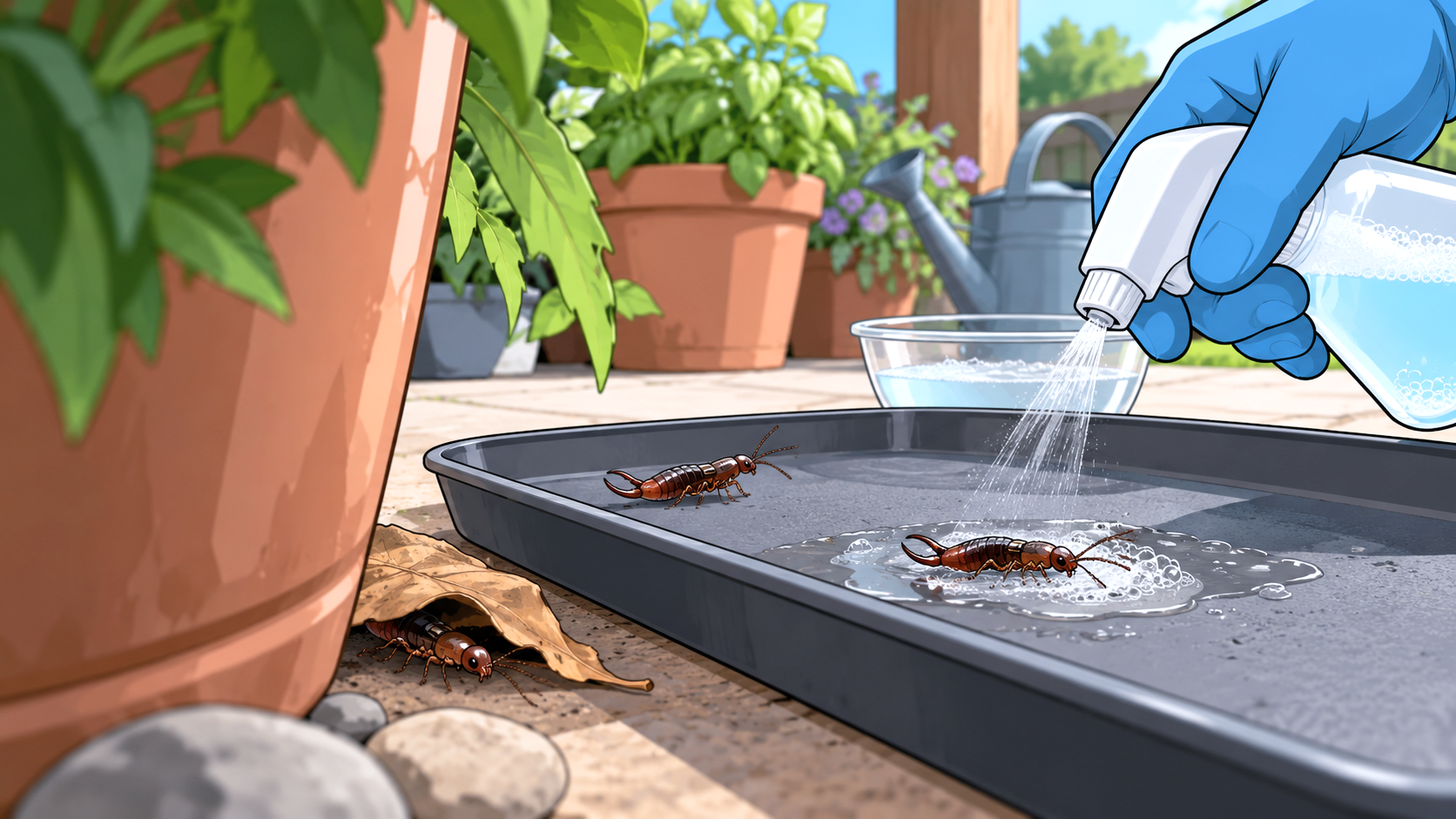
Dish soap sounds like another internet home remedy until you look at how soapy water is actually used in earwig control. Gardeners are routinely told to shake trapped earwigs into soapy water, and some extension guidance even describes shallow containers of soapy water as earwig traps. That makes dish soap more defensible than many improvised household remedies, but there is an important limit to what it can accomplish.
Soapy water can kill earwigs that are dropped into it or thoroughly contacted by it. However, dish soap is best treated as a direct-contact or trap-disposal method, not as a complete earwig treatment. It has no practical role in stopping new earwigs from entering a house or removing the outdoor conditions supporting them. The difference between those two uses matters. A container of soapy water can be useful when you already have earwigs in hand. Spraying dish soap around the house and expecting the earwig problem to disappear is a very different proposition.
Where Soapy Water Actually Fits Into Earwig Control
One of the most established uses of soapy water has nothing to do with spraying earwigs as they crawl around. It is used as the final step in a refuge-trapping system. Earwigs are active at night and seek dark, protected hiding places during the day. Rolled newspaper, corrugated cardboard, short sections of hose and similar materials can exploit that behavior by providing attractive daytime refuges.
The traps are placed where earwigs are active and checked later. Once earwigs have accumulated inside, they can be shaken into a container of soapy water. This exact approach appears in earwig management guidance for home gardens, where repeated trapping is used to bring populations down to tolerable levels. Similar guidance recommends transferring captured earwigs into soapy water for disposal.
That distinction gives soapy water a clear job. The refuge attracts or collects the earwigs, while the soapy water provides a way to kill the insects after capture. The soap does not need to repel earwigs, remain active on a surface for days or somehow eliminate a hidden population for this method to be useful.
You can also use soapy water itself as the liquid in a shallow pitfall-style trap. Shallow containers containing soapy water can be sunk to their rims in the garden, where earwigs that enter the containers drown. Vegetable oil is another established liquid for earwig pitfall traps, so dish soap is not the only household option available.
A Soap Spray Is a Much Narrower Tool
Using a spray bottle changes the situation because the soap has to reach the insect. Soap-based insect control depends heavily on direct contact, which means a wet earwig in front of you is a very different target from earwigs hidden beneath mulch, inside cracks or under garden debris. Once the spray dries, you should not treat the residue as a lasting barrier that will continue controlling earwigs passing through later.
There is also an important distinction between ordinary dishwashing liquid and a commercial insecticidal soap. They are not interchangeable products simply because both contain soap-like ingredients. Insecticidal soaps are pesticide products formulated and labeled for controlling specified pests on specified sites. Older earwig-control guidance specifically notes that insecticidal soaps can kill earwigs on contact without leaving residual control. That supports the contact-kill principle, but it does not turn every bottle of kitchen dish detergent into a labeled insecticide.
For that reason, we would not build an earwig-control plan around repeatedly spraying diluted dish detergent across plants, walls, baseboards or other surfaces. A homeowner who only wants to dispatch a few captured earwigs has a much simpler use case than someone trying to protect an entire garden or stop repeated indoor sightings.
Dish Soap Works Better With a Trap Than as a Search-and-Spray Routine
This is where we think dish soap becomes genuinely useful. Instead of walking around at night trying to find individual earwigs to spray, make their daytime hiding behavior do some of the work for you. A rolled refuge trap placed near a plant with confirmed earwig activity can collect several insects in one place. In the morning, the trap can be emptied into soapy water.
That approach also gives you information. If one trap repeatedly fills while another remains nearly empty, you have learned something about where the activity is concentrated. Trapping therefore serves two purposes at once by removing earwigs and helping identify the areas where control efforts matter most. Our DIY earwig trap guide goes deeper into the different trap designs and where to position them.
Oil traps provide another option when you want the killing medium and trap to be the same object. A low-sided can containing vegetable oil and an attractant such as fish oil can capture earwigs directly. If you are comparing that approach with the soap method, our soy sauce and oil earwig trap explains why the attractant and the liquid that traps the insect perform different jobs.
The practical lesson is that dish soap does not need to become a homemade pesticide spray to be useful. Its strongest role is much simpler: use soapy water where captured earwigs are going to end up.
Dish Soap Will Not Stop Earwigs From Entering the House
Finding earwigs indoors creates a different problem because killing the insects already inside does not prevent replacements from arriving. European earwigs do not reproduce indoors, and individual earwigs do not live long inside houses. However, they can continue entering buildings from outdoors, especially during periods when outdoor conditions or nearby populations favor movement into structures.
That makes repeated indoor spraying with dish soap a poor use of effort. An earwig walking across a floor can simply be vacuumed or swept up. If new earwigs keep appearing, inspect the exterior for the conditions and openings that are allowing the pattern to continue. Cracks and gaps around doors, windows, foundations, vents and other exterior penetrations deserve more attention than the bottle of soap under the kitchen sink.
Our guide to keeping earwigs out of the house covers that prevention work in detail. Outdoor shelter matters too. Leaves, boards, dense vegetation, mulch and other protected areas can provide daytime hiding places near a structure. Reducing shelter and keeping excess water away from buildings addresses the environment that supports continuing activity rather than simply killing whichever earwig crosses the floor next.
Be More Careful About Dish Soap on Plants
The garden is where a simple soapy-water idea can become unnecessarily complicated. Earwigs may chew seedlings, flowers, soft fruit and other susceptible plant material, but they also consume decaying organic matter and other insects. Therefore, finding an earwig beside a damaged plant is not enough by itself to justify spraying the plant.
First confirm the culprit. Earwig feeding can resemble damage caused by slugs and other pests, so checking affected plants after dark with a flashlight can reveal whether earwigs are actually feeding. We use the same principle in our guide to getting rid of earwigs in the garden because unnecessary treatment makes little sense when the insect has not been connected to the damage.
Once earwig feeding is confirmed, trapping lets you target the insects without coating the plant in household detergent. This is especially appealing around vulnerable seedlings, where our approach is to protect the plants during their most susceptible stage rather than treating every earwig elsewhere in the garden.
We would also keep ordinary dish detergent separate from insecticidal soap in this decision. If you want a soap-based pesticide for use on plants, use a product specifically labeled for that purpose and follow its directions. A homemade concentration guessed from a kitchen detergent bottle gives you no pesticide label governing the plant, concentration or application method.
Use Dish Soap for the Job It Does Well
Soapy water earns a place in earwig control, but it is a supporting tool rather than the whole strategy. It makes sense as a disposal container for earwigs collected from refuge traps, and a shallow soapy-water trap can capture earwigs directly. Those are simple uses with a clear relationship between the insect and the treatment.
For a larger outdoor problem, combine trapping with changes to the conditions helping earwigs persist. Remove unnecessary hiding places, avoid excessive surface moisture and concentrate control around plants where damage has actually been confirmed. When you are dealing with repeated indoor sightings, shift the priority toward exclusion instead. Our broader guide to getting rid of earwigs brings those different situations together.
That is the line we would draw with dish soap. Use soapy water when you need somewhere to put captured earwigs or when it forms part of a simple trap. Do not expect a bottle of dish detergent to substitute for finding out why the earwigs are there.
Other Questions About Dish Soap and Earwigs
How much dish soap should I add to water for earwigs?
There is no need to invent a precise homemade pesticide concentration for disposing of captured earwigs. Established guidance describes a container or pail of soapy water for this purpose without requiring the mixture to become a carefully measured spray treatment. If you want a product to spray as an insecticide, use a labeled insecticidal soap and follow its directions rather than creating an application rate for household detergent.
Can I put soapy water in an earwig trap overnight?
Yes. A shallow container of soapy water can function as a pitfall-style earwig trap when positioned appropriately in the garden. Another approach is to use a dry refuge such as rolled newspaper or corrugated material overnight, then shake the earwigs collected inside into soapy water the following morning.
Will dish soap keep earwigs away after it dries?
Do not rely on dried dish-soap residue as an earwig barrier. The useful applications described here depend on the earwig contacting or entering the soapy water. For continuing indoor entry, physical exclusion and changes to favorable outdoor shelter are more appropriate.
Can I use dish soap on earwigs in a potted plant?
We would avoid automatically spraying household dish detergent over the plant or saturating its potting mix just because an earwig is present. Earwigs can use the protected spaces around pots as shelter without necessarily damaging the plant. Inspect the container and confirm feeding first, then use the targeted approach in our guide to getting rid of earwigs in potted plants.