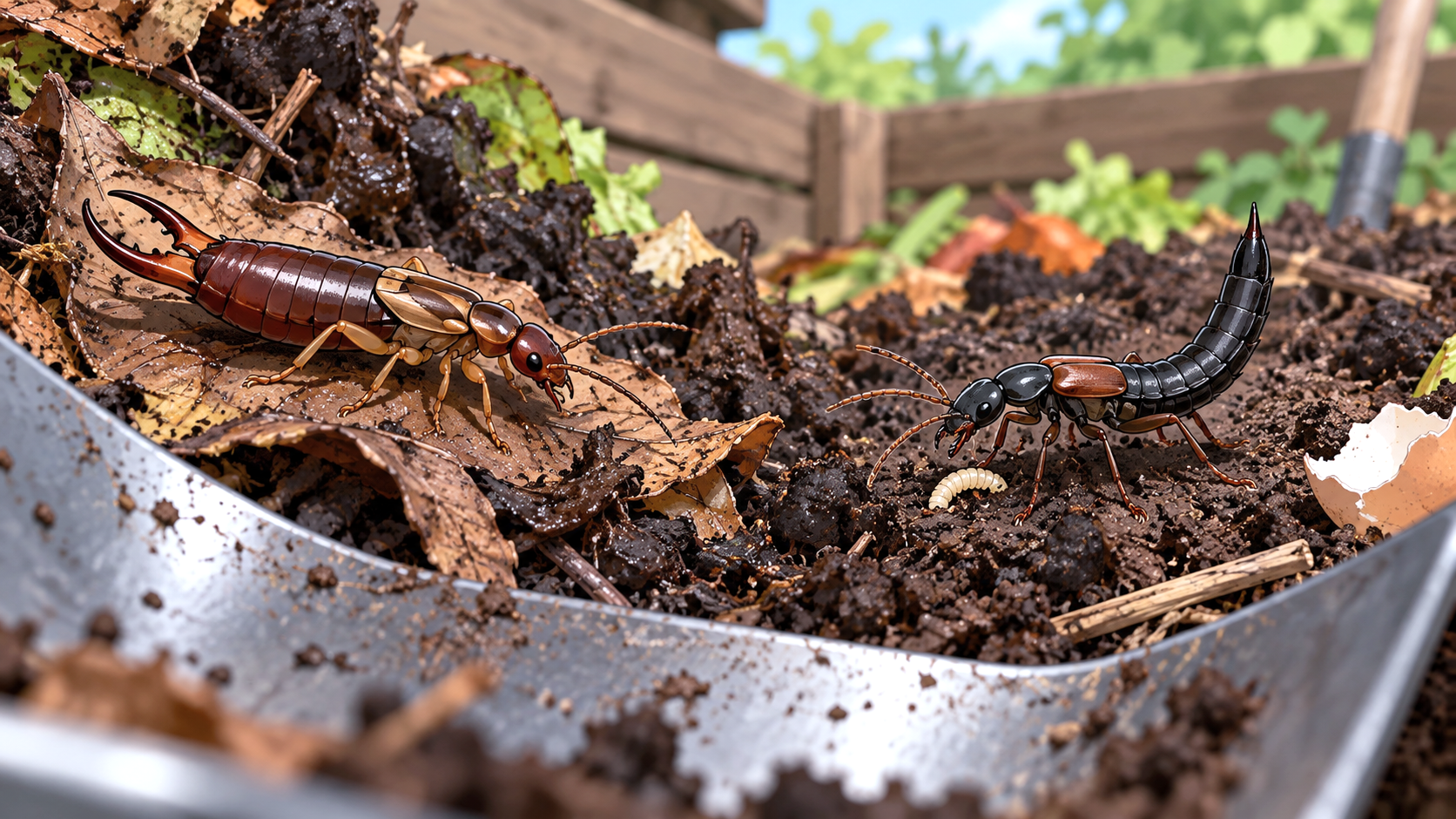
Earwigs and rove beetles are surprisingly easy to confuse. Both can have long, narrow bodies, short-looking wings, exposed abdominal segments, and a habit of running across the ground. The easiest difference is at the rear. Earwigs have a conspicuous pair of forceps at the end of the abdomen. Rove beetles do not. Instead, their defining beetle feature is a pair of very short wing covers that leaves much of the abdomen exposed.
That distinction matters because a rove beetle may even curl its abdomen upward when disturbed, making the resemblance stronger for a moment. Once you know which features to check, though, an earwig vs. rove beetle identification is usually much easier than the initial resemblance suggests.
Earwig vs. Rove Beetle: Check the End of the Abdomen First
The rear of the insect is the best place to start. An adult earwig has a pair of modified cerci that form the familiar forceps at the tip of its abdomen. These are the defining feature behind the “pincher bug” appearance. In the European earwig (Forficula auricularia), female forceps are generally straighter while male forceps are more curved. That variation is worth remembering because not every earwig has the dramatic curved pincers people expect.
Rove beetles belong to the family Staphylinidae, and their rear end looks quite different. They lack the large earwig-style forceps. Some species can raise and curve the abdomen when disturbed, producing a posture that resembles a tiny scorpion. That behavior is probably one of the strongest reasons a hurried glance can lead to a wrong identification. The curved abdomen is a posture, however, not a pair of pincers.
For a quick identification, we would trust visible anatomy over posture. A pair of forceps physically attached to the tip of the abdomen points toward an earwig. An exposed, flexible abdomen without those forceps points toward a rove beetle. Our broader guide to what earwigs look like covers the other features you can use when the rear of the insect is difficult to see.
Rove Beetles Have Unusually Short Wing Covers
The wings provide another useful distinction, although this one takes a closer look. Rove beetles are true beetles, but they do not have the long, hard wing covers that people normally associate with beetles. Instead, they have very short wing covers that leave most of the abdomen exposed. This gives the body a flexible, segmented appearance that can make a rove beetle look less beetle-like than expected.
Earwigs also have short forewings, so simply noticing that an insect has abbreviated wings will not settle the comparison. Adult European earwigs have leathery forewings with folded hind wings underneath, although they rarely fly. The combination of short wings and a long exposed abdomen is therefore one reason these insects can resemble each other.
The better approach is to combine the wing clue with the rear of the body. A rove beetle has shortened beetle wing covers and no large terminal forceps. An earwig has short forewings plus its characteristic cerci. If the wing structure itself is what caused the confusion, our guide to whether earwigs have wings and can fly goes into that anatomy in more detail.
Earwigs and Rove Beetles Can Be Similar in Size and Color
Color is not a dependable shortcut here. Many rove beetles are black or brown, while the European earwig is generally reddish brown. Depending on the species, lighting, and how quickly the insect is moving, both can simply register as a small dark insect with an elongated body.
Size overlaps as well. Rove beetles vary enormously because Staphylinidae is a huge family containing thousands of species. Common examples can range from only a few millimeters to around 20 millimeters long, while another identification guide places many rove beetles between 1/8 and 3/4 inch long. European earwigs are commonly around 5/8 inch long, putting them directly within that broad rove-beetle size range.
This is why we would not identify either insect from a description such as “small, brown, and about half an inch long.” Those details narrow the possibilities very little. Structural features are much more useful. Look for the earwig’s rear forceps or the rove beetle’s short wing covers and exposed abdomen instead. For the earwig side of the comparison, earwig size varies with age and species, so size works best as supporting evidence rather than the deciding feature.
Their Body Shape Explains Why They Get Confused
Most people picture a beetle as compact, rounded, and covered by a hard shell. Rove beetles break that familiar pattern. Their bodies are flat and slender, while their unusually short wing covers expose several abdominal segments. Consequently, they can look more like earwigs than like lady beetles, June beetles, or many other familiar beetles.
Earwigs are also elongated and somewhat flattened. Their head, thorax, and abdomen form a narrow profile that allows them to enter tight hiding places. When the forceps are obscured by debris or the insect is viewed from the front, the shared slender outline becomes much more noticeable than their differences.
This is one comparison where a clear photograph can be far more useful than trying to remember the insect after it runs away. A top-down or slightly angled image that captures the entire abdomen gives you a chance to check both decisive features at once. The broader guide to bugs that look like earwigs can help when the specimen does not quite fit either insect.
Earwigs and Rove Beetles Can Hide in the Same Places
Finding the insect under a stone does not help much with this comparison. Rove beetles are commonly found on the ground, beneath stones and leaves, in loose soil, under wood, and around decaying vegetation. Earwigs also spend daylight hours in protected spaces and readily shelter in dark, moist crevices beneath boards, stones, plant material, and similar cover.
The habitat overlap makes misidentification more understandable. Lift a damp board in a garden and either insect could fit the setting. Both can also move rapidly when their shelter is disturbed, which leaves little time to examine the body before the insect disappears.
Location becomes more useful only when combined with anatomy. Instead of deciding that an insect must be an earwig because it was beneath mulch, use the hiding place as context and then inspect the rear. Earwigs have their own strong relationship with moisture and shelter, which is covered more fully in our guide to what attracts earwigs.
Rove Beetles Are Predators, Not Garden Pests You Should Automatically Kill
Correct identification matters for more than satisfying curiosity. Rove beetles are an important group of predatory insects. Both adults and larvae of many species prey on other insects, while some also consume decaying plant material. They are often encountered running across the soil rather than sitting on plants.
Their predatory role means finding a rove beetle in the garden is not, by itself, a reason to reach for an insecticide. In fact, rove beetles are recognized as beneficial predators, and different species can feed on soil-dwelling insects and other small invertebrates. Treating one as an earwig and killing it automatically can remove an insect that was hunting other organisms in the garden.
Earwigs have a more complicated relationship with gardens. They are omnivorous and can feed on other arthropods, but they can also damage certain flowers, vegetables, and seedlings when populations are high. That mixed role is why our guide to whether earwigs are good or bad for the garden treats them differently from insects that are simply plant pests.
An Upraised Abdomen Does Not Turn a Rove Beetle Into an Earwig
One of the easiest mistakes is identifying the insect from its behavior instead of its anatomy. Some rove beetles raise the end of the abdomen when disturbed. From a distance, that defensive posture can resemble the way people imagine an earwig presenting its pincers.
Look more closely and the difference becomes obvious. The rove beetle is curving the abdomen itself. There is no large pair of earwig forceps at its tip. An earwig’s forceps are permanent physical appendages and remain visible regardless of whether the insect is threatening anything.
That gives you a useful rule when the insect is moving too quickly for a detailed inspection. Do not use “it curled its tail up” as the identification. Wait for a clearer view or take a photograph. The actual presence or absence of rear forceps carries much more weight than the posture the insect happened to adopt.
What to Do After You Identify the Insect
Once you are confident it is a rove beetle, an outdoor individual normally has no reason to be treated simply for being present. Its predatory behavior can make it useful around gardens and other outdoor areas. If one accidentally wanders indoors, physical removal is a more proportionate response than assuming the house needs pest treatment.
An earwig found indoors is also often an incidental invader rather than evidence of an indoor breeding population. Earwigs do not reproduce indoors, and individual insects can be vacuumed or swept up. Repeated appearances are more useful as a reason to investigate entry points and outdoor conditions around the building than as a reason to spray every earwig you see. Our guide to why earwigs appear inside houses covers those conditions separately.
When you cannot see the rear clearly enough to distinguish the two, avoid making a control decision from color, size, or behavior alone. Capture a clear photograph showing the full insect from above. For this particular comparison, seeing one small area at the end of the abdomen can prevent you from treating a beneficial beetle as the wrong pest.
Other Questions About Earwigs and Rove Beetles
Can rove beetles fly?
Yes. Adult rove beetles have functional wings beneath their shortened wing covers, and they can fly even though they are commonly encountered running on the ground. Their short outer wing covers therefore should not be mistaken for an inability to fly.
Are all rove beetles black?
No. Many are black or brown, but Staphylinidae contains thousands of species and their appearance varies. Color alone is not reliable enough to distinguish a rove beetle from an earwig.
Do rove beetles have pincers like earwigs?
No. Rove beetles do not have the conspicuous pair of abdominal forceps that identifies an earwig. Some have prominent jaws at the front of the head, and some raise the abdomen defensively, but neither feature is equivalent to an earwig’s rear cerci.
Is a rove beetle a type of earwig?
No. Rove beetles are beetles in the family Staphylinidae and belong to the order Coleoptera. Earwigs belong to a separate insect order, Dermaptera. Their resemblance comes from features such as their elongated bodies and short forewings rather than a close classification as the same kind of insect.
Can rove beetles and earwigs live in the same garden?
Yes. Their preferred environments can overlap because both may occur around soil, stones, wood, leaf litter, and other protected outdoor areas. Finding both in the same garden does not mean they form a colony together or have the same feeding habits.
One thought on “Earwig vs. Rove Beetle”