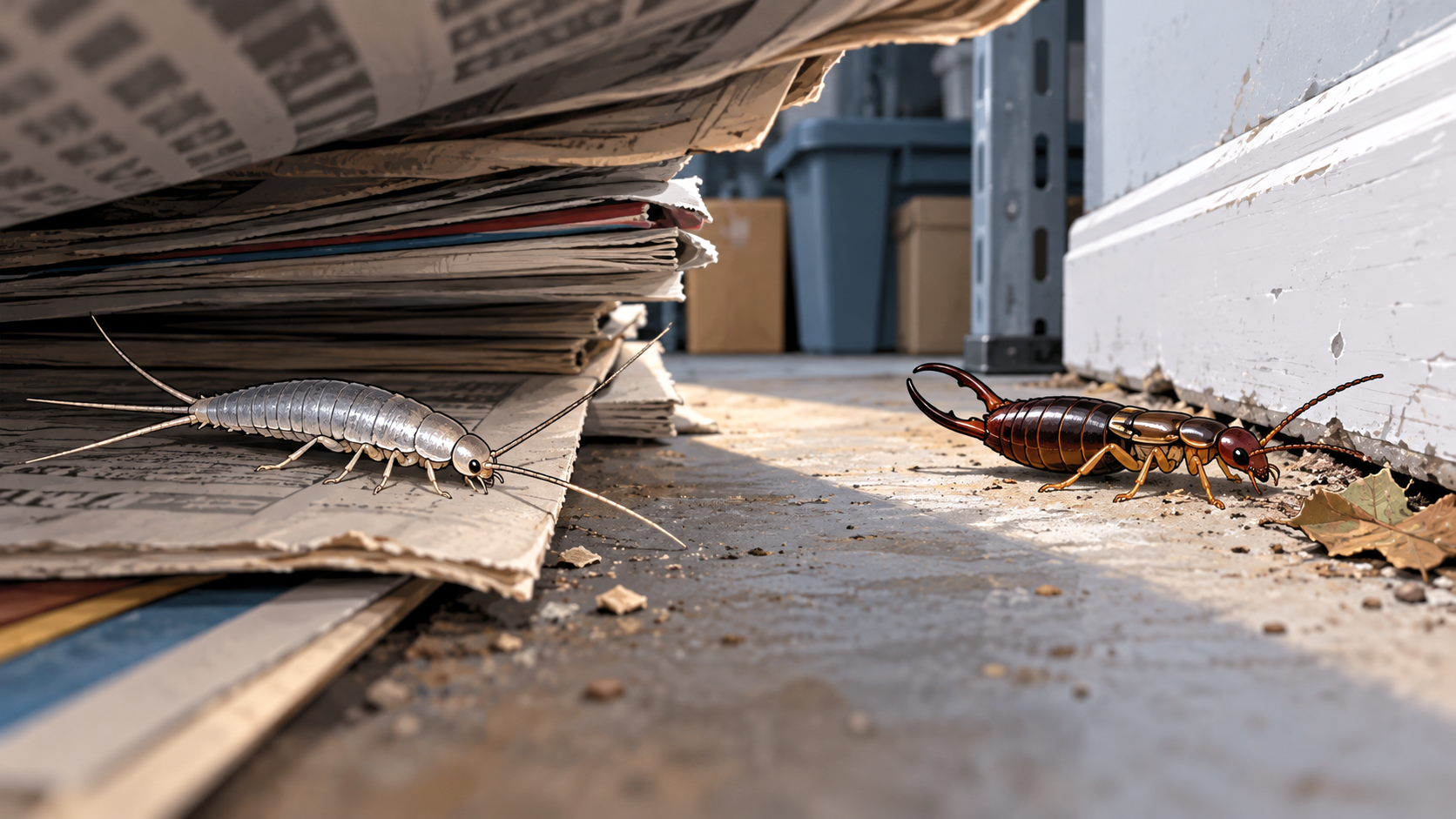
Earwigs and silverfish can both turn up in dark, damp parts of a home and disappear quickly when disturbed. Their bodies, however, are quite different. An earwig has two obvious forceps at the end of its abdomen, while a silverfish has a tapered, scale-covered body ending in three long tail-like filaments. Those rear appendages are the easiest way to tell them apart. You do not need to judge the insect by color or where you found it. Get a clear look at its back end first. In most cases, that settles an earwig vs. silverfish identification immediately.
Earwig vs. Silverfish: Look at the Tail End First
The back of the insect provides the strongest visual difference. An earwig has a pair of conspicuous forceps, also called cerci, projecting from the tip of its abdomen. The common European earwig (Forficula auricularia) has a somewhat flattened, reddish-brown body. Its rear forceps can be straight or strongly curved, depending partly on the sex of the adult.
A common silverfish (Lepisma saccharina) has no pincers. Instead, its abdomen narrows toward the rear and ends in three long filaments. Silverfish also have long antennae at the front. Together, the antennae and rear filaments give the insect a noticeably different outline from an earwig.
This is one comparison where we would put very little weight on a quick impression of color. Rear forceps mean earwig. Three slender tail filaments mean silverfish. For a closer look at the first insect, our guide to what earwigs look like covers its identifying features in more detail.
Earwigs and Silverfish Have Different Body Shapes
Once you move past the rear appendages, body shape provides another strong clue.
Earwigs are elongated insects, but their bodies remain relatively broad through much of the abdomen. The European earwig is somewhat flattened and about 5/8 to 3/4 inch long. Its head is clearly distinguishable, and the abdomen ends abruptly at the forceps.
Silverfish have the more distinctive silhouette. Their bodies are often described as carrot-shaped because they are broader near the front and gradually taper toward the rear. Adult silverfish are about 1/4 to 1/2 inch long, excluding the impression created by their long appendages.
Their surface is different too. Silverfish have silvery metallic scales covering the body. That scaly covering helps create the shiny gray or silver appearance behind their common name. Earwigs are not covered in the same silvery scales and commonly appear reddish brown.
Size can support an identification, but we would not use it alone. A small earwig or an immature specimen can make a size-only comparison unreliable. The forceps-versus-three-filaments distinction remains much stronger.
Silverfish Have Three Tail Filaments, Not Three Pincers
A moving silverfish can make its rear appendages surprisingly difficult to count. That sometimes causes people to interpret the filaments as pincers.
They are not pincers.
Silverfish belong to a group commonly called bristletails because of the three tail-like appendages projecting from the final abdominal segment. The appendages are narrow and flexible-looking rather than thick and claw-shaped. A silverfish has one central filament with another on either side.
Earwigs have only the prominent paired forceps. Those structures are much thicker and more substantial. Earwigs use their cerci for defense and for grabbing and holding prey. Adult males of the European earwig usually have more strongly curved forceps, while females generally have straighter ones.
That sex difference can occasionally make a female earwig less immediately recognizable than a male. Even so, she still has a pair of forceps rather than the silverfish’s three slender filaments. Our guide to male vs. female earwigs shows why the shape of the pincers can vary without changing the identification.
Silverfish Are Wingless, While Adult Earwigs Can Have Wings
The two insects also differ in their wings, although this feature is much less obvious than their tails.
Silverfish are wingless insects. Adults never develop wings. Their flattened bodies and rapid running movement are their means of getting around.
Adult European earwigs have wings, but they do not look like the long exposed wings you might expect. The visible forewings are short and leathery, while the larger hind wings remain folded beneath them. Earwigs seldom fly, so watching one run across a floor does not tell you that it lacks wings.
This distinction is useful when examining a clear photograph or specimen, but it should not be your first test. Immature earwigs have not developed adult wings, which removes that clue. The terminal appendages work much better across different life stages. Our guide to earwig wings and whether earwigs can fly goes deeper into their unusual wing arrangement.
Both Can Appear in Damp Parts of a House
Where you find the insect can actually be the reason these two pests get confused.
Silverfish favor cool, moist, dark areas such as basements, closets, bookcases, and storage spaces. They are also associated with bathrooms and laundry rooms. Because they hide during the day and move rapidly when disturbed, a homeowner may only get a brief nighttime look at one.
Earwigs are also active mainly at night and hide during the day in dark, confined, damp places. They normally occur outdoors but can enter homes and other buildings, sometimes in substantial numbers.
A damp basement, therefore, does not give you enough information to choose between them. Neither does finding a fast-moving insect in a bathroom.
This is a useful example of why location should come after anatomy when identifying household pests. Two unrelated insects can seek similar conditions without looking remotely alike once you stop and examine them. For repeated earwig sightings specifically, our guide to why earwigs get into houses covers the indoor side of their behavior.
Earwigs and Silverfish Can Cause Different Problems
Correct identification matters because these insects do not behave the same way around your belongings.
Silverfish feed on materials containing starch and can damage items such as paper, book bindings, wallpaper, and some stored foods. Severe infestations can leave irregular holes in starchy materials. Their presence around books or stored papers therefore deserves more attention than simply finding an occasional nuisance insect.
Indoor earwigs are different. They do not damage people, property, or food and are considered nuisance invaders inside buildings. Outdoors, however, earwigs can chew irregular holes in flowers and leaves, while also feeding on other insects and organic matter.
This is why treating every long, fast-moving bathroom insect as interchangeable can send you after the wrong problem. A silverfish around damaged books points toward a very different food source and hiding environment from an earwig that wandered inside from damp outdoor shelter.
Confirm Which Insect You Found Before Trying to Control It
For an insect that vanished before you got a close look, start with the features you actually remember. Pincers at the rear strongly favor an earwig. A silvery, tapered body with three long tail filaments strongly favors a silverfish.
When possible, take a clear photograph from above. A picture that captures the entire insect is far more useful than one focused only on its color. The antennae, body outline, and rear appendages can then be compared together.
Once you have confirmed an earwig, deal with the conditions allowing earwigs into the building rather than assuming you have a silverfish problem. Our guides to signs of an earwig infestation and how to get rid of earwigs cover those next steps.
When the insect does not match either description cleanly, broaden the comparison instead of forcing an identification. Several household arthropods can be mistaken for earwigs at a glance, and our guide to bugs that look like earwigs can help narrow down the alternatives.
Other Questions About Earwigs and Silverfish
Can earwigs and silverfish live in the same house?
Yes. Their preferred indoor conditions can overlap, particularly in dark and damp spaces. Finding both in one building does not mean they have the same food source or that one insect is attracting the other.
Can silverfish pinch you like an earwig?
Silverfish do not have the rear forceps that an earwig uses defensively. Their three tail-like appendages can look prominent, but they are not pincers.
Is a firebrat an earwig or a silverfish?
Neither. A firebrat (Thermobia domestica) is a separate species closely related to silverfish. It has the same general bristletail body plan, including three rear filaments, but its scales create a mottled brown or gray appearance rather than the characteristic silvery appearance of a common silverfish.
Why did the insect disappear so quickly when I turned on the light?
Both insects are active mainly at night and seek protected hiding places during the day. Their nighttime activity therefore cannot distinguish an earwig from a silverfish by itself. Use the insect’s physical features for the identification.
2 thoughts on “Earwig vs. Silverfish”