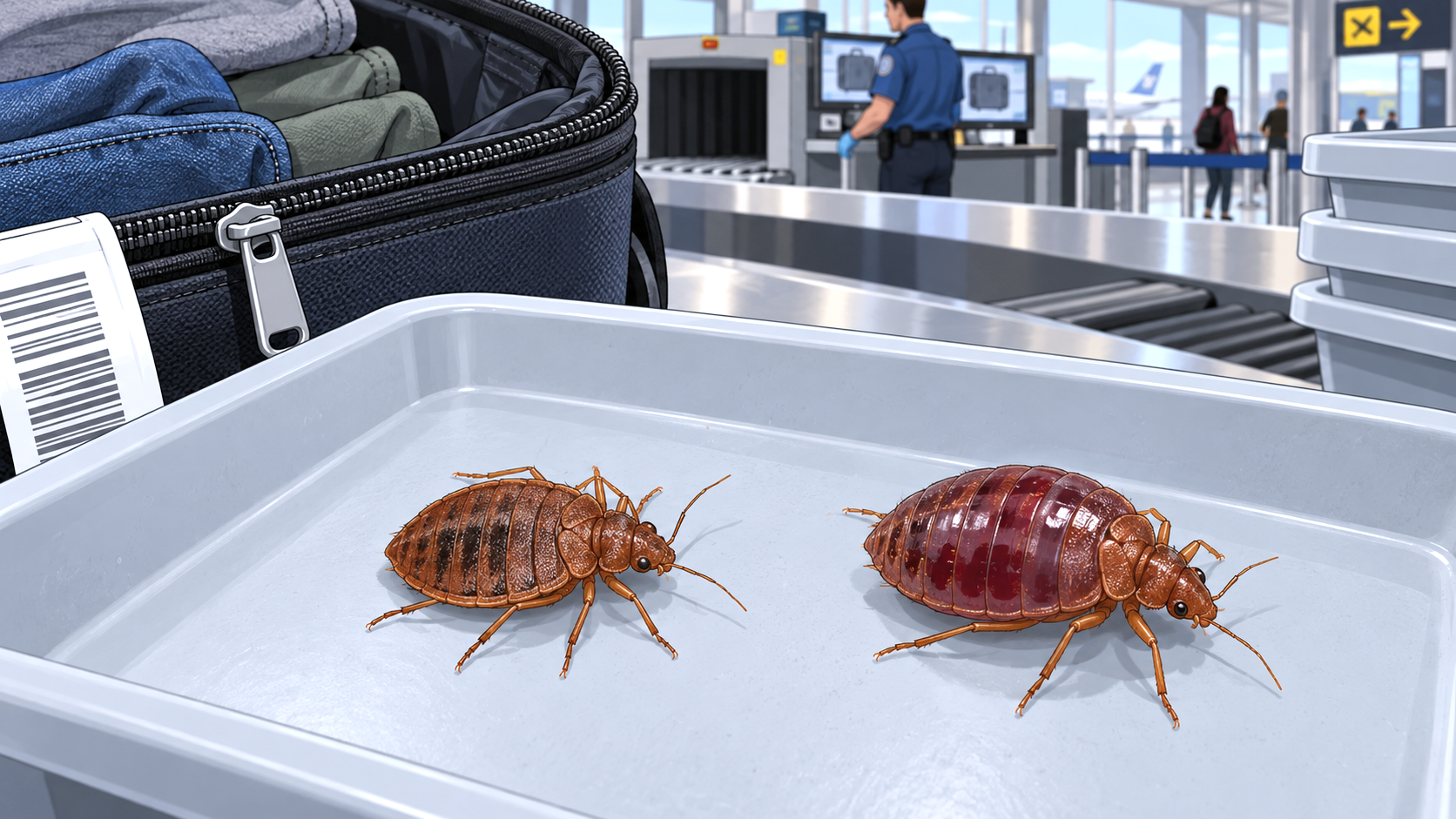
A bed bug can look surprisingly different after a blood meal. An unfed adult is broad, oval, brown, and extremely flat. Once it feeds, the abdomen expands, the body becomes longer and more rounded, and its color shifts toward reddish brown or dark red. The change can be dramatic enough that a recently fed bug barely resembles the flat specimen people expect from bed bug photos.
A bed bug after feeding is noticeably longer, rounder, and darker than an unfed one. Young nymphs can look especially red because their bodies are paler and more translucent. As the blood meal is digested, the abdomen gradually shrinks toward its unfed shape.
A Blood Meal Changes the Bed Bug’s Shape
The easiest difference to notice is the abdomen. An unfed adult Cimex lectularius has the familiar flattened, oval profile that helps it squeeze into narrow cracks and crevices. After taking a full blood meal, the abdomen becomes elongated and distended, giving the insect a much rounder appearance.
The change also affects how large the insect appears. That’s worth remembering when judging how big a bed bug is, because feeding status can substantially alter its dimensions. The expansion can be considerable. In a laboratory study examining abdominal distension, adult females increased to about 138% of their pre-feeding body length after taking a blood meal. The abdomen is built to accommodate that temporary increase in volume rather than remaining rigid as the insect feeds.
That gives you a useful identification clue. A recently fed bed bug does not simply look like a slightly larger version of an unfed one. Its proportions change too, with the abdomen becoming longer, fuller, and less obviously flattened.
Fresh Blood Changes Its Color Too
Feeding changes more than the outline of the body. The color changes at the same time.
Unfed adult bed bugs are generally brown to reddish brown. After feeding, the abdomen becomes darker and redder as it fills with blood. Young nymphs show the effect particularly well because their unfed bodies are much paler.
A newly fed nymph can appear strikingly red because blood is visible through its relatively translucent body. As nymphs mature through successive stages, their overall appearance becomes progressively closer to that of adults.
That means a bright red bed bug is not a separate species or unusual color form. Life stage and feeding status both affect what color bed bugs appear to be.
This also explains why bed bug photographs can seem inconsistent. A pale unfed nymph, a red recently fed nymph, a flat brown adult, and an engorged dark adult can look remarkably different even though they belong to the same species.
The Abdomen Shrinks Again During Digestion
The fully engorged appearance does not last until the bed bug’s next meal. After feeding, the insect leaves the host, returns to a protected hiding place, and begins digesting and excreting what it consumed.
Under favorable conditions, bed bugs commonly feed at intervals of several days, although the timing varies with life stage, temperature, host availability, and other conditions. An established infestation therefore contains bugs at different points in the feeding and digestion cycle rather than a population that all looks equally engorged.
The abdomen gradually contracts as digestion proceeds. Researchers have even used changes in female abdominal size to estimate the time elapsed since feeding, confirming that the shrinking abdomen follows the progression of digestion.
For ordinary identification, though, appearance is better treated as a broad clue than a clock. A very full, dark abdomen points toward recent feeding, while a flatter abdomen indicates that the insect is no longer freshly engorged. You cannot reliably look at one bed bug and assign an exact number of hours or days since its last meal.
Young Bed Bugs Show the Change Most Clearly
The post-feeding transformation is particularly noticeable in nymphs.
Bed bugs pass through five nymphal stages before becoming adults, and each nymph must obtain a blood meal before it can successfully molt to the next stage. The youngest nymphs are small and pale enough that a fresh meal can be plainly visible through the abdomen.
That can make baby bed bugs look dramatically different before and after feeding. An unfed first-stage nymph may be pale enough to be difficult to spot against a light surface, while the same insect after feeding can have a conspicuous red abdomen.
The contrast becomes less dramatic as the insect develops and its body darkens. Adults still become visibly fuller and darker after eating, but the blood meal does not stand out against their body in quite the same way it does in a pale young nymph.
Feeding Changes What the Bed Bug Does Next
Once a bed bug has finished feeding, it normally leaves the host rather than remaining attached. Bed bugs are temporary ectoparasites, and fed individuals return to protected harborages and aggregation sites where they can rest and digest the meal.
For adults, feeding is also tied closely to reproduction. Both males and females require blood, and mating commonly involves recently fed females. Research into bed bug reproductive behavior has found that males preferentially mate with recently fed females.
The enlarged abdomen itself can influence that behavior. Males use body size and other cues when approaching potential mates, and experiments have shown that recently fed fifth-stage nymphs can also attract mating attempts from males.
The differences between male and female bed bugs are easier to judge from mature adults than from feeding status alone, so an engorged abdomen should not be used as a shortcut for determining sex.
An Engorged Bed Bug Confirms That It Has Fed
Finding a clearly engorged bed bug gives you one useful piece of information: that insect has successfully obtained a blood meal recently enough for the physical effects to remain visible.
It does not tell you exactly where the meal occurred. Bed bugs crawl away from the host after feeding, so a swollen bug discovered in a bed-frame joint, baseboard gap, nightstand, or another hiding place may have fed somewhere nearby before retreating there.
Nor does one engorged bug tell you how large the infestation is. A single fed specimen confirms feeding by that individual, but determining whether you have a broader problem requires looking for additional evidence. A proper check for signs that you have bed bugs considers live insects alongside fecal spotting, eggs, shed skins, and other evidence.
Feeding status should therefore support identification rather than replace it. Bed bugs vary enough in size, color, and proportions that relying on one feature can be misleading. Looking at the insect as a whole is more dependable, especially because bed bugs look different across their life stages.
Other Questions About Bed Bugs After Feeding
Can a bed bug become almost twice as long after feeding?
A full blood meal can produce a substantial increase in length. Recently fed adults can approach twice the length of unfed adults, although the exact dimensions of an individual bug vary.
Can you see the blood inside a fed bed bug?
It is especially easy to see in young nymphs. Their pale, relatively translucent bodies allow a fresh blood meal to show through as a conspicuous red area in the abdomen. As the insect matures and darkens, that contrast becomes less pronounced.
Can you tell exactly when a bed bug last fed from its appearance?
No. Abdominal size changes as digestion progresses, but appearance alone does not provide a dependable hour-by-hour or day-by-day dating method for a bed bug found in a home.
Does every bed bug in an infestation feed at the same time?
No. Individuals can be at different stages of feeding, digestion, molting, and reproduction. An infestation can therefore contain flat unfed bugs, partially digested bugs, and visibly engorged individuals at the same time.
Does a fed bed bug stay on your body afterward?
No. After obtaining its meal, a bed bug normally leaves the host and returns to a hiding place. It does not live permanently on people in the way lice do.
4 thoughts on “Fed vs. Unfed Bed Bugs: What’s the Visual Difference?”