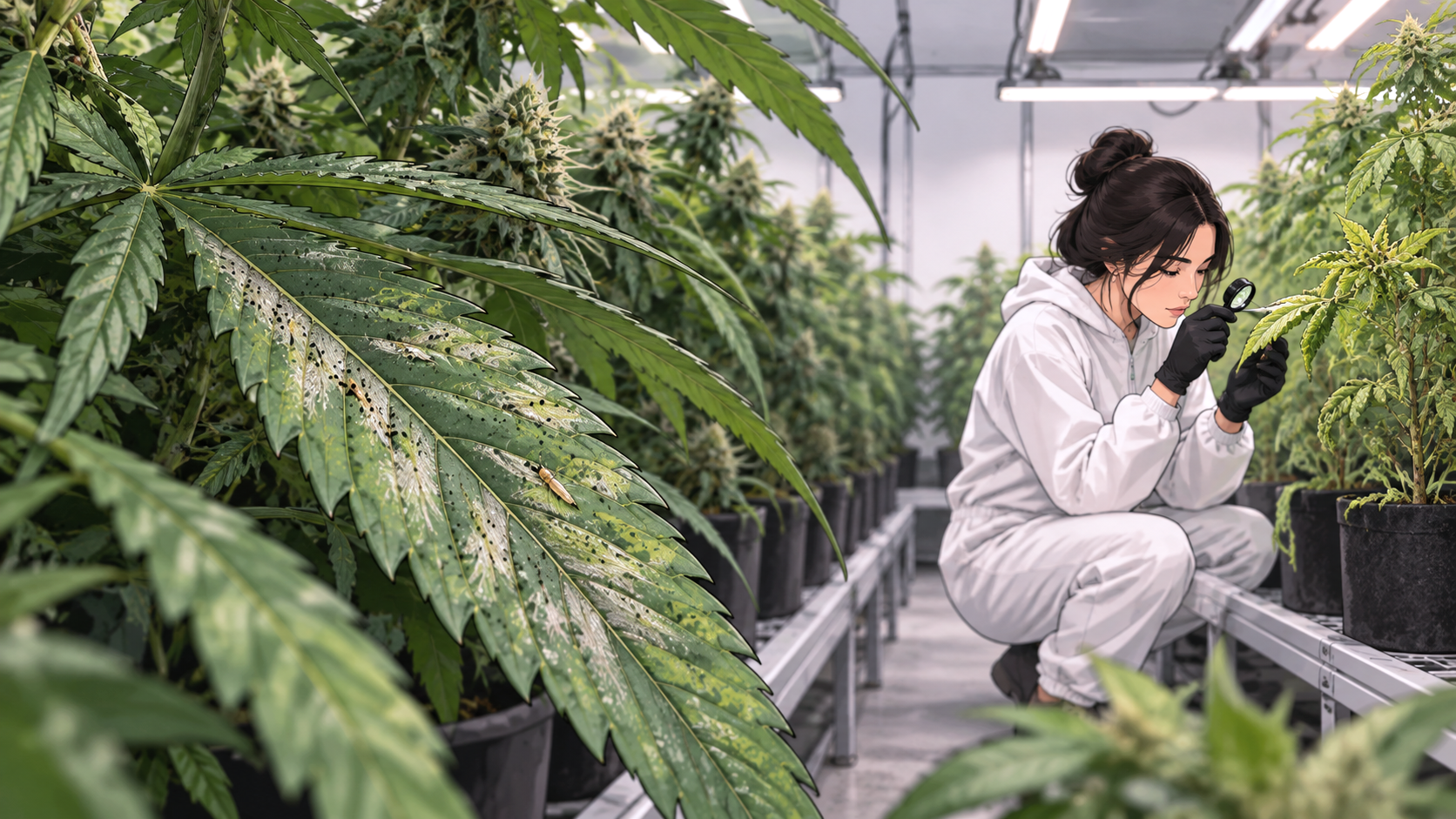
The first clue can be easy to miss. A cannabis leaf develops a few pale streaks that look almost like scratches, then nearby leaves begin showing silvery patches and tiny dark specks. Look closely and a narrow yellowish or brown insect may dart across the underside of a leaf before disappearing into the canopy. Thrips can establish themselves before the damage becomes obvious because their small size, rapid development, and tendency to feed in protected plant tissue make early populations difficult to detect.
Thrips on cannabis can cause pale stippling, white or silvery feeding scars, distorted young leaves, and tiny dark fecal spots around damaged areas. Adults are slender insects with narrow fringed wings, while immature thrips are smaller and wingless. Management works best when growers detect them early, remove sources of infestation, monitor the crop consistently, and use an integrated pest management program appropriate for cannabis rather than waiting for a large population to develop.
What Do Thrips Look Like on Cannabis?
Thrips are extremely small, narrow-bodied insects that can look like tiny moving splinters against a cannabis leaf. Western flower thrips, Frankliniella occidentalis, is one of the most important greenhouse thrips pests and is capable of feeding on a very broad range of plants. Adults are roughly 1/16 inch long and possess narrow wings edged with fine hairs. Immature thrips are wingless and often light yellow, making them particularly difficult to notice against pale plant tissue.
Color should not be your only identification feature. Thrips can appear yellowish, tan, brown, or darker depending on species, sex, and developmental stage. Their elongated body and characteristic adult wings are more informative than searching for one specific color. A 10X or 20X hand lens makes identification considerably easier and can prevent pieces of growing medium or plant debris from being mistaken for insects.
What Does Thrips Damage Look Like on Cannabis Leaves?
Thrips feeding commonly creates pale, white, or silvery marks across leaves. Instead of removing large sections of tissue like a chewing caterpillar, thrips damage plant cells and feed on their contents. When damaged cells fill with air, the affected areas develop the characteristic silvery appearance. Feeding on young developing tissue can have a different effect because injured cells cannot expand normally, leaving mature foliage distorted.
Early damage may consist of only a few scattered pale spots or short streaks. As feeding continues, those marks can become larger irregular patches. The general pattern resembles the silvery and scarred leaf damage caused by thrips on other plants, although cannabis leaves have their own structure and growth pattern. Inspect fresh damage closely rather than relying on old deteriorated leaves, because recently injured tissue provides a better opportunity to find the insects responsible.
Look for Silvery or Whitish Feeding Scars
Silvery scarring is one of the most recognizable clues. Affected portions of the leaf may look scraped, streaked, or bleached compared with the surrounding green tissue. Some marks remain small and separate, while continued feeding can create larger irregular areas. White streaking can be particularly noticeable on darker green leaves.
The pattern does not have to be identical on every plant. Damage depends partly on where the insects feed and whether the leaf was fully expanded at the time. Thrips feeding on mature tissue tends to leave visible surface scars, while feeding on young developing tissue can produce deformation as the leaf expands. Neither appearance alone proves that thrips are responsible, so the next step should always be a close inspection for insects and supporting evidence.
Tiny Dark Specks Can Appear Around the Damage
Fresh feeding areas can be accompanied by tiny dark fecal deposits. These may look like pinpricks of black or brown material scattered across or beside the silvery scars. On an indoor crop, it can be tempting to dismiss them as particles of growing medium or ordinary debris.
The combination of pale feeding scars, dark specks, and actual narrow-bodied insects is much more persuasive than any of these signs individually. Similar signs of a thrips infestation occur across many host plants. When several cannabis plants begin developing the same pattern, inspect the entire growing area rather than concentrating exclusively on the first affected plant.
New Cannabis Leaves Can Become Distorted
Thrips feeding on developing tissue can interfere with normal leaf expansion. New growth may emerge curled, misshapen, scarred, or uneven rather than opening normally. This can be particularly noticeable around active growing points where tender plant tissue provides attractive feeding sites.
Distortion is not specific to thrips. Broad mites, nutritional problems, environmental stress, chemical injury, and other issues can also deform new cannabis growth. Even in greenhouse crops generally, broad mite injury can be mistaken for western flower thrips damage to young tissue. Confirm the pest with magnification instead of choosing a treatment solely because a leaf looks twisted.
Thrips Damage Can Be Confused With Spider Mites
Spider mites and thrips can both leave cannabis foliage looking pale, stippled, or unhealthy, but the pests themselves are very different. Thrips are elongated insects, whereas spider mites are tiny oval arachnids. Spider mite infestations can also produce fine silk webbing as populations increase. Thrips do not make webs.
The feeding patterns can overlap enough that inspecting the pest is more dependable than comparing leaf photographs. Look beneath affected leaves with magnification and use a white-paper test to dislodge small arthropods. The physical differences between thrips and spider mites become much clearer once you can see the organisms rather than relying entirely on plant symptoms.
Check the Undersides of Cannabis Leaves
A quick look at the top of the canopy is not enough. Thrips can occupy protected plant surfaces and feed where they are difficult to notice. Turn suspicious leaves over and examine the undersides, veins, petioles, tender growth, and other sheltered areas. A hand lens makes pale immature thrips much easier to distinguish from ordinary plant material.
Move through the crop systematically. Check apparently healthy plants as well as those already showing scars because damage may lag behind the establishment of the insects. In a larger indoor or greenhouse crop, record where thrips are being found. Mapping hotspots can reveal whether the population is concentrated near an entry point, new plant material, or a particular part of the room.
Tap Leaves Over White Paper
A simple white-paper test can make hidden thrips much easier to find. Hold clean white paper beneath suspicious foliage and gently tap or shake the plant. Dislodged insects become visible against the contrasting background, where their narrow bodies and movement are easier to observe.
The same monitoring principle is used in greenhouse production, where flowers and plant tips can be shaken over paper to reveal thrips. Examine what falls with magnification because other tiny arthropods may be present as well. Finding several elongated adults or pale larvae near plants showing fresh scarring provides much stronger evidence of an established population.
Blue Sticky Cards Can Help Detect Adult Thrips
Sticky cards are useful for monitoring flying adults. Blue cards are particularly effective for detecting western flower thrips, while yellow cards attract a wider range of greenhouse pests, including whiteflies, winged aphids, fungus gnats, and shore flies. Place monitoring cards close enough to the crop canopy to intercept adults moving among plants.
Sticky cards should not be treated as a complete census of the infestation. They primarily capture adults. Eggs remain protected within plant tissue, and immature thrips are wingless. The fact that flight occurs in the adult stage means a crop can contain substantial immature activity without producing an equivalent number of trap catches. Use cards to track trends while continuing direct inspections of leaves and growing points.
Why Thrips Can Seem to Reappear After Treatment
The thrips life cycle helps explain why a population can seem to disappear and then return. Females of western flower thrips insert eggs into plant tissue, protecting them from many treatments directed at exposed insects. After hatching, the first two immature stages feed on the plant. Later developmental stages commonly occur in protected locations, including the growing medium, before adults emerge.
A treatment that reduces exposed larvae and adults may therefore leave other stages untouched. Greenhouse management guidance specifically notes that eggs and pupal stages can escape pesticide sprays, allowing newly emerged larvae and adults to replenish the visible population. Successful management requires continued monitoring rather than assuming that one clean inspection means the entire life cycle has been interrupted.
Thrips Can Spread Through an Indoor Grow
Adult thrips are weak active fliers, but they can move between plants and can also be carried by air currents. They may enter a growing area on new plants or cuttings, and infestations can spread from one part of a greenhouse or indoor crop to another.
This makes prevention especially valuable. Inspect incoming plant material before introducing it to an established crop, keep infested plants separated when practical, and monitor areas near entrances and ventilation points. Clothing and plant-handling activities can also contribute to movement through a production area. Treating one visibly damaged plant while ignoring the rest of the crop can allow a hidden population to continue developing elsewhere.
Remove Weeds and Plant Debris From the Growing Area
Sanitation removes alternative habitat and reduces places where pests can persist between crops. Weeds can serve as hosts for western flower thrips, and plant debris around benches and floors can complicate pest management. Keeping the production area clean is therefore part of prevention rather than simply a housekeeping preference.
Pay attention to the space surrounding the crop as well as the cannabis plants themselves. Remove discarded leaves, unwanted volunteer plants, and unnecessary plant material rather than allowing it to accumulate beneath benches or containers. Clean growing areas thoroughly between crop cycles when possible. A new crop introduced into a room already containing thrips starts at an immediate disadvantage.
Be Careful When Bringing New Plants or Cuttings Into the Grow
Plant material is one of the easiest ways to introduce thrips into a protected growing environment. A cutting can look healthy while carrying eggs inserted into its tissue or a few immature thrips concealed on its surfaces. Once introduced into favorable conditions, the population can expand before obvious leaf damage appears.
Inspect incoming material with magnification and keep it separate from established plants when feasible until repeated checks show no evidence of pests. Sticky cards around the quarantine area can provide additional monitoring. Prevention requires far less effort than trying to suppress thrips after they have dispersed throughout a dense indoor canopy.
Biological Control Works Best When Started Early
Predatory arthropods can play an important role in greenhouse thrips management, particularly when introduced before the pest population becomes large. Predatory mites such as Neoseiulus cucumeris and Amblyseius swirskii attack young thrips, while Orius predatory bugs can also feed on thrips. Soil-dwelling predators such as Stratiolaelaps scimitus can contribute against developmental stages occurring in the growing medium.
Timing is critical because some predatory mites concentrate on the smallest thrips larvae and cannot simply erase a severe outbreak after it has developed. Preventive or early introductions generally provide a better opportunity for biological control to keep pace with the pest. Growers using beneficial organisms should build the program around crop conditions, pest pressure, compatible inputs, and instructions from the biological-control supplier rather than treating individual predator species as interchangeable.
Predatory Mites Target Young Thrips
Neoseiulus cucumeris is widely used against western flower thrips because it feeds on young larvae. Amblyseius swirskii is another commercially used predatory mite and can perform particularly well under warmer conditions. Because these predators primarily target small thrips stages, introducing them after adults are already abundant may provide slower suppression than establishing predators earlier.
Biological control also changes how other products should be selected. A pesticide capable of killing thrips may also kill the beneficial organisms released to control them. Growers using predators should therefore check compatibility before applying insecticides, miticides, fungicides, or other crop-protection products. An IPM program works only when its individual components do not continually undermine one another.
Beneficial Nematodes Can Target Protected Stages
The entomopathogenic nematode Steinernema feltiae is another biological control organism used against western flower thrips, particularly for developmental stages associated with the growing medium. This approach addresses a different portion of the pest’s life cycle than predators hunting larvae on foliage.
That does not mean every cannabis grow with thrips should automatically receive a growing-medium treatment. Production system, substrate, environmental conditions, pest species, and the biological-control program all matter. Beneficial organisms are living control agents with specific requirements, so they should be used according to supplier instructions and within a planned IPM strategy.
Avoid Waiting Until Flowering to Start Thrips Control
Thrips become harder to manage once a crop has a large, established population. Dense plant growth also creates additional protected feeding sites and makes complete inspection more difficult. Greenhouse experience with western flower thrips consistently favors early detection and biological control before populations become high.
For cannabis, this has an additional practical benefit. Avoiding a major infestation before flowering reduces the need to consider interventions later when flowers are developing. Regular scouting during vegetative growth, inspection of incoming plants, sanitation, sticky-card monitoring, and early biological control can prevent a small problem from becoming a flower-stage emergency.
Thrips During Flowering Require Extra Care
Finding thrips after cannabis has entered flowering complicates management because the crop is producing material that may ultimately be consumed. Residues, microbial contaminants, product registrations, and local cannabis regulations all become relevant when deciding what can be applied. A product that is labeled for use on an ornamental greenhouse crop is not automatically permitted or appropriate for cannabis.
This is where generic internet pesticide lists become particularly risky. Cannabis pesticide rules differ among jurisdictions, and permitted products can change. Growers should use only pest-control products currently authorized for their crop, jurisdiction, production system, and growth stage, following all label and regulatory requirements. Where biological control and physical management can suppress the population without leaving unwanted residues on flowers, those approaches can be especially valuable.
Do Not Assume Neem Oil Is Automatically Safe for Cannabis
Neem-derived products are frequently mentioned in discussions of cannabis pests, but “natural” does not mean universally permitted or suitable. Whether a neem or azadirachtin product can legally be used on cannabis depends on the product registration and local rules. Application to developing flowers can also create quality and residue concerns even when a similar product is used on other crops.
The same caution applies to horticultural oils, insecticidal soaps, pyrethrins, spinosad, and other active ingredients used against thrips in various agricultural or ornamental crops. Their effectiveness against thrips does not establish permission for cannabis. Always separate the question “Can this ingredient affect thrips?” from the much more important question “Is this exact product permitted for this cannabis crop and application?”
Avoid Homemade Sprays on Cannabis Flowers
Household detergent, improvised oil mixtures, essential oils, alcohol mixtures, and other homemade sprays are sometimes recommended online for thrips. These mixtures lack the crop-specific directions and standardized concentrations supplied with registered pest-control products. They can injure plant tissue, leave unwanted residues, or interfere with beneficial organisms without reliably controlling the infestation.
This concern becomes greater as harvest approaches. Spraying an untested mixture onto resinous flowers intended for inhalation or consumption introduces unnecessary uncertainty. Prevention, sanitation, direct monitoring, biological control, and legally permitted crop-protection products provide a more defensible management framework than improvising a spray from household ingredients.
Insecticide Resistance Makes Thrips Harder to Control
Western flower thrips has developed resistance to numerous insecticides, which is one reason it remains such a difficult greenhouse pest. Resistance has been documented across multiple active ingredients, and even products that initially perform well can lose effectiveness when selection pressure becomes intense.
Repeatedly applying the same mode of action can accelerate this problem. When chemical intervention is legally available and necessary, resistance management should follow the current product label and locally applicable IPM guidance. Growers should also continue monitoring after treatment rather than assuming an application worked. Surviving populations can reveal declining efficacy before the problem becomes much larger.
Old Thrips Damage Will Not Disappear
Silvery scars remain after the insect that caused them is gone. A distorted leaf will not straighten simply because the population has been controlled, and damaged cells cannot return to their original condition. This makes old foliage a poor way to judge whether an IPM program is currently succeeding.
Watch the newest leaves instead. If fresh growth develops normally, new silver scars stop appearing, sticky-card catches decline, and repeated inspections reveal fewer larvae and adults, the infestation is moving in the right direction. Conversely, continuing fresh scars or newly discovered larvae show that active feeding is still occurring even if older leaves look unchanged.
How to Manage Thrips on Cannabis
Begin with confirmation. Inspect both surfaces of damaged leaves with magnification, tap suspicious foliage over white paper, and place sticky cards around the growing area to track adult activity. Remove weeds and unnecessary plant debris, inspect incoming plant material carefully, separate infested plants where practical, and identify hotspots throughout the crop. Do not wait until widespread silvering appears before responding because early populations are substantially easier to manage.
Build control around integrated pest management. Biological controls such as predatory mites, Orius bugs, and other appropriate beneficial organisms can suppress thrips when introduced under suitable conditions and early enough to establish. If a pesticide becomes necessary, use only a product currently permitted for cannabis in your jurisdiction and compatible with the crop stage and intended use. Continue monitoring throughout management because the protected stages within the thrips life cycle allow populations to persist after exposed insects have been reduced.
More Questions About Thrips on Cannabis
Can thrips kill a cannabis plant?
A small population usually causes localized feeding injury rather than immediate plant death. Heavy, persistent infestations can damage substantial amounts of foliage, distort developing growth, and reduce plant vigor, making early control much preferable to allowing the population to build.
Can thrips spread from one cannabis plant to another?
Yes. Adult thrips can fly between plants and can also move on air currents. Infested plant material introduced into an indoor or greenhouse crop can provide another route for spread.
Should you remove every cannabis leaf with thrips damage?
No. Old feeding scars remain after thrips have gone, and a partially scarred leaf can still contain substantial healthy tissue. Remove material when doing so contributes meaningfully to sanitation or eliminates heavily infested tissue rather than stripping the plant of every cosmetically damaged leaf.
Why are thrips still appearing after I killed the adults?
Eggs inserted into plant tissue and protected later developmental stages can survive measures directed primarily at exposed adults. New larvae and adults may therefore appear after the visible population initially declines. Continued scouting is necessary to determine whether the life cycle has actually been interrupted.
Are blue or yellow sticky traps better for cannabis thrips?
Blue sticky cards are particularly effective for detecting western flower thrips, while yellow cards attract thrips along with a broader range of flying greenhouse pests. Either can contribute to monitoring, but sticky cards should be combined with direct plant inspections because they primarily sample flying adults.