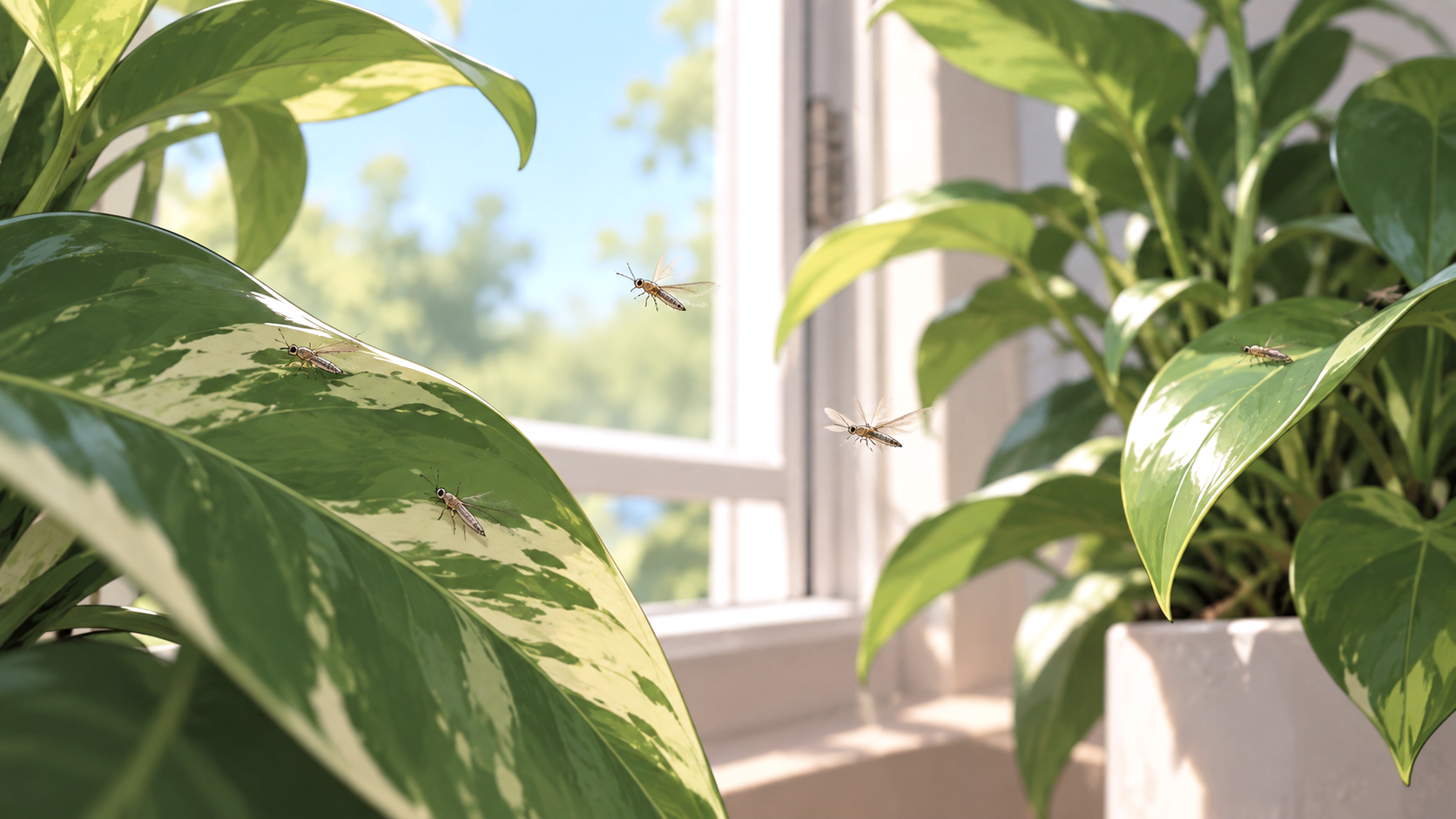
Yes, adult thrips can fly, although many pest thrips are not strong, sustained fliers. Their tiny bodies have two pairs of extremely narrow wings fringed with long hairs, giving the wings a featherlike appearance under magnification. Thrips can use those wings to move between nearby leaves, flowers, and plants, while air currents can carry them considerably farther. Immature thrips cannot fly because they do not yet have functional adult wings.
That distinction matters when thrips suddenly appear on a plant. An adult does not necessarily have to crawl from one neighboring plant to another. It may fly a short distance itself or become airborne and travel with moving air. Thrips can also spread on infested plants and other transported material, so flight is only one way they reach new locations.
What Do Thrips Wings Look Like?
Adult thrips have some of the most distinctive wings among tiny insects. Instead of broad wings like those of a housefly, most adult thrips have two pairs of long, extremely narrow wings. The edges carry rows of microscopic hairs that create the characteristic fringed appearance associated with the insect order Thysanoptera. When the insect is resting, the wings are generally folded along the back over the abdomen.
Those fringes become particularly noticeable under magnification. The narrow wings of adult thrips have long hairs along their margins, while immature thrips lack wings entirely. In flight, the adult wings can look almost featherlike because so much of their effective surface consists of the fringe rather than a broad solid membrane. These structures are one of the most useful features for confirming that a tiny elongated insect is an adult thrips. Our broader explanation of what thrips look like covers the rest of the body in more detail.
Are Thrips Strong Fliers?
Many pest thrips are not strong fliers in the conventional sense. They can actively fly, but their minute size also makes them highly influenced by surrounding air movement. For western flower thrips and onion thrips, for example, adults are the only flying life stage and are not strong fliers. That does not prevent them from moving effectively through an environment because wind can do much of the long-distance transportation.
It is therefore useful to separate flight ability from dispersal ability. An insect does not need to power itself continuously through the air for a long distance to spread successfully. A thrips can take off from vegetation, become caught in an air current, and arrive somewhere much farther away than its own active flight would suggest. Its tiny size and fringed wings make air movement particularly important to how thrips populations spread.
How Far Can Thrips Fly?
There is no single distance that describes how far every thrips can fly. Species, weather, wind, landscape, and the difference between active flight and wind-assisted movement all affect dispersal. A thrips moving under its own power between nearby plants is different from one being transported by an air current, so attaching one universal flight distance to the entire group would be misleading.
What is well established is that thrips can move much farther than their tiny size might suggest when air currents assist them. Thrips can travel long distances by floating with the wind, and they can also spread when infested plants are transported. Consequently, finding thrips does not prove that the source must be a plant immediately beside the affected one. The insects may have originated elsewhere in the surrounding environment.
Do Thrips Actually Use Their Wings to Fly?
Yes. Adult thrips do not merely possess decorative or nonfunctional wings. Winged adults can actively take off and fly. The unusual design of their wings works at the extremely small scale of the insect, where the aerodynamics of flight differ from what we see in much larger insects. The long marginal hairs increase the functional area of wings that would otherwise be extraordinarily narrow.
The wings can be difficult to appreciate when the insect is stationary because they are folded over the abdomen. A thrips may therefore look like a simple narrow line until it begins moving or is examined with magnification. The four adult wings folded over the abdomen appear featherlike during flight because of their microscopic fringes. That unusual wing structure is one of the defining visual characteristics of adult thrips.
Can Baby Thrips Fly?
No. The actively feeding immature stages are wingless. After an egg hatches, the thrips passes through two feeding larval or nymphal stages before reaching the nonfeeding prepupal and pupal stages. Functional adult wings are not present during those feeding immature stages, so a young thrips moving across a leaf is walking rather than flying away.
Wing development becomes increasingly apparent during the later immature stages. Prepupae and pupae develop wing pads as they approach adulthood, but those structures are not the functional fringed wings of a mature thrips. The distinction between wingless larvae, developing wing pads, and winged adults is covered more closely in our article on what thrips larvae and nymphs look like. The complete progression from egg to winged adult is explained in the thrips life cycle.
Can All Adult Thrips Fly?
Flight should not be treated as identical across every thrips species or every individual. Most of the familiar adult thrips encountered as plant pests have the characteristic fringed wings, but flight behavior varies. Some species fly readily, while others are relatively sluggish and may fly infrequently. Greenhouse thrips provide a useful example because adults have wings but are known for being sluggish and seldom flying.
Sex can make another difference in some thrips. Certain species can have wing differences between males and females, and thrips as a group include forms with reduced wings as well as fully winged forms. Therefore, “adult thrips can fly” is a useful general answer for the common winged pest species, but it should not be turned into a claim that every adult individual of every thrips species flies equally well. The diversity covered in the different species of thrips extends to behavior as well as appearance.
Can Thrips Travel on the Wind?
Yes. Wind-assisted movement is an important part of thrips dispersal. Their tiny size means moving air can pick them up and transport them beyond the distance they would cover through active flight alone. The microscopic hairs along their wing margins also allow adult thrips to be carried readily on air currents.
This helps explain why thrips can appear even when plants are not touching. A population developing on vegetation elsewhere can produce adults that disperse through the surrounding area. Wind direction and local vegetation can influence where those insects end up, while movement of infested plants provides another route. Therefore, isolating plants so their leaves do not touch can reduce opportunities for direct movement, but physical separation does not create a barrier that flying or windborne adults cannot cross.
Can Thrips Fly From Plant to Plant?
Yes. Adult thrips can move between plants, and that ability is important to their biology. Flowers, young leaves, buds, and other suitable feeding or reproductive sites can attract dispersing adults. Once a thrips reaches a suitable host, it can feed and, if conditions allow, contribute to another generation.
Plant-to-plant movement is particularly important for thrips species capable of transmitting plant viruses. In western flower thrips and certain other vector species, immature thrips can acquire Tomato spotted wilt virus while feeding on infected plants, while adults are responsible for much of the subsequent plant-to-plant transmission. The relationship between thrips development, adult movement, and virus transmission is one reason winged adults can have consequences beyond the feeding injury caused directly by the insects.
Can Thrips Fly Around Your House?
Adult thrips can fly indoors, although their flight may be easy to miss because the insects are so small. On an infested houseplant, adults can move from one plant to another rather than remaining permanently on the plant where you first noticed them. The University of Minnesota Extension notes that adult thrips on indoor plants can fly, while the immature stages remain wingless.
You may still see considerably more running than obvious flying. Thrips are tiny, and a short flight can be difficult for the eye to follow. An adult that disappears after a plant is disturbed may have flown, fallen, or moved quickly into another protected location. Rather than relying on seeing them in the air, inspect flowers, leaf undersides, buds, and other protected plant areas for the insects themselves and for signs of a thrips infestation.
Can Thrips Fly Through an Open Window?
They can enter through openings, including open windows, particularly when adults are dispersing outdoors. Their tiny size means a window does not need to provide a large opening for an individual insect to get inside. Air currents can also contribute to their movement, so an adult reaching an indoor plant does not necessarily indicate that it originated elsewhere inside the home.
However, an open window is only one possible route. Thrips can arrive on newly purchased or moved plants, cut flowers, and other infested plant material. They can also be transported on clothing. Because there are multiple ways for thrips to reach a home, finding them near a window does not prove that the window was their point of entry.
Do Thrips Jump or Fly When Disturbed?
Adult thrips can take flight when disturbed, while both adults and immature stages can move rapidly across plant surfaces. Their tiny size can make these movements difficult to distinguish with the naked eye. An insect that seems to vanish suddenly may have flown, dropped from the plant, or moved into a nearby crevice.
That behavior should not be used by itself to identify an unknown insect. Other tiny arthropods move in very different ways, and some are much more conspicuous jumpers. If the insect repeatedly appears to spring substantial distances without showing the narrow adult wings associated with thrips, it is worth considering bugs that look like thrips rather than deciding from movement alone.
Why Do Thrips Have Fringed Wings?
Thrips wings are unusual because a broad, solid wing surface would behave differently at such a small scale. Instead, their narrow wings carry long hairs around the margins. These fringes contribute to the aerodynamic function of the wings while keeping the structure extremely lightweight. Under magnification, the result resembles a narrow shaft bordered by fine hairs rather than the broad transparent wing familiar from many flies or wasps.
This structure also explains the name Thysanoptera, the insect order to which thrips belong. The name refers to their fringed wings, making this feature fundamental to how the group is recognized. However, you will not see those fringes on the wingless immature stages. If the insect on your plant has the right narrow body but no visible wings, its developmental stage needs to be considered before you decide it cannot be a thrips.
Does Flying Help Thrips Spread to New Plants?
Yes, but active flight is only part of the process. Thrips can fly between suitable nearby plants, become transported farther on wind currents, and travel with infested plant material. Together, those routes allow a population to spread beyond the individual plant on which it first developed.
That mobility is worth considering when several plants are grouped together. If thrips are confirmed on one plant, inspect nearby susceptible plants rather than assuming the insects have remained confined to their original host. Pay particular attention to flowers, tender growth, buds, and leaf undersides. Finding a few flying adults nearby does not by itself tell you how extensive the problem is, but checking neighboring plants can reveal whether feeding larvae and other stages have become established elsewhere.
What to Do If You See Thrips Flying Around Your Plants
First confirm that the insects are actually thrips. Adult thrips should have a narrow, elongated body and, under adequate magnification, the characteristic fringed wings. Check the affected plant for adults and wingless immature stages as well as feeding symptoms. A white sheet of paper held beneath flowers or foliage can make dislodged insects easier to see, while a hand lens can reveal details that are almost invisible at normal viewing distance.
If thrips are established rather than represented by a single stray adult, inspect nearby plants and determine where the population is concentrated before choosing a control method. Removing heavily infested plant material, managing weeds or other host plants where appropriate, and using targeted controls can all form part of an integrated approach. Our dedicated article on how to get rid of thrips covers those control decisions in depth rather than turning this flight article into a treatment guide.
More Questions About Thrips Flight
Do thrips fly at night?
Thrips flight activity varies with species and environmental conditions. The ability to fly is an adult characteristic, but simply seeing a thrips at night does not establish whether it arrived through active flight or another form of movement.
Can thrips fly after getting wet?
Water can interfere temporarily with the movement of such tiny insects, but getting wet does not permanently remove an adult thrips’ wings. Once conditions permit, a surviving winged adult can move again.
Can thrips fly from an outdoor plant to an indoor plant?
Yes, if there is an accessible route. Adult thrips can disperse between plants and can enter buildings through openings, while infested plants and cut plant material provide additional ways for them to reach indoor plants.
Can a thrips without wings still move to another plant?
Yes. Wingless immature thrips can walk across plant surfaces and potentially reach nearby touching vegetation, although they cannot fly like winged adults. Plants in direct contact therefore provide opportunities for movement even before adulthood.