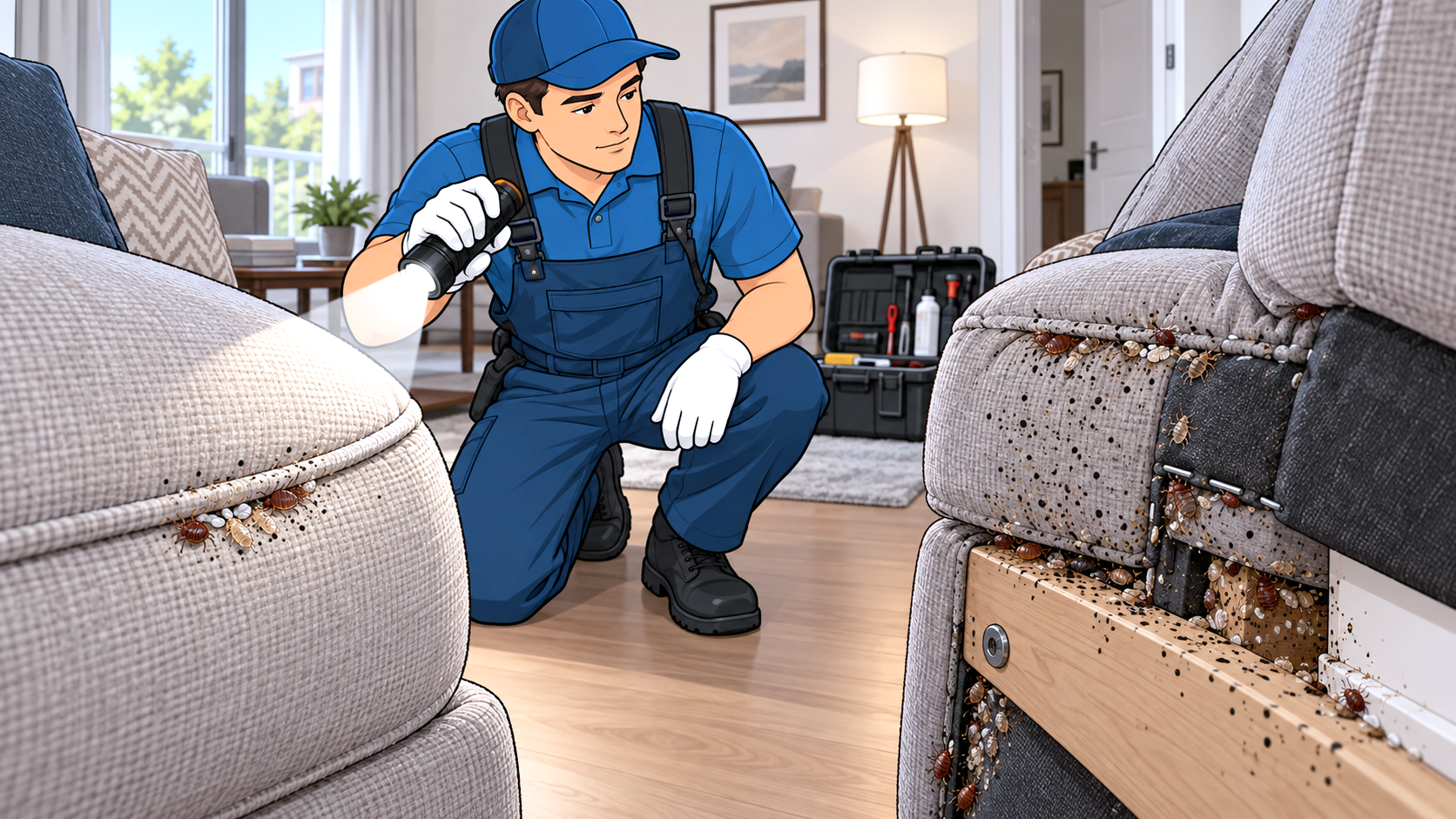
A few bed bugs concentrated around one bed and an infestation spreading through several rooms aren’t the same control problem. Yet there isn’t one universally adopted numerical definition that separates a “mild” bed bug infestation from a “severe” one. Researchers have measured severity using several approaches, including trap counts, visual counts, and how far an infestation has spread through a dwelling or building.
One particularly useful spatial framework was published in Scientific Reports in 2023. It classifies infestations from Level 0 to Level 6 according to where bed bugs have been found.
A mild or early bed bug infestation is generally localized around the sleeping area, while a severe infestation involves substantially wider distribution, such as additional rooms, neighboring units, or much of a building. Bug counts can provide useful information too, but bites alone aren’t a reliable measure of infestation severity because people’s skin reactions vary considerably. The farther confirmed bed bug activity extends from the original sleeping area, the more complicated inspection, containment, and treatment usually become.
One Research Scale Defines Exactly How Far an Infestation Has Spread
Researchers studying a homeless shelter in southern France developed a seven-level bed bug infestation scale ranging from Level 0 through Level 6. Their goal was to create a shared vocabulary for people dealing with infestations and to help trigger an appropriate control response.
Level 0 means an inspection confirmed no bed bugs. At Level 1, bed bugs are found in the bed and within one metre, about 3.3 feet, of it. The researchers called this the beginning of an infestation.
Level 2 extends beyond that immediate bed zone. Bed bugs are present elsewhere in the room, including surrounding furniture or walls, and satellite harborages may have developed. Level 3 means bugs have been detected in other rooms within the same dwelling, such as another bedroom or the living room.
The scale then moves beyond a single dwelling. Level 4 means bed bugs have been detected in adjoining apartments, or adjoining bedrooms in a hotel. Level 5 represents a critical infestation involving all or almost all apartments or rooms in the building. Level 6 means bed bugs have been localized at the neighborhood level, at which point the researchers say involvement from public authorities is necessary.
The authors classify Levels 0 through 4 as occurring within a “private area” and Levels 5 and 6 as involving “public areas” and representing a public-health issue.
It’s a useful framework, but we wouldn’t treat those numbers as a universal industry standard. They were developed for this particular study and provide one research-based way to describe spatial spread.
Mild Infestations Stay Concentrated Around the Sleeping Area
Using that spatial framework, the clearest example of an early infestation is Level 1: confirmed bed bugs in the bed and within approximately one metre of it.
That distribution fits what is already known about bed bug behavior. Bed bugs generally establish harborages close to places where a host remains still long enough for them to feed, which is why mattresses, box springs, bed frames, headboards, and nearby furniture receive so much attention during an inspection.
An early infestation can therefore involve live bugs, eggs, shed skins, and fecal spotting while still being geographically concentrated around one sleeping area. “Mild” shouldn’t be confused with harmless or something worth watching for a few weeks. A localized infestation is already an active infestation, and treating it before additional harborages become established gives you a smaller area to inspect and manage.
Our guide to the early signs of bed bugs covers what you may find during this stage.
A Developing Infestation Starts Appearing Elsewhere in the Room
The French research scale becomes particularly useful at Level 2 because it distinguishes a bed-centered infestation from one that has established additional hiding places throughout the room.
At this stage, bed bugs may be found in surrounding furniture, walls, or other locations away from the immediate bed area. The study specifically describes the possibility of satellite colonies, including at wall and ceiling junctions.
That wider distribution matters during treatment. Inspecting and treating the mattress and bed frame alone is no longer enough when confirmed activity is occurring elsewhere in the room.
It also illustrates why simply counting the bugs visible on a mattress can underestimate the problem. Ten visible bugs concentrated around one bed represent a different spatial problem from bugs detected in the bed, dresser, upholstered chair, baseboards, and wall cracks, even if you happen to count the same number during an inspection.
A Severe Infestation Can Extend Into Other Rooms or Units
Level 3 in the 2023 framework is described as a heavy infestation. Bed bugs have moved beyond the original room and are detected elsewhere within the same dwelling, such as another bedroom or living room.
Level 4 goes farther, with bed bugs detected in adjoining apartments or, in a hotel, other bedrooms in contact with the original case. The researchers classify this as a very important infestation.
For someone trying to distinguish a mild infestation from a severe one, this is the most useful dividing line in the scale. An infestation localized around one bed is fundamentally different from confirmed activity across multiple rooms or separate housing units.
Multi-unit housing adds another complication because the problem may no longer be controllable from one apartment alone. Bed bugs can spread between apartments in the same building, so inspection and treatment may need to account for neighboring units rather than repeatedly treating one apartment in isolation.
Building-Wide and Neighborhood Infestations Are the Extreme End of the Scale
Levels 5 and 6 describe situations well beyond what most homeowners mean when they say they have a severe infestation.
Level 5 means bed bugs are present in all or almost all apartments in a building, or almost all bedrooms in a hotel. The study labels this a critical infestation.
Level 6 reaches the neighborhood level. At that point, the researchers classify the problem as requiring involvement from public authorities.
These upper levels make more sense for shelters, hotels, apartment buildings, and other settings where many sleeping spaces or households are physically connected than for a detached single-family home.
They also shouldn’t be confused with evidence that bed bugs naturally progress from one home until an entire neighborhood becomes infested. Movement between dwellings can happen through several routes, including dispersal within connected buildings and hitchhiking on people’s belongings. Neighborhood prevalence is a population-level problem, not simply an oversized version of one household infestation.
Bug Counts Can Measure Severity Too
Spatial spread is useful, but it isn’t the only legitimate way researchers classify infestation severity.
A separate 2023 study examining histamine in bed-bug-infested homes used visual observations together with one week of trap catches to divide infested apartments into low, medium, and high categories. A low infestation had bed bugs observed but none trapped during the study. Medium infestations had observed bugs and fewer than 10 trapped, while high infestations had observed bugs and more than 10 trapped.
That doesn’t create a universal household rule that 11 trapped bed bugs automatically equals a severe infestation. It was the classification system used for that particular research project.
Together, these studies show why we wouldn’t define severity using one number alone. Population size and spatial distribution answer different questions. Trap counts can provide information about relative activity, while distribution tells you how extensively the infestation has established itself throughout the environment.
Bite Numbers Are a Poor Way to Judge Infestation Severity
The number of marks on someone’s skin is much less useful.
People react very differently to bed bug bites. Some develop obvious itchy lesions, while others show little or no visible reaction. The CDC notes that bite marks can take days to appear in some people and that some individuals don’t develop signs of bites at all.
One person waking with numerous obvious marks therefore doesn’t necessarily have a larger infestation than someone who sees almost nothing on their skin.
Bite frequency is also affected by who is being bitten, where the person sleeps, individual sensitivity, and whether the marks were actually caused by bed bugs in the first place.
Use confirmed environmental evidence instead. Live bed bugs, eggs, shed skins, fecal spotting, monitor captures, and the locations where those signs occur provide a much stronger basis for judging the extent of an infestation than skin reactions.
The Wider the Spread, the More Important a Complete Inspection Becomes
If you’ve confirmed a bed bug around the bed, inspect the entire immediate sleeping area rather than assuming that one sighting represents the full extent of the problem.
Our room-by-room bed bug inspection is particularly useful when you’re trying to establish whether activity remains concentrated around one bed or has reached other areas. Finding bugs in another bedroom, living-room furniture, or elsewhere changes the scope of the treatment problem.
The same principle applies in apartments. Once there is evidence involving neighboring units, coordinated management becomes increasingly important because treating one unit without addressing connected infestations creates an opportunity for continued movement and reintroduction.
If you’re deciding whether the infestation is still realistic to handle yourself, the comparison between DIY and professional bed bug treatment covers that decision separately. Confirmed spread across rooms or units is also a strong reason to consider calling an exterminator for bed bugs rather than repeatedly treating isolated visible areas.
Questions About Mild and Severe Bed Bug Infestations
Can a mild bed bug infestation become severe quickly?
An established population can grow and spread if it isn’t controlled, but there isn’t a universal timetable for moving from “mild” to “severe.” Temperature, access to hosts, the number and reproductive status of bugs present, and opportunities for dispersal all affect progression. We’ve covered the timing more closely in how long it takes a bed bug infestation to take hold.
Does finding bed bug eggs mean the infestation is severe?
Not by itself. Eggs confirm reproduction, but their presence doesn’t tell you how far the infestation has spread. Bed bugs commonly attach individual eggs inside protected harborages near hosts, as explained in where bed bugs lay their eggs. Severity requires more context than finding eggs in one location.
Does having lots of bites mean you have a severe infestation?
Not reliably. Bite reactions vary substantially between people, and some people show no obvious reaction. Physical evidence and the distribution of confirmed bed bug activity are more informative than the number or intensity of skin marks.
Is one bed bug automatically a mild infestation?
No. One detected bug tells you that at least one bed bug is present, not that you’ve counted the entire population or established its distribution. A thorough inspection is needed before describing the infestation as localized.
When does a bed bug problem become a building-wide issue?
The 2023 spatial scale classifies an infestation involving all or almost all apartments or hotel rooms as Level 5. In real multi-unit housing, coordinated action can become necessary earlier than that if bed bugs are confirmed in adjoining units, because treating connected infestations independently can make control more difficult.
7 thoughts on “Mild vs. Severe Bed Bug Infestation: How to Tell the Difference”