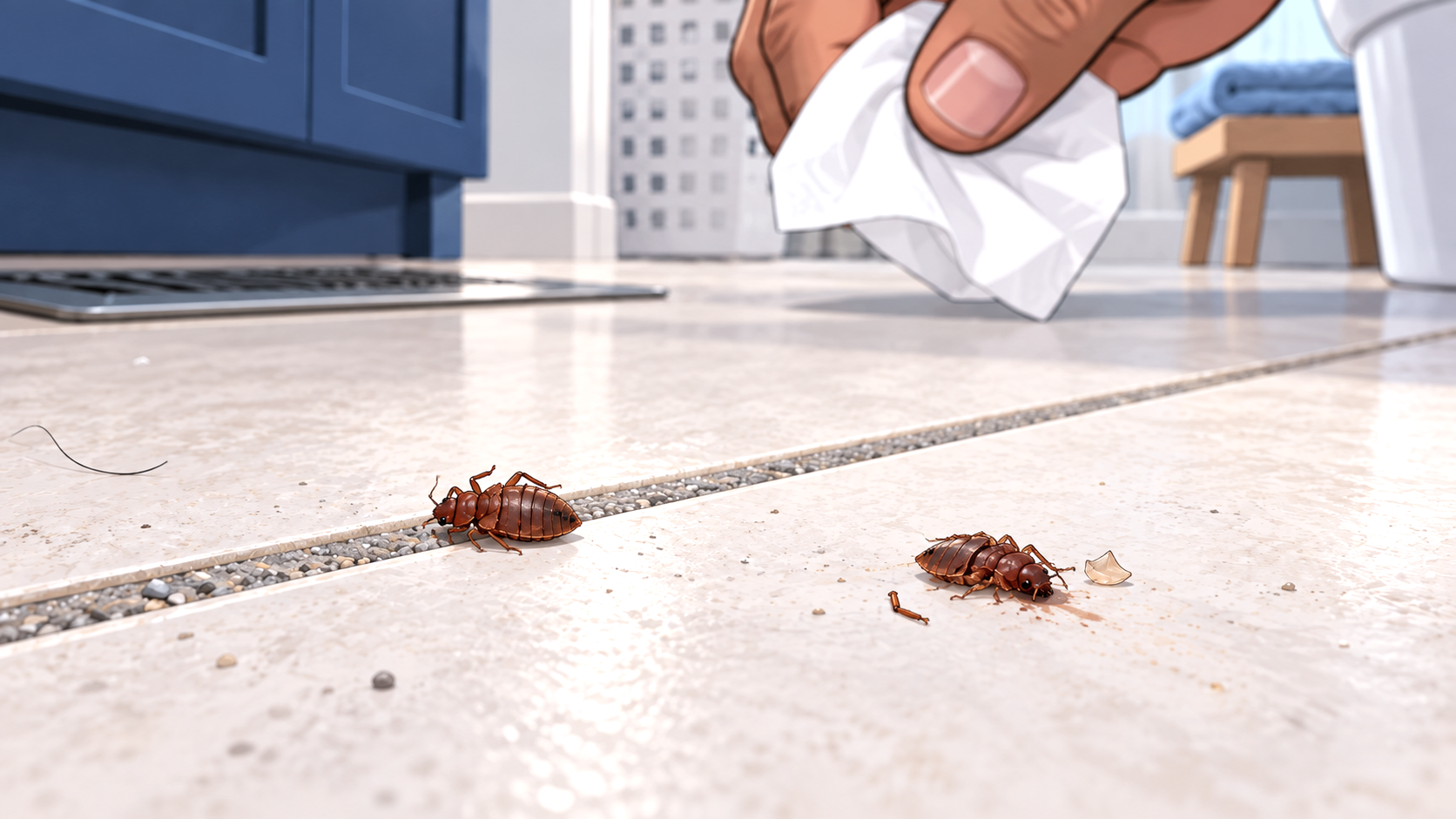
A dead bed bug can be harder to recognize than a living one. Legs may curl underneath the body, the abdomen can dry out, and a squished specimen may no longer have the neat oval outline shown in identification photos. Crushing a recently fed bug can make things even messier because blood may stain the surrounding fabric.
A dead bed bug usually still has the recognizable features of a bed bug: a small, flattened, oval body, six legs, antennae, and brown to reddish-brown coloring. A squished bed bug may look flattened, distorted, or broken apart. If it fed recently, crushing it can also leave a rusty or reddish blood stain.
The important part is not expecting every dead bed bug to look the same. What remains depends heavily on whether the insect was crushed, dried out, damaged, or recently fed.
An Intact Dead Bed Bug Can Still Look Surprisingly Normal
Death does not immediately erase the features used to identify a bed bug. An intact adult may still look much like the familiar live insect, except that it does not move and its legs may sit in an unnatural position.
Adult common bed bugs (Cimex lectularius) are generally about 5 to 7 mm long. An unfed adult is brown with a flat, oval body, while a recently fed adult becomes more elongated and reddish-brown. They are wingless and have six legs and antennae.
Those are the features we would concentrate on when examining a dead specimen. Color alone is much weaker evidence. Brown debris is everywhere in a bedroom, and a tiny dark object can resemble an insect until you look closely. An identifiable body outline, legs, antennae, and abdominal segmentation carry far more weight.
Size also provides useful context. Adult bed bugs are visible without magnification, although the immature stages are considerably smaller. Our guide to the actual size of bed bugs shows how much that scale changes as they develop.
A dead nymph can consequently be much less obvious than a dead adult. Young bed bug nymphs are smaller and lighter in color, particularly when they have not recently fed. A tiny pale specimen should therefore not be rejected simply because it does not resemble a dark brown adult.
Squishing Changes the Shape More Than the Identity
A crushed bed bug is where identification becomes less tidy. Pressure can flatten the abdomen further, push body contents outward, detach legs, or break the insect into pieces. Instead of an apple-seed-like outline, you may be looking at a flattened brown fragment surrounded by smaller pieces.
Still, some identifying structures can survive. Look closely for six legs, antennae, the head and thorax, or recognizable portions of the segmented abdomen. The more of those structures that remain together, the stronger the identification becomes.
This is also why we would not deliberately crush an unknown insect before identifying it. Bed bugs have numerous look-alikes, and destroying the specimen removes information that could have settled the question. The general bed bug identification process is much easier with an intact insect.
When possible, capture a suspicious specimen instead. Pest-identification guidance recommends collecting a sample for identification, particularly before beginning control. That small step can prevent an expensive response to the wrong insect.
A Recently Fed Bed Bug Can Leave the Messiest Remains
The appearance of a squished bed bug changes considerably depending on when it last fed.
Before feeding, an adult bed bug is relatively flat and brown. After taking a blood meal, its abdomen expands, the body becomes more elongated, and its color shifts toward reddish-brown. You can see that difference more closely in our guide to what a bed bug looks like after feeding.
If that recently fed insect gets crushed, blood can end up on the surrounding surface. Rusty or reddish stains on sheets and mattresses are recognized signs that can result from bed bugs being crushed.
However, a blood spot is not a preserved bed bug. Without an insect body or other bed bug evidence, a reddish mark by itself cannot tell you what produced it. This distinction matters because people often find a stain first and then work backward toward an identification that the stain cannot actually prove.
When the insect and stain are both present, the situation is much more informative. A flattened bed bug-shaped body beside fresh reddish material is very different evidence from an unexplained red dot on a sheet.
A Dried Dead Bed Bug May Look Darker and More Shriveled
A bed bug that has been dead for some time may not preserve the plump appearance of a recently killed specimen. As the body dries, it can become more brittle and shriveled. Legs or antennae can also break away, particularly if the remains have been disturbed during cleaning.
At that point, identification increasingly depends on whatever anatomy remains. A recognizable head, segmented abdomen, legs, and general body proportions are more useful than trying to assign an exact shade of brown.
This is one reason a photograph of a pristine living adult is only a starting point when you are examining something dead on the floor. Real specimens get damaged. We think it is more useful to ask, “Which bed bug structures can I still see?” than, “Does this look exactly like the picture?”
When very little of the body remains, certainty falls quickly. A tiny brown fragment without recognizable insect anatomy should not become proof of bed bugs merely because it was found beside a bed. Other small bugs can be mistaken for bed bugs, and ordinary household debris adds another layer of confusion.
Dead Bed Bugs and Shed Skins Are Not the Same Thing
One of the easiest mistakes is identifying a bed bug shed skin as a dead bed bug.
Bed bug nymphs molt as they develop. What they leave behind is the old exoskeleton, not a dead insect. These cast skins are typically pale and hollow but can preserve the recognizable outline of the bed bug that emerged from them. They are one of the physical signs used when inspecting for bed bugs.
A dead bed bug, in contrast, is the actual insect. Its body contains tissue rather than being an empty shell. Depending on its condition, it may also be darker and more substantial than a shed skin.
Our guide to bed bug shed skins goes deeper into that distinction. For this identification, the useful question is whether you are looking at a hollow translucent shell or the remains of an actual insect.
Both can matter during an inspection, but they tell you different things about what you found.
Do Not Confuse a Squished Bed Bug With Bed Bug Fecal Spots
A badly crushed insect can leave a dark mark, which creates another common source of confusion. Bed bug fecal spots are not dead bed bugs.
Fecal spots consist of digested blood deposited by the insects. They commonly appear as dark reddish-brown or dark spots and smears on sheets, mattresses, and nearby surfaces. On fabric, the material can soak into the fibers rather than sitting on top as a three-dimensional insect body.
A dead or crushed bed bug should therefore contain recognizable insect material if enough of it remains. A fecal spot is a deposit. Our guide to bed bug feces and spotting covers the appearance of that evidence separately.
This difference becomes particularly useful when inspecting mattress seams. Several dark dots embedded in fabric are a different finding from several tiny brown bodies lodged in the seam, even though both may occur in an infestation.
One Dead Bed Bug Is Evidence Worth Following
Finding a dead specimen does not tell you why it died, how long it has been there, or whether other bed bugs remain. It does give you something much more useful than an unexplained bite or stain if the specimen can be positively identified.
We would treat the identification as the starting point of the inspection rather than the conclusion. Check mattress seams and tags, the box spring, bed frame, headboard, and nearby cracks. Bed bugs commonly hide in these protected areas when they are not feeding, and physical inspection is more dependable than judging an infestation from skin reactions.
Look for a combination of evidence rather than expecting another dead bug. Live insects, eggs, shed skins, and fecal spotting can all help establish what is happening. Our guide on what to do after finding one bed bug covers the next steps without assuming that a single specimen automatically tells you the size of the problem.
Most importantly, keep an identifiable specimen if you are uncertain. A dead bed bug in a clear sealed container or bag can still be useful for identification. A brown smear after you crush it cannot.
Other Questions About Dead and Squished Bed Bugs
Can a dead bed bug still have blood inside it?
A recently fed bed bug has blood in its expanded abdomen, so crushing the insect can produce a reddish stain. An unfed bed bug will not have the same recently ingested blood meal inside its abdomen, which is one reason squished specimens can look different from one another.
Can dead bed bugs be found after treatment?
Yes. Dead bed bugs can remain in cracks, furniture joints, mattress areas, and other hiding places after control measures kill them. Finding a dead specimen after treatment is therefore different from finding a live one, although continued monitoring is still important when determining whether bed bug treatment worked.
Do dead bed bugs turn into empty shells?
No. The empty bed bug-shaped shells associated with development are cast exoskeletons left when nymphs molt. A dead insect may dry and deteriorate over time, but that process does not turn it into a developmental shed skin.
Can you identify a bed bug if it has been completely smashed?
Sometimes there is enough anatomy left to make an identification, but severe crushing can destroy the features needed to distinguish it from other insects. When the remains are only an unstructured smear or tiny fragments, surrounding evidence becomes important and another intact specimen may be necessary for confident identification.