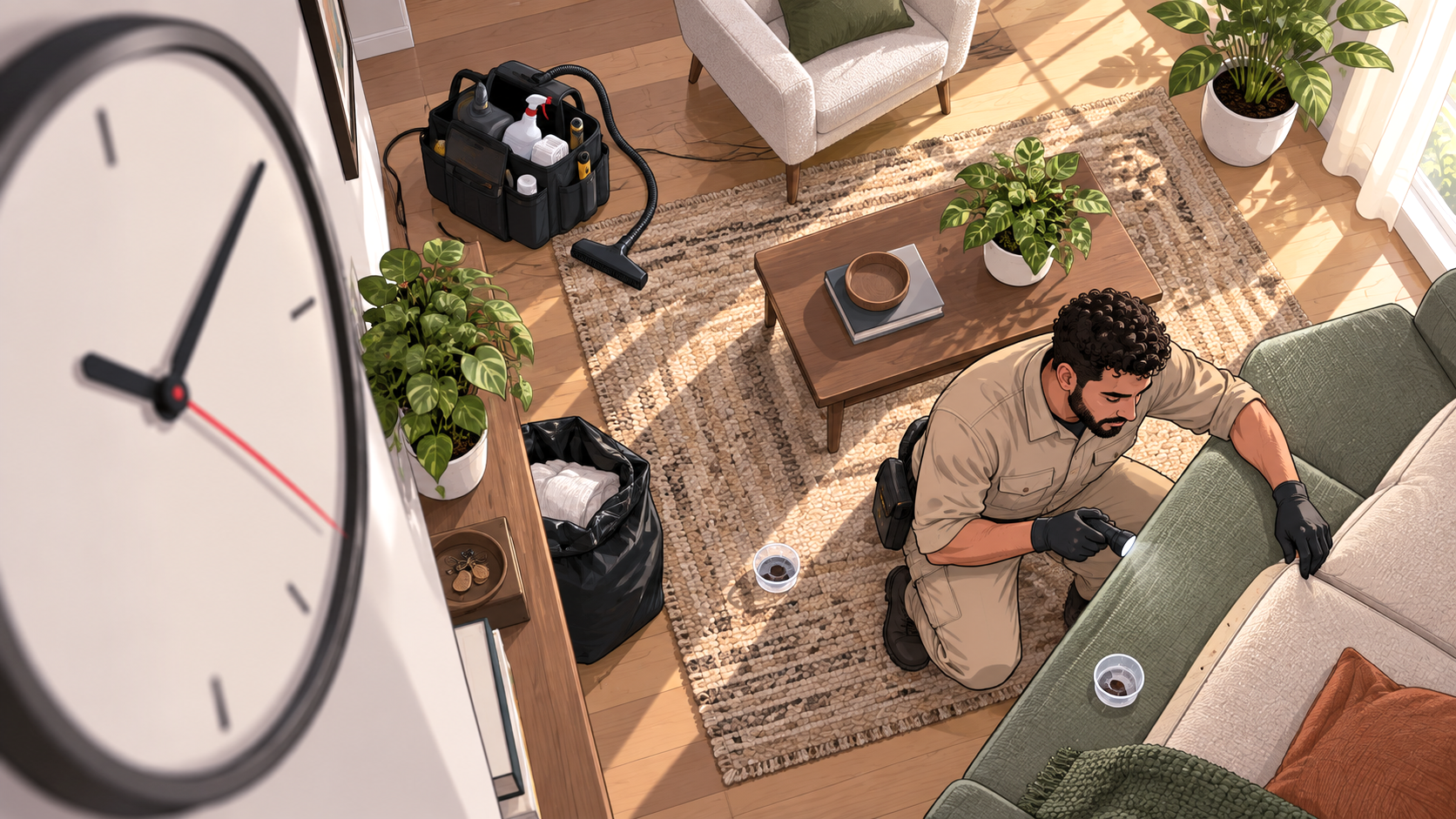
Professional bed bug treatment can take anywhere from several hours to several weeks, depending on the treatment method and extent of the infestation. A heat treatment may be completed in one intensive session, while conventional pesticide-based treatment commonly requires an initial service followed by one or more inspections or treatments.
For a single residence, professional bed bug control can range from about four hours to repeated treatments spread across roughly three weeks. The actual timeline depends on infestation size, treatment method, preparation, number of affected rooms, and whether live bed bugs remain during follow-up inspections.
How Long Does the First Bed Bug Treatment Take?
The first appointment is often the longest because the technician must inspect the property, identify affected areas, move or dismantle furniture when necessary, and perform the planned treatment. Professional control of a single residence can range from about four hours to multiple treatment days spread across three weeks.
A small infestation concentrated around one bed may require much less work than a severe infestation involving bedrooms, couches, furniture, baseboards, and multiple rooms. Clutter can also extend the process because it creates additional hiding places and makes inspection and treatment more difficult.
The time spent inside your home on treatment day is therefore only part of the overall timeline. Professional bed bug elimination also includes preparation, follow-up inspections, monitoring, and retreatment when necessary.
Chemical Treatment Usually Takes More Than One Visit
Conventional treatment often combines targeted pesticides with methods such as vacuuming, steam, encasements, and monitoring. Although the initial application may take only several hours, complete elimination can take considerably longer.
One reason is that many pesticides do not kill bed bug eggs. Eggs that survive the initial application can hatch afterward, requiring the treatment program to account for the emerging nymphs. Some products also work gradually rather than killing every bed bug immediately.
A professional program may therefore return for another inspection and treatment after sufficient time has passed for surviving eggs to hatch. A roughly two-week interval is common in professional guidance, and complete control with conventional methods may take around three weeks or longer depending on what is found during follow-up.
This is why seeing a live bug shortly after the first visit does not automatically prove the entire treatment failed. The more important question is whether activity continues through the scheduled treatment and monitoring period.
How Long Does Professional Heat Treatment Take?
Whole-room heat treatment is much faster in terms of the overall treatment schedule. Specialized heaters and fans raise temperatures throughout the treatment area while sensors confirm that difficult hiding places reach lethal conditions.
The active heating portion often lasts several hours. Professional guidance notes that technicians may maintain high room temperatures for four to five hours, but the total appointment can be longer because the building must first heat up and difficult locations must reach lethal temperatures. Some homes can require substantially more time depending on their size, construction, contents, equipment, and outside conditions.
Simply reaching a high air temperature does not finish the job. Successful professional heat treatment requires lethal temperatures to reach cracks, furniture, floor-wall junctions, and other places where bed bugs are actually hiding. Hard-to-heat locations must be monitored throughout treatment, which can extend the session.
Heat may eliminate all life stages in one treatment when performed successfully. It still makes sense to monitor afterward because heat leaves no residual protection and cool areas can allow survivors.
Why Can Professional Treatment Take Several Weeks?
Bed bugs spend much of their time hidden, and eliminating the infestation means accounting for insects you cannot see. A technician may kill most of the population during the first visit while eggs, deeply hidden bugs, or insects in overlooked harborages remain.
Follow-up is therefore part of treatment rather than evidence that the exterminator necessarily did something wrong. Very few infestations are controlled with only one conventional treatment, so professional services should include monitoring for bugs missed during the initial treatment.
If live bugs are found during follow-up, the technician may retreat specific areas and continue monitoring. Complete control takes longer when bed bugs have spread throughout several rooms, neighboring apartments remain infested, or preparation prevented access to important hiding places.
Does a Severe Infestation Take Longer?
Usually. A small population confined to a bed and nearby furniture gives the technician fewer harborages to locate and treat. A severe bed bug infestation can extend into couches, chairs, baseboards, closets, wall-floor junctions, and other protected locations.
Multi-unit housing can further complicate the timeline. If bed bugs are spreading between apartments, treating one unit while another remains infested can result in continuing or renewed activity. Adjacent units may need inspection and coordinated treatment before the problem is completely resolved.
Preparation also matters. Following the company’s bed bug treatment preparation instructions gives technicians access to areas they need to inspect and treat. Moving potentially infested belongings incorrectly, however, can spread bugs and make treatment more complicated.
When Can You Return Home After Treatment?
That depends on the treatment. With pesticide applications, the required re-entry period is determined by the products used and their labels. Follow the pest-control company’s instructions rather than using a general number from the internet.
Heat treatment also requires occupants and pets to remain outside while the property is being heated. The company will tell you when temperatures have fallen sufficiently and the property can be reoccupied.
Fumigation has different requirements again. True bed bug fumigation requires the structure to be vacated, aerated, and formally cleared before anyone returns. The treatment method therefore matters whenever a company gives you a timeline for leaving and re-entering the property.
How Long Until You Know the Bed Bugs Are Gone?
Finishing the scheduled treatment is not the same as immediately proving eradication. Continue inspecting and monitoring after the last service. Interceptor traps and other bed bug monitors can help reveal insects that remain active around beds.
The evidence should move consistently toward zero activity. No live bugs, no newly discovered eggs or fecal spotting, and no captures in monitoring devices are more useful indicators than relying on bites alone. Some people show little or no reaction to bed bug feeding, while existing skin reactions can persist after the exposure occurred.
If you continue finding live insects after the expected treatment period, contact the company rather than repeatedly applying additional products yourself. Determining whether bed bug treatment actually worked requires looking at physical evidence and monitoring over time.
Other Questions About Professional Bed Bug Treatment
Can professional bed bug treatment be finished in one day?
Yes, some professional heat treatments may be completed in one day. Conventional pesticide-based programs are more likely to require follow-up visits because surviving eggs or hidden bugs may remain after the initial treatment.
How many exterminator visits does it take to get rid of bed bugs?
There is no fixed number. Very few infestations are controlled with only one conventional treatment, so you should expect follow-up. The number of visits depends on the infestation and what technicians find afterward.
Why do exterminators wait between bed bug treatments?
One reason is to allow surviving eggs to hatch so newly emerged bed bugs can be exposed to subsequent control measures. Residual pesticides may also require time to work.
Does a longer treatment mean the infestation is worse?
Not necessarily. Treatment method, property size, construction, belongings, preparation requirements, and follow-up protocol can all affect the timeline.
5 thoughts on “How Long Does Professional Bed Bug Treatment Take?”