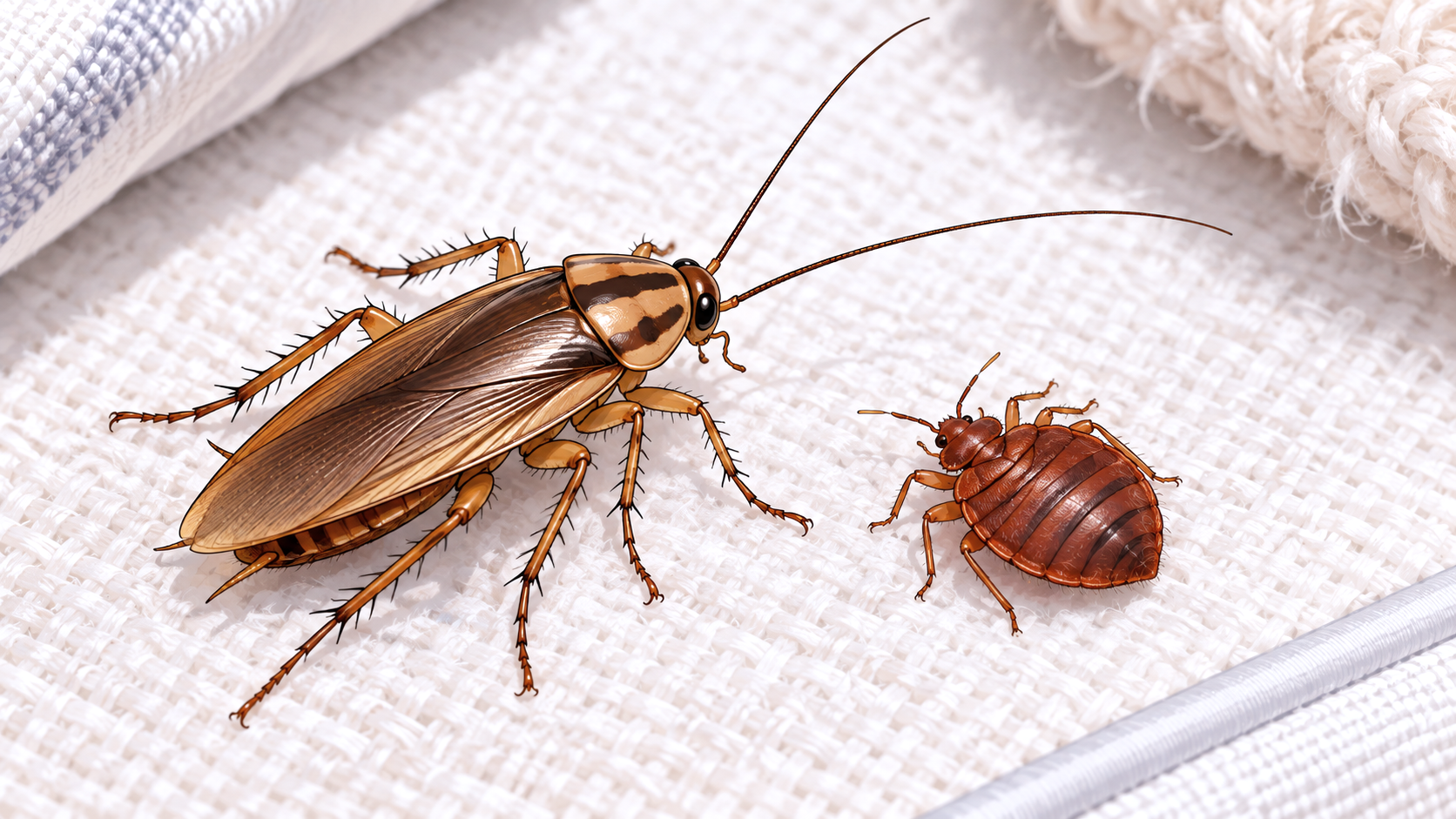
An adult cockroach is usually too large and long-legged to resemble a bed bug closely. The harder identification comes when the insect is small. A cockroach nymph can be wingless, brown, and only a fraction of its eventual adult size, putting it much closer to the visual territory of a bed bug.
Bed bugs are small, wingless, broadly oval insects with relatively short antennae and legs. Cockroach nymphs have much longer antennae, more prominent spiny legs, a body that extends farther lengthwise, and paired cerci at the rear. An adult bed bug is generally about 5 to 7 mm long.
Size Helps Most When the Cockroach Is an Adult
A common adult bed bug (Cimex lectularius) averages around 5 mm long, with adults generally falling around 5 to 7 mm. Bed bug nymphs start considerably smaller, with the first stage measuring about 1.5 mm.
Many familiar pest cockroaches become substantially larger as adults. An adult American cockroach, for example, can approach 2 inches long, while even the smaller German cockroach is noticeably more elongated than a bed bug. The considerable size differences among cockroach species mean that measurements should be treated as supporting evidence rather than a universal cutoff. Size becomes least useful when you are comparing a bed bug with a small cockroach nymph.
Bed Bugs Have a Compact, Rounded Outline
An unfed adult bed bug is broad, flattened from top to bottom, and oval. After feeding, its abdomen expands and becomes more elongated, while its color can shift toward a deeper reddish brown. That change can make two photographs of the same species look surprisingly different. Recently fed bed bugs become more elongated and swollen, so a round, flat profile should not be treated as mandatory.
A cockroach has a more elongated body with conspicuous legs projecting from its sides. The pronotum forms a broad plate behind the head, and the overall cockroach body shape looks built for rapid running rather than the compact seed-like appearance of a bed bug. Young cockroaches preserve that basic roach profile even before adult wings develop.
Compare the Antennae and Legs
A bed bug has antennae composed of four segments, but they are relatively short compared with the extremely long, slender antennae of a cockroach. On a cockroach nymph, the antennae can extend roughly the length of the body or farther and are often among the first features visible in a photograph.
The legs reinforce the difference. Both insects have six, but cockroaches have conspicuous running legs armed with spines. The arrangement and structure of cockroach legs give the insect a noticeably leggier outline. Bed bug legs are shorter relative to the body and do not have the same heavily spined appearance. If a tiny brown insect has extraordinarily long antennae and obvious spiny legs, those features weigh strongly against bed bug identification.
The Rear of the Abdomen Can Confirm a Cockroach Nymph
Cockroaches possess two sensory appendages called cerci at the end of the abdomen. They are relatively short, but a clear photograph from above can reveal them. Cerci are part of the normal external anatomy of cockroaches and remain useful when a nymph has no developed wings to examine.
Bed bugs do not have a matching pair of protruding cerci. Their abdomen instead ends in the rounded or somewhat pointed outline characteristic of the species and sex. When a small insect otherwise seems ambiguous, magnifying a sharp image of the rear can provide a feature that color cannot.
Wings Only Help With Adult Cockroaches
Bed bugs are functionally wingless. Adults retain only reduced wing pads and cannot fly. Adult cockroaches vary by species and sex: some have well-developed wings, some have shortened wings, and others rarely or never use their wings for sustained flight.
A clearly winged adult can therefore rule out a bed bug, but the reverse does not work. A wingless insect could be a bed bug, a cockroach nymph, or an adult of a cockroach species or sex with reduced wings. The developmental stages of cockroaches explain why the absence of wings is expected in juveniles rather than evidence against a cockroach identification.
Where You Found It Can Support the Physical Evidence
Bed bugs are strongly associated with places where people sleep or remain still long enough for the insects to feed. They commonly hide in mattress seams, box springs, bed frames, headboards, furniture joints, and nearby cracks and crevices. Finding a tiny oval insect along a mattress seam alongside other physical signs on the mattress gives its appearance useful context.
Cockroach locations depend on species, but household pest species commonly exploit protected areas with suitable food, water, warmth, and shelter. A small roach-like insect beneath a refrigerator or inside a kitchen cabinet therefore presents a different identification context from one lodged in a mattress seam. Location should support visible anatomy, not replace it, because either insect can occasionally turn up somewhere unexpected.
Skin Marks Cannot Tell You Which Insect You Saw
A skin reaction after sleeping is not a reliable way to identify a bed bug. Bed bug reactions vary among people, may resemble other insect bites or skin conditions, and some people show no visible reaction. Physical evidence such as live insects, eggs, shed skins, or characteristic spotting is more useful for confirming their presence.
For that reason, do not identify an unfamiliar insect as a bed bug simply because someone in the home has itchy marks. What bed bug bites can look like is a separate medical and identification issue from determining whether the insect in front of you is Cimex lectularius.
Details That Can Settle an Unusual Specimen
Can a bed bug be almost translucent?
Yes. Young, unfed bed bug nymphs can be translucent or whitish-yellow and may be difficult to see against a light surface. After taking a blood meal, the contents of the abdomen become much more visible.
Can a cockroach nymph be reddish brown like a bed bug?
Yes. Color varies with cockroach species and developmental stage, so brown or reddish coloration alone cannot resolve the identification. Body proportions, antenna length, leg structure, and cerci provide stronger evidence.
Do bed bugs jump when disturbed?
No. Bed bugs crawl and can run, but they do not jump or fly. If an insect genuinely jumps, another identification should be considered.
Are cockroach eggs and bed bug eggs similar?
Not closely. Bed bug eggs are tiny, pearl-white structures about 1 mm long and are attached to surfaces. Cockroaches generally enclose multiple eggs within an ootheca, giving cockroach eggs and their protective case a very different appearance.