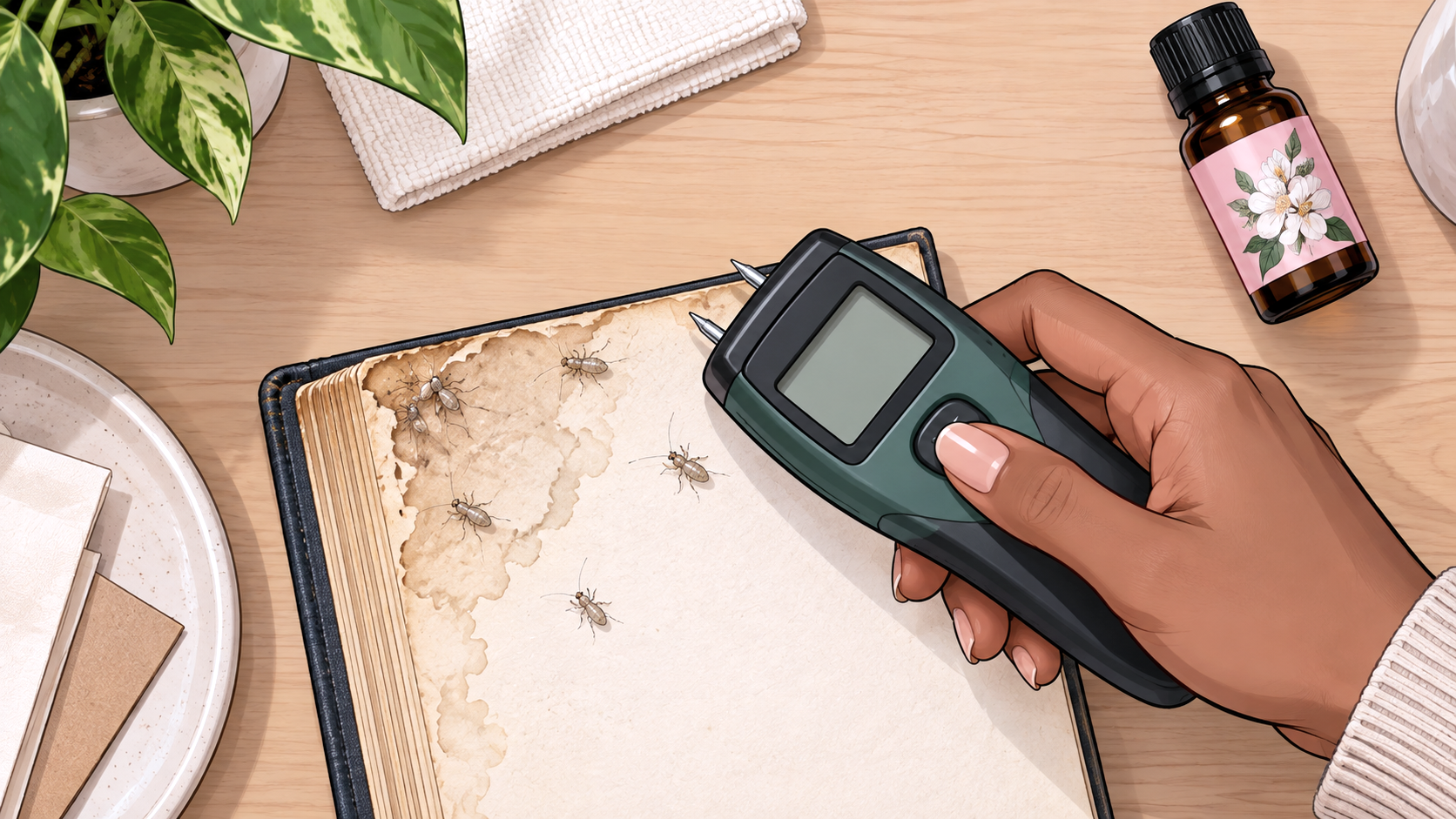
There is no single household smell proven to reliably drive booklice out of a home. Laboratory studies have shown repellency from certain essential oils and volatile compounds, including carvone, menthol, geraniol, citronellol, borneol, and cinnamaldehyde. Their effects depend on concentration, formulation, species, and exposure time, so simply making a room smell like peppermint, citrus, or another fragrance is not an established control method.
Some Plant Odors Really Do Repel Booklice Under Controlled Conditions
Booklice are capable of responding to volatile plant chemicals. Experiments with Liposcelis bostrychophila found strong repellency from several essential oils extracted from medicinal plants, and individual compounds including (R)-carvone, menthol, borneol, and beta-eudesmol also produced marked avoidance at tested concentrations. In the same work, carvone produced particularly strong repellency against L. bostrychophila.
Other volatile compounds have shown similar activity. Geraniol and citronellol produced strong repellency in experiments with L. bostrychophila, whereas citronellal and limonene were considerably weaker under the same testing conditions. The repellent response to geraniol and citronellol shows why listing an entire fragrance family such as “citrus” or “herbal smells” is too imprecise. Chemically similar-smelling substances can produce very different responses.
Cinnamon-Like Compounds Can Repel Booklice, but the Effect Is Dose-Dependent
Trans-cinnamaldehyde, the compound responsible for much of cinnamon’s characteristic odor, has demonstrated strong repellency against L. bostrychophila in laboratory testing. An essential oil from Kaempferia galanga also produced contact and fumigant toxicity, while its individual components varied considerably in repellent strength. Trans-cinnamaldehyde was strongly repellent while 1,8-cineole was not.
That result prevents a simple conclusion such as “booklice hate cinnamon.” A concentrated, measured chemical exposure on a laboratory surface is very different from placing cinnamon sticks on a bookshelf or using a scented household product. Repellency depends on the amount of active compound that actually reaches the insect, how quickly it evaporates, and how long the exposure remains strong enough to alter behavior.
The same limitation applies to essential oils used against booklice. Some oils contain genuinely active compounds, but a pleasant household scent does not automatically reproduce an experimental dose.
Peppermint-Like Odors Have Some Supporting Evidence, but Not for Ordinary Peppermint Sprays
Menthol has produced strong repellency against booklice in controlled experiments, which gives some biological support to the idea that mint-associated compounds can affect their movement. Other terpenes found in aromatic plants, including alpha-terpineol and alpha-terpinyl acetate, have also shown substantial repellent activity, while linalool and related compounds were weaker in the same study. The repellent activity of several terpenes against L. bostrychophila varied enough that “essential oils repel booklice” is too broad a statement.
A bottle labeled peppermint oil is also not chemically identical to purified menthol used at a defined experimental concentration. Commercial oils vary in composition, age, extraction method, plant variety, and dilution. Using more oil to compensate is not automatically safer or more effective, particularly on books, finished furniture, painted surfaces, or around children and pets.
Eucalyptus and Citrus Oils Have Produced Repellent Effects Too
Some eucalyptus- and citrus-derived oils have repelled L. bostrychophila under laboratory conditions. Research comparing six plant oils found that oils from tangerine, bitter orange, bergamot, pine, cypress, and lemon-scented eucalyptus all caused measurable avoidance, although their strength differed considerably. Cypress oil produced the strongest repellency among the oils tested.
These findings show that booklice can respond to several different volatile chemical profiles rather than one specific hated odor. They do not establish orange peel, eucalyptus leaves, pine cleaner, or citrus air freshener as dependable household repellents. The active chemistry, concentration, persistence, and delivery method differ too much.
Basil-Type Essential Oils Can Affect Booklice, but Repellency Is Not Permanent
More recent experiments have continued to find repellent and insecticidal effects from plant oils. Essential oils from Ocimum basilicum and Ocimum × africanum produced both contact toxicity and repellency against L. bostrychophila, with the strength of the response changing according to concentration and exposure time. The repellent effect of basil-derived essential oils was not constant across doses and time periods.
That time dependence is especially relevant inside a home. Volatile compounds disperse. A smell that is obvious immediately after application may be much weaker hours later, while booklice hidden in cracks, bindings, wall voids, cardboard, or stored products may receive little exposure at all.
Repelling insects from one surface can also push them elsewhere without eliminating the conditions allowing them to survive.
Vinegar Smell Is Not a Reliable Booklice Repellent
Vinegar is often suggested because its acetic-acid odor is sharp, but there is no strong evidence that ordinary household vinegar provides dependable residual repellency against booklice. The odor dissipates as acetic acid evaporates, and spraying damp materials can be counterproductive when the insects already thrive in humid environments.
The limitations of using vinegar against booklice become even clearer when the goal is repellency rather than directly wetting an exposed insect. A temporary smell around a bookshelf or wall does not remove booklice from protected locations elsewhere.
Vinegar can also damage stone, metals, finishes, adhesives, and other acid-sensitive materials, making indiscriminate spraying a poor tradeoff for an unproven repellent effect.
A Stronger Smell Does Not Mean Better Control
Repellent strength cannot be judged by the human nose. A substance that smells intense to a person may have little behavioral effect on booklice, while a compound that seems mild can be biologically active at the insect’s sensory level. Magnolia laevifolia essential oils, for example, produced more than 80% repellency in some laboratory tests, but activity varied with plant part and collection time because the chemical composition of the oil changed. The repellent performance of those oils depended on their actual chemistry, not simply how strong they smelled.
The same principle applies to commercially fragranced cleaners, moth products, candles, diffusers, and room sprays. None should be assumed effective against booklice because its odor is strong or unpleasant to humans.
Repelling Booklice Is Less Useful Than Making the Habitat Unsuitable
A repellent can change where an insect walks without eliminating the population. Booklice survive because a location supplies enough moisture and suitable food, commonly microscopic fungi. Their dependence on high humidity makes environmental drying much more consequential than fragrance.
Household psocids generally fail to persist when relative humidity remains around 45% to 50% or lower, and lower humidity also suppresses much of the fungal growth they consume. A dry shelf remains unfavorable long after a scent has evaporated.
The same environmental relationship explains why mold is an important booklice food source and why a heavily scented but damp room can still support them. Fragrance changes the air chemistry temporarily; drying changes the habitat.
Essential-Oil Repellency Should Not Be Treated as a DIY Fumigation Method
Laboratory fumigant experiments use measured amounts of volatile compounds in controlled spaces. Some essential oils and isolated constituents can affect booklice strongly enough to produce both repellency and mortality, but reproducing those concentrations in an occupied room is a different matter. An essential oil from Clinopodium chinense, for example, showed fumigant and contact toxicity against L. bostrychophila under experimental conditions.
Pouring large amounts of essential oil into diffusers, spraying concentrated oils throughout a room, or sealing an occupied space to increase vapor concentration is not an appropriate way to imitate laboratory fumigation. Essential oils can irritate skin and airways, damage materials, and pose risks to pets depending on the oil and exposure.
The safer natural approaches to booklice control rely primarily on moisture reduction, physical removal, and correcting the environmental conditions supporting them.
Questions About Smells and Booklice
Do booklice hate peppermint?
Menthol, a major mint-associated compound, has shown strong repellency in laboratory tests. That does not prove that ordinary peppermint oil, peppermint plants, or mint-scented cleaners will reliably keep booklice away.
Does cinnamon repel booklice?
Trans-cinnamaldehyde has demonstrated strong repellency against L. bostrychophila. Cinnamon powder or cinnamon sticks have not been shown to provide equivalent household protection.
Do booklice hate eucalyptus?
Some eucalyptus-derived essential oils have produced measurable repellency in laboratory experiments, but effectiveness varies by oil composition and concentration.
Does lemon or citrus smell keep booklice away?
Several citrus oils have repelled booklice experimentally, although strength varies substantially. Citrus-scented household cleaners should not be assumed to have the same chemical concentration or effect.
Will lavender keep booklice away?
There is not strong evidence supporting household lavender scent as a dependable booklice repellent. Linalool, a compound present in many aromatic plants including lavender, has shown relatively weak repellency in some Liposcelis experiments compared with stronger compounds.
Can air freshener repel booklice?
Ordinary air fresheners are not established booklice-control products. A fragrance may mask odors in a room without affecting the insects or the humid conditions supporting them.
Can essential oils make booklice move into another room?
A localized repellent could potentially change insect movement without killing the population. If the original damp habitat remains suitable, repelling visible insects from one surface does not resolve the infestation.
What works better than trying to repel booklice with smells?
Removing visible insects and correcting damp conditions has much stronger practical support. The broader method for getting rid of booklice focuses on moisture, fungal food, and infested materials rather than maintaining a particular odor in the room.