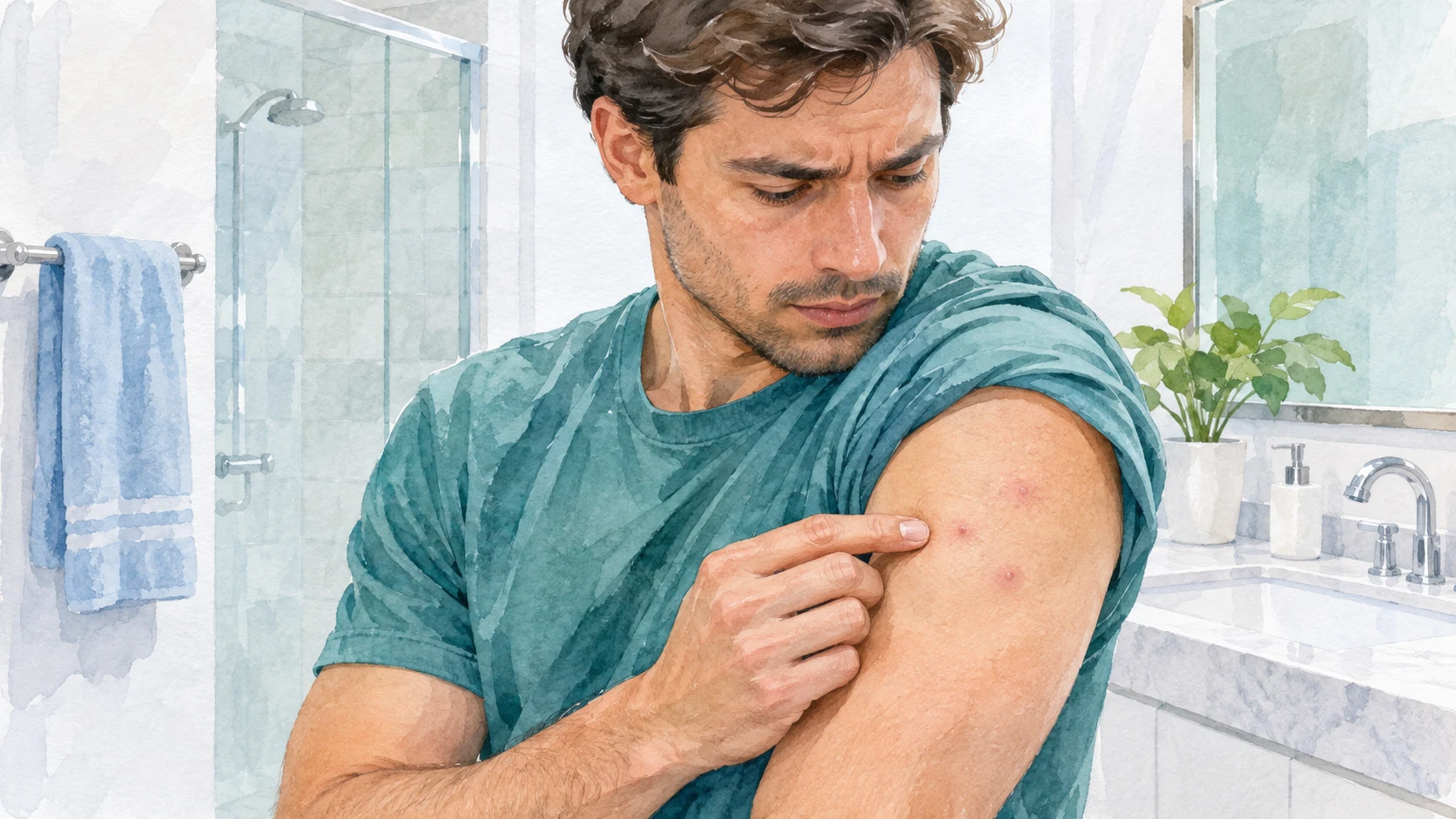
Acne and bed bug bites can overlap visually when both appear as small inflamed bumps. The most useful difference is the type of lesion. Blackheads, whiteheads, pustules, and deep tender nodules belong to acne, while bed bug bites are usually itchy papules or welts without a clogged pore. The location and surrounding evidence can strengthen the identification, but neither a cluster nor a line of bumps proves bed bugs.
Comedones Do Not Come From Bed Bug Bites
Acne begins inside a hair follicle when oil and dead skin cells obstruct the pore. The American Academy of Dermatology identifies blackheads, whiteheads, pimples, nodules, and cysts as acne lesions, while MedlinePlus defines open comedones as blackheads and closed comedones as whiteheads. Seeing either type among the inflamed bumps gives acne a major advantage over an insect-bite explanation because a bed bug does not clog follicles.
Inflammatory acne adds other recognizable lesion types. Papules are solid red or inflamed bumps, pustules contain visible pus, and deeper obstruction can produce painful nodules or cystic lesions. Mayo Clinic lists this mixture of comedones, papules, pustules, nodules, and cystic lesions as the typical acne spectrum. A person may therefore have several different kinds of blemishes in the same area rather than a set of nearly similar itchy marks.
Bed bug reactions arise from feeding rather than blocked follicles. The CDC describes them as small bite marks that may become red, swollen, and itchy, although some people show no visible reaction. Their variability explains why bed bug bites can appear flat, raised, or swollen, but they do not naturally produce blackheads or whiteheads.
Acne Usually Builds a Persistent Pattern
Acne commonly behaves as an ongoing skin condition. Individual pimples may heal while new ones form nearby, and deeper lesions can remain tender for days or longer. The American Academy of Dermatology notes that different acne breakouts require different treatment because they form at different depths. Recurring blemishes in the same acne-prone area over weeks or months therefore fit acne much better than a series of isolated feeding events.
Bed bug marks can appear after a delay. The CDC notes that some people do not notice visible reactions until one or several days after being bitten. A new group of itchy lesions can consequently seem to appear suddenly, but timing by itself is weak evidence because delayed reactions make it difficult to identify the exact night of exposure.
Itching also overlaps. Bed bug reactions are commonly itchy, while acne lesions are more often described as tender, sore, or painful when inflammation extends deeper into the skin. Severe acne can produce large painful nodules and cysts beneath the surface, a presentation unlike uncomplicated bed bug bites.
Where the Bumps Appear Can Support the Other Clues
Acne favors areas with many sebaceous glands. Mayo Clinic identifies the face, forehead, chest, upper back, and shoulders as common sites because follicles in those areas are closely associated with oil glands. MedlinePlus likewise notes that acne frequently affects the face, chest, and back. A mixture of blackheads, whiteheads, and pimples across these areas is therefore consistent with acne even when the bumps are itchy.
Bed bug bites are shaped more by access during feeding. The face, neck, arms, shoulders, hands, and legs are commonly affected, although bites can occur elsewhere. The range of bed bug bite appearances and locations is broad enough that body location should support, not replace, other evidence.
Skin tone can make both conditions less obvious. Inflammation from bites may look brown, purple, or darker than surrounding skin rather than bright red, and bed bug bites on dark or Black skin may be easier to recognize by swelling or texture. Acne can also leave post-inflammatory darkening after individual lesions heal.
A Bedroom Inspection Can Rule the Bed Bug Theory In or Out
Skin lesions cannot establish a bed bug infestation by themselves. A person can have acne and bed bugs at the same time, and ordinary acne can be mistaken for bites when new pimples are first noticed in the morning. Bed bug identification therefore depends heavily on evidence away from the skin.
Mattress seams, box springs, headboard joints, bed frames, and nearby upholstered furniture should be checked for live insects, eggs, shed skins, dark fecal spots, and rusty staining. Those early signs of bed bug activity provide a factual connection between the skin reaction and an insect source. Repeated evidence on the mattress and surrounding bed structure carries far more weight than whether several bumps happen to form a row.
If unexplained itchy marks continue appearing but no insect evidence is obvious, a more methodical inspection can establish whether bed bugs are actually present. Treating the room based only on pimples risks unnecessary pesticide use, while assuming confirmed bed bug bites are acne leaves the infestation untouched.
Deep Painful Lesions and Severe Bite Reactions Need Different Care
Persistent acne containing nodules, cysts, or lesions that are beginning to scar deserves medical evaluation because deeper inflammatory acne can cause permanent scarring. Mayo Clinic advises seeking care when self-treatment fails or acne becomes severe, and dermatologists can distinguish acne from other follicular and inflammatory disorders that resemble it.
Bed bug bites usually require little more than symptom control, but heavy scratching can damage the skin and allow secondary infection. Severe swelling, spreading redness, pus, fever, difficulty breathing, or other signs of a significant reaction warrant medical attention. The threshold for seeing a doctor after suspected bed bug bites is higher than simple itching but lower when allergy or infection is suspected.