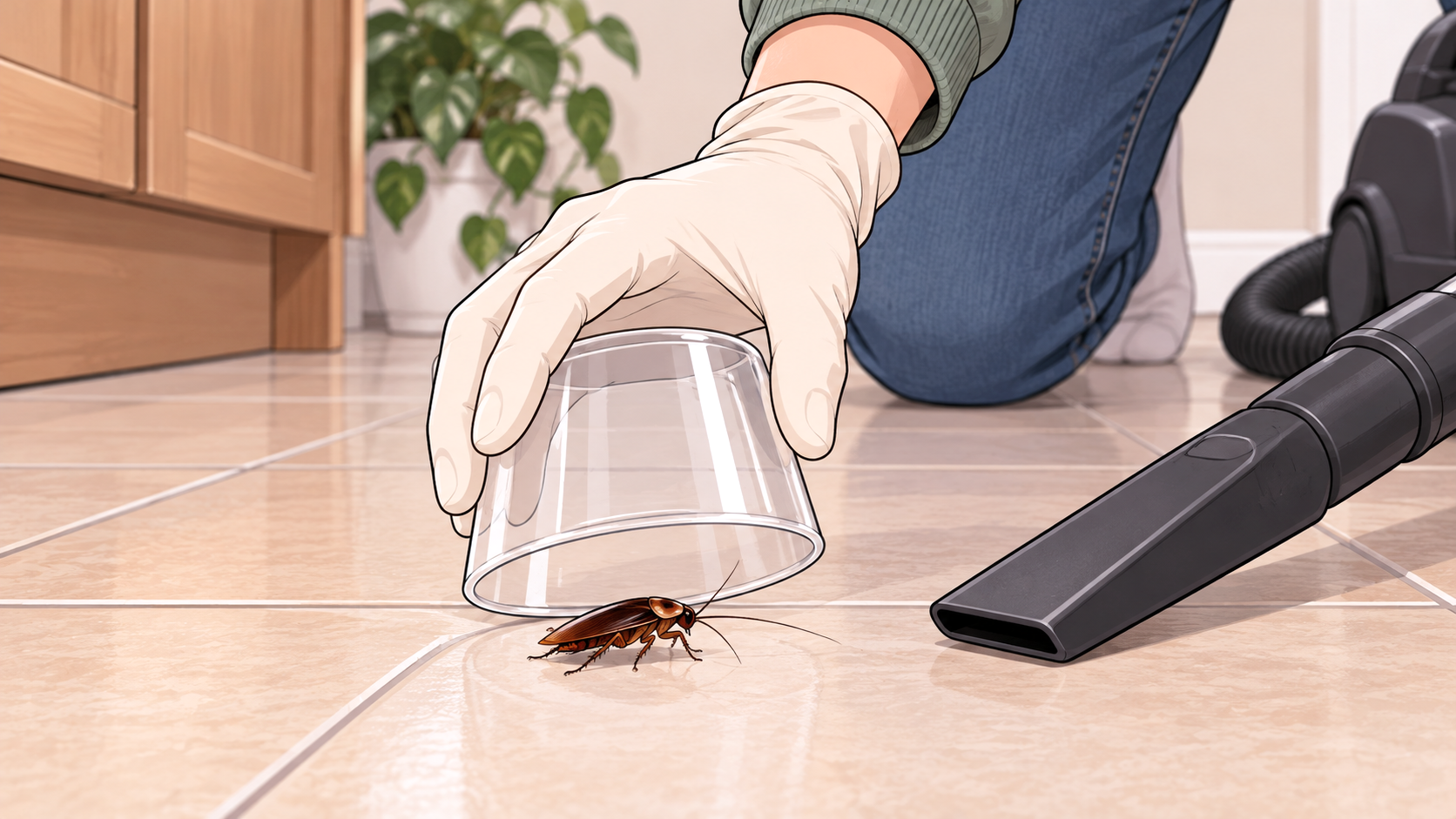
A cockroach racing across the floor presents an immediate problem: how do you kill it before it disappears? Several methods can stop an exposed cockroach within seconds, but not everything that makes an insect stop moving actually kills it.
A firm, direct crush is the most immediate and reliable way to kill a visible cockroach. Certain contact insecticide sprays can cause rapid paralysis, while soapy water may immobilize an insect quickly without guaranteeing instant death. A vacuum can capture the cockroach immediately, although suction alone does not reliably kill it.
The best choice depends on whether the insect is accessible, whether you want to avoid chemicals, and whether the surrounding surface can be cleaned safely.
Crushing: The Fastest Physical Method
A single decisive application of pressure can kill a cockroach almost immediately by causing severe physical damage. Use a shoe, folded paper towel, or another firm object appropriate for the surface. A hard floor provides a more reliable crushing surface than soft carpet or upholstery, where the insect may be pushed into the material instead of receiving sufficient force.
Avoid repeated light taps, which may injure the cockroach without killing it. Cockroaches can move surprisingly quickly, so attempting to catch one with your fingers is less reliable than using an object with a broad, firm contact surface.
Afterward, collect the insect with a tissue or disposable towel, seal it in a rubbish bag, and clean the affected surface. Wash your hands after handling the contaminated material. The EPA’s household pest-control recommendations favor nonchemical measures where practical, avoiding unnecessary pesticide exposure.
If the cockroach is on bedding, upholstered furniture, or another surface that cannot tolerate pressure, capture or vacuum removal may be preferable to crushing it in place.
Contact Insecticide Sprays: Quick Knockdown Is Not Always Instant Death
Many aerosol cockroach killers contain pyrethrins or synthetic pyrethroids that interfere with insect nervous systems. When an adequate amount reaches a susceptible cockroach, the insect may lose coordination, flip over, or become paralyzed rapidly.
The National Pesticide Information Center’s pyrethrins fact sheet explains that these insecticides excite nerve activity, producing paralysis and potentially death. However, the speed and outcome depend on the formulation, dose, insect species, and susceptibility.
A cockroach lying motionless after spraying is not necessarily dead. Some insects may recover from knockdown, while others die after further exposure. The University of California’s cockroach guidance also notes that spray performance can be affected by insecticide resistance.
Use only a product labeled for cockroaches and the intended application site. Follow its instructions for ventilation, application quantity, and reentry. Avoid exposed food, food-contact surfaces, bedding, pet areas, and electrical equipment unless the label specifically permits the application.
The health risks of cockroach spray exposure make repeated spraying an unnecessary choice when an insect can be safely captured or killed mechanically.
Vacuuming: Immediate Capture, Not Guaranteed Death
A vacuum cleaner equipped with a hose attachment can remove a cockroach from a difficult-to-reach surface without requiring direct contact. This is particularly useful when the insect is on curtains, near furniture, or in an accessible crevice.
However, vacuum suction and impact inside the machine do not guarantee instant death. A cockroach may survive collection, particularly if it enters a bag or compartment containing soft debris.
The University of California’s integrated pest management guidance includes vacuuming among methods for physically removing cockroaches and their debris. Its usefulness lies in collecting insects rather than assuring immediate mortality.
Use a crevice attachment to capture the cockroach, then promptly seal the vacuum contents in a disposable bag. A bagless vacuum should be emptied carefully into a suitable container. Avoid leaving collected insects inside the machine.
Vacuuming is especially useful when dealing with cockroaches concealed in accessible cracks, provided the nozzle can reach the insect without damaging nearby objects.
Does Soapy Water Kill Cockroaches Immediately?
Soapy water can immobilize a cockroach rapidly when the solution thoroughly contacts its body. However, immobility is not proof of immediate death, and results depend on soap concentration, coverage, and the insect’s condition.
A study published in the Journal of Economic Entomology examined German cockroach responses to dishwashing liquid. At concentrations of 3% or greater, treated cockroaches became unresponsive within three minutes, but confirmed mortality occurred over a longer observation period. Some insects exposed to lower concentrations recovered.
The researchers suggested that soap interfered with insect respiration, potentially by blocking respiratory openings. Their findings demonstrate that soapy water can kill cockroaches under controlled conditions, not that an ordinary splash guarantees immediate death.
Using soap as a contact treatment also introduces practical limitations. Liquids should not be sprayed into electrical outlets, appliances, or other equipment where moisture can cause damage. Wet floors can become slippery, and excessive application may damage sensitive finishes.
A cockroach that stops moving after exposure should be collected and securely disposed of rather than assumed dead.
Can Boiling Water Kill a Cockroach Instantly?
Direct exposure to sufficiently hot water can cause fatal injury to a cockroach, but the effect depends on the water temperature when it reaches the insect and the amount of contact.
Boiling water is an unnecessarily hazardous way to kill a visible household cockroach. It can scald skin, damage flooring and furniture, and create electrical hazards if spilled near outlets or appliances. Water also cools rapidly after leaving its container, so splashing a cockroach does not guarantee immediate death.
Pouring boiling water into a wall opening or beneath furniture is especially unreliable because there is no assurance that it will reach the insect. Physical capture is preferable when the cockroach is accessible.
Freezing sprays and improvised extreme-temperature treatments have similar limitations. Products or techniques that immobilize an insect are not automatically approved for household use, and exposing nearby materials to extreme temperatures can cause avoidable damage.
Why Cockroach Baits and Powders Are Not Instant Killers
Cockroach baits, boric acid dust, silica-based dusts, and insect growth regulators serve different purposes from immediate contact methods. They generally require ingestion, sufficient contact, or biological development before their effects become evident.
The University of Kentucky’s cockroach elimination guidance explains that cockroaches consuming insecticidal baits typically die within one to three days rather than immediately. These slower effects can be useful for managing established infestations, but bait is not an instant solution for a cockroach running across the floor.
Boric acid and desiccant dusts are likewise unsuitable for killing a visible cockroach within seconds. They depend on sufficient exposure and require careful application in locations permitted by their labels. Scattering powder directly onto exposed household surfaces is not an appropriate substitute for capture.
If several cockroaches appear regularly, the difficulty of killing established cockroach populations cannot be overcome simply by choosing the fastest contact product. Killing individual insects and controlling a population involve different outcomes.
Why Bug Bombs Are a Poor Choice for Immediate Cockroach Control
Total-release foggers distribute pesticide mist throughout a room, so they cannot be aimed precisely at a single moving cockroach. Their effectiveness against insects concealed inside cracks or enclosed spaces may be limited because the pesticide must reach the target.
The EPA’s safety guidance for total-release foggers warns about flammable propellants, possible fires and explosions, inhalation exposure, and the need to vacate treated spaces.
Using a fogger to kill one visible cockroach is disproportionate to the problem. Nor does finding several dead insects afterward establish that all concealed cockroaches have been eliminated.
For one exposed insect, direct physical removal avoids dispersing insecticide throughout the room.
How to Tell Whether a Cockroach Is Actually Dead
A cockroach lying on its back, twitching, or remaining motionless may be dying, paralyzed, injured, or temporarily incapacitated. These appearances are especially ambiguous following insecticide exposure.
The National Pesticide Information Center’s permethrin guidance explains that pyrethroid exposure can cause muscle spasms and paralysis before death. Loss of coordinated movement therefore does not establish that the insect is dead.
Rather than leaving a motionless cockroach unattended, collect it using a disposable tissue or suitable tool and place it in a securely sealed disposal bag. If it remains active, do not handle it with bare fingers.
The appearance of dead cockroaches around a home can result from several circumstances, including pesticide exposure, so the number of motionless insects is not a dependable measure of treatment success.
For an isolated cockroach on an accessible surface, a decisive physical method is usually the fastest practical option. Contact insecticides can provide rapid knockdown where their labeled use is appropriate, but instant paralysis, instant capture, and instant death are not interchangeable outcomes.
3 thoughts on “What Kills Cockroaches Instantly?”