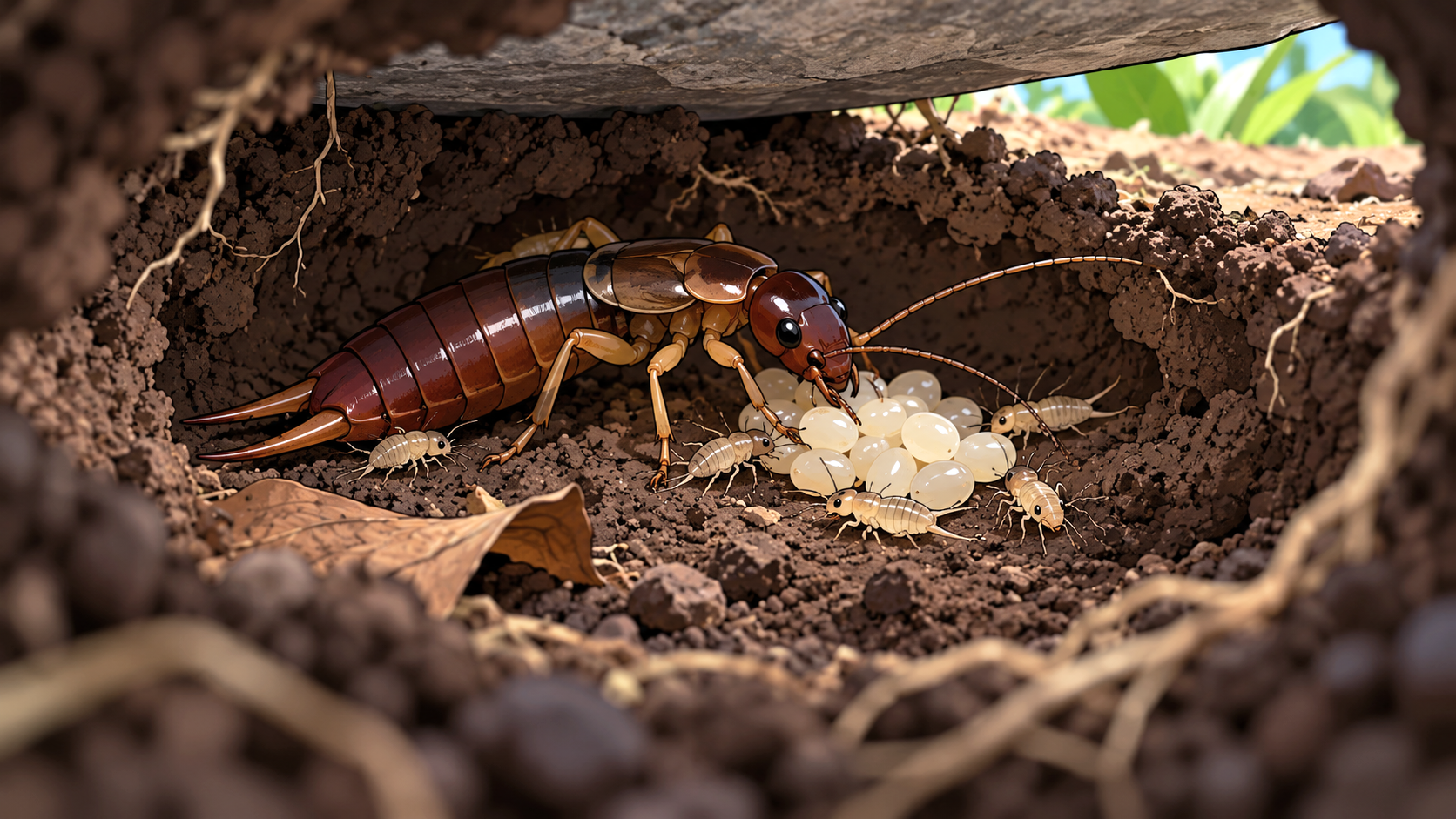
Yes. Female earwigs take care of their eggs and newly hatched young, an unusually involved form of parental care for an insect. A mother guards her underground nest, tends the eggs, removes mold and other hazards, and continues protecting the earliest nymphs. The young eventually leave the nest and begin living independently.
That behavior makes earwigs much more attentive parents than their appearance might suggest. In the European earwig (Forficula auricularia), the female’s job does not end when she lays her eggs. Instead, she remains with them through hatching and stays with the youngest nymphs during the first part of their development.
Female Earwigs Guard Their Eggs
A female European earwig lays her eggs together inside a nest in the soil. She then stays with the clutch rather than abandoning it. Her care includes gathering the eggs together and standing guard over them, keeping the developing brood concentrated inside the protected nest.
Guarding is only part of the job. The mother also removes mold and other hazards from her eggs. That detail is important because it shows that earwig maternal care involves active nest maintenance, not simply remaining nearby until the eggs hatch.
The eggs themselves are small, pale structures that look nothing like miniature earwigs. Our guide to what earwig eggs look like covers their appearance separately. What matters here is that the female remains closely involved throughout this stage instead of leaving the clutch unattended.
Earwig Mothers Care for Nymphs After They Hatch
The maternal behavior continues after hatching. Female earwigs guard and protect their newly hatched young, so hatching is not the point when parental care suddenly stops.
Those young are called nymphs. They already resemble miniature earwigs rather than worm-like larvae, although they are smaller and less developed. If you are trying to identify them rather than understand their relationship with the mother, baby earwigs have several features that separate them from adults.
Food can also form part of this early care. European earwig females have been documented providing food to young nymphs. That makes the mother-young relationship more substantial than simple nest defense. She protects the brood during the period when the youngest offspring are still closely dependent on the nest.
We think this is the part of earwig biology that most changes how people see them. The pincers make the insect look rather hostile, yet a female uses the same general rear structures while defending a brood and spends a significant portion of the reproductive cycle caring for offspring.
How Long Do Earwigs Take Care of Their Young?
Maternal care is concentrated in the earliest nymphal stages. First-instar nymphs remain in the nest with the female. After they molt, second-instar nymphs begin leaving at night to find food, although some return to the nest during the day.
The association becomes progressively weaker from there. First and some second instars remain in the nest under maternal protection, while later nymphs disperse to forage independently. By the third and fourth instars, European earwig nymphs live as free-foraging insects on the soil surface.
So earwig parental care has a definite endpoint. The mother protects the offspring while they are eggs and vulnerable young nymphs, but she does not accompany them throughout the rest of their development. The earwig life cycle from egg to adult puts that transition into the wider developmental sequence.
Earwig Mothers Actively Maintain the Nest
It is easy to picture parental care in insects as little more than sitting over a clutch of eggs. Earwig behavior is more active than that. The female maintains the nest and protects the developing brood from hazards while the offspring are still dependent on that sheltered space.
The nest itself is generally a shallow chamber in the soil. During this period, the female spends much of her time underground with the brood rather than moving around openly. The combination of nest construction, egg tending, protection, and continued care after hatching is what makes earwig maternal behavior so distinctive.
A female can also use her forceps in defense. The rear appendages are useful structures rather than decorative “pinchers,” and their functions extend beyond anything involving humans. Our explanation of what earwig pincers are actually for covers their roles in defense, prey handling, and reproduction.
Male Earwigs Don’t Share the Childcare
The parental care described for European earwigs is maternal. Males and females can overwinter together in underground nests, but the male does not remain as a second parent caring for the eggs and nymphs.
Before the female lays her eggs, the male leaves the nest. The female then handles the brood care herself. That distinction matters because finding an adult beside eggs or very young nymphs strongly fits the behavior of a female rather than a male.
Adult sex is particularly easy to judge from the rear forceps. Males have more strongly curved forceps, while females have straighter ones. The full male vs. female earwig comparison explains how to tell them apart without relying on their reproductive behavior.
What Finding a Mother Earwig With Young Means
Finding one adult earwig surrounded by tiny nymphs can look like a random cluster of insects. In the right setting, however, you may be looking at a mother with her brood. Earwig mothers guard their young after hatching, so close association between a female and very young nymphs is normal biology.
We would pay particular attention to the developmental stage of the smaller earwigs. A female with very young nymphs in a protected soil nest fits the maternal period well. A group of larger earwigs roaming together does not necessarily represent a family, since later nymphs have already moved into independent foraging.
That distinction prevents an easy identification mistake. Earwigs can occur together for reasons unrelated to parenting, so proximity alone does not prove that one individual is caring for the others. The combination of a female, a nest, eggs or very young nymphs, and protective behavior makes the interpretation much stronger.
Other Questions About Earwig Parenting
Do earwig mothers recognize their own young?
Second-instar nymphs can leave the nest to forage and later return, but some may enter a different nest rather than their original one. That means an earwig nest is not necessarily an exclusive family unit once young nymphs begin moving between shelters.
Do all earwig species show exactly the same parental behavior?
No. Earwigs are an entire order of insects containing multiple species, and the details of reproduction and maternal behavior can differ among them. The specific sequence described in this article centers on the European earwig, Forficula auricularia, a widespread species that commonly becomes a household and garden pest.
Can a female earwig have more than one brood?
Yes. A female European earwig can produce a second brood, although the number of eggs in the second clutch is lower in populations described in the eastern United States. Reproductive patterns can also differ between European earwig populations in different regions.
Do earwig mothers stay with their offspring until adulthood?
No. By the later nymphal stages, the young have left maternal care and forage independently. They complete the remaining immature development without the mother accompanying them.
3 thoughts on “Do Earwigs Take Care of Their Young?”