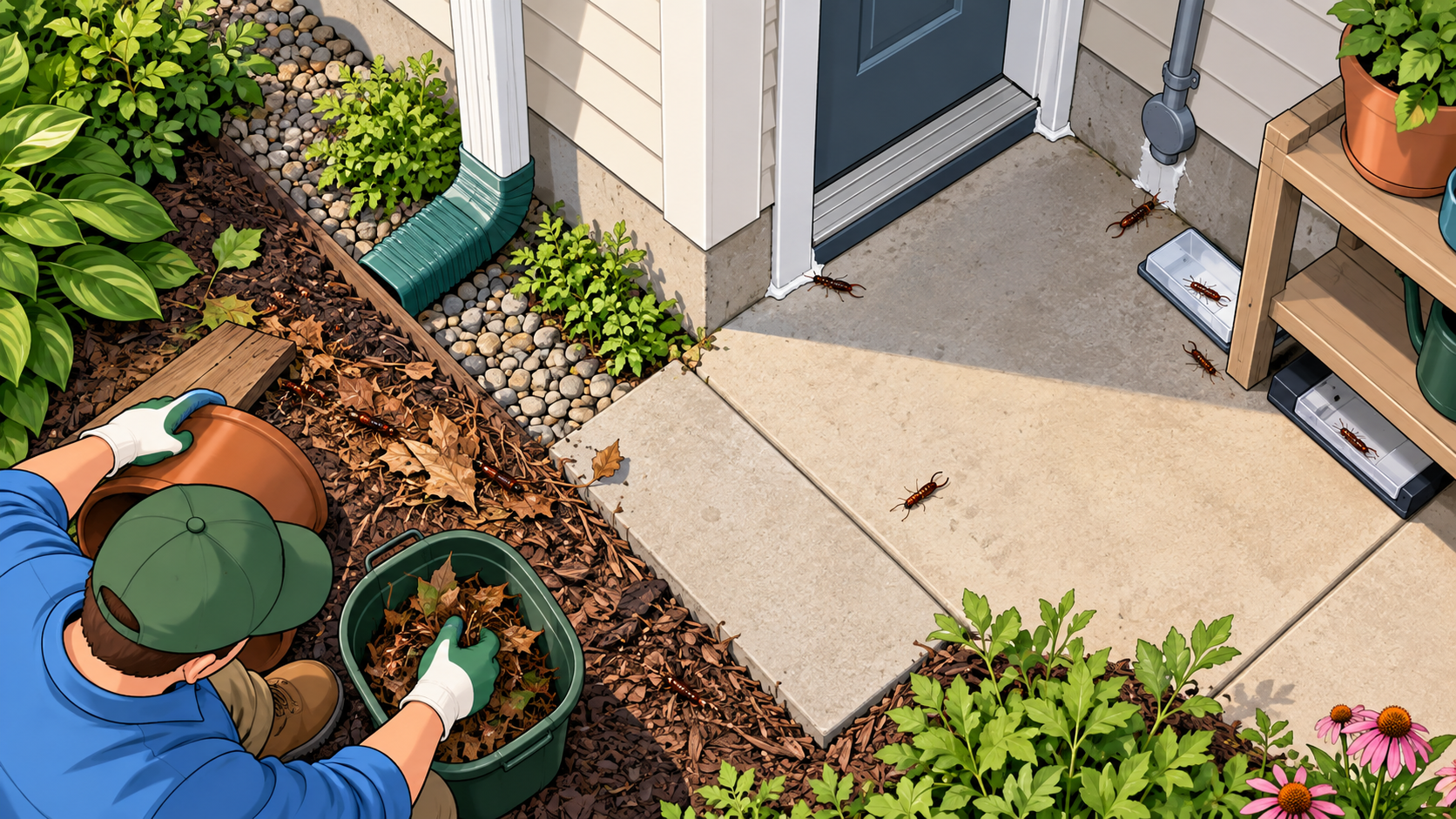
The biggest mistake people make when trying to get rid of earwigs is treating the insect they can see while ignoring the place it came from. Killing three earwigs on a bathroom floor may solve tonight’s problem, but it does little when dozens more are sheltering beneath damp mulch beside the foundation.
Getting rid of earwigs works best when you attack the problem from the outside in. Remove unnecessary damp hiding places, trap earwigs where they are concentrated, correct excess moisture, and seal the openings they use to enter buildings. Indoors, vacuum or sweep up individual earwigs. Pesticides are rarely necessary for ordinary earwig problems.
That approach is less dramatic than spraying every earwig you find, but it fits how these insects actually live. Earwigs spend daylight hours hidden in dark, cool, moist places and become active at night. A successful control plan therefore targets their shelter and movement rather than chasing individual insects from room to room.
First, Find Out Where the Earwigs Are Coming From
Before doing anything else, work out whether you have an indoor nuisance, an outdoor garden problem, or both. That distinction changes what you need to fix.
European earwigs (Forficula auricularia) commonly shelter outdoors beneath mulch, leaves, boards, flowerpots, groundcover and other protected materials. They feed mainly at night. If you are unsure whether the insect you found is actually an earwig, the paired forceps at the rear of the abdomen are the quickest identifying feature. Our guide to what earwigs look like covers the identification details and common look-alikes.
For an indoor problem, inspect the exterior area directly outside the rooms where sightings occur. Pay particular attention to doorways, window wells, foundation edges and places where vegetation or landscape materials meet the building. Earwigs can enter through small gaps around doors, windows and vents, so physical exclusion is one of the most effective ways to prevent movement into homes.
Outdoor problems require a different inspection. Look beneath movable objects and through vegetation close to plants showing damage. Because earwigs are nocturnal, checking the garden with a flashlight after dark can reveal far more than inspecting it in the middle of the afternoon.
We would not treat every earwig sighting as an infestation. Earwigs naturally live outdoors, and a few wandering into a house does not mean they are breeding behind the walls. European earwigs do not reproduce indoors, which makes finding the exterior source much more important than treating interior rooms.
Remove the Places Earwigs Hide During the Day
Once you know where activity is concentrated, shelter reduction is one of the most useful changes you can make.
Earwigs deliberately seek dark, tight and moist refuges during daylight. Around a house or garden, those refuges can include leaf litter, weeds, dense groundcover, landscape debris, wood, loose materials and objects resting against damp soil. Removing unnecessary hiding places makes the immediate area less accommodating and also leaves fewer protected locations from which earwigs can emerge at night.
Start closest to the problem. A woodpile at the far end of a large property matters less to an indoor earwig problem than wet leaves sitting against the foundation beside a basement window. Likewise, you do not need to strip every piece of mulch from a garden. The better target is excessive or unnecessary shelter around vulnerable plants and likely building entry points.
This distinction matters because earwigs can be useful outdoors. They are omnivores and consume aphids and other small organisms in addition to plant material. Earwigs do not need to be managed in every outdoor situation, particularly when they are not causing unacceptable plant damage or entering the house.
The goal is therefore not an earwig-free yard. We would focus on reducing the conditions that allow large numbers to remain immediately beside whatever you are trying to protect.
Correct Excess Moisture Without Drying Out Your Garden
Shelter and moisture often work together. A layer of debris becomes a much better earwig refuge when the ground underneath remains damp.
Check for persistently wet areas around foundations, leaking outdoor faucets, poorly directed downspouts and irrigation that repeatedly wets surfaces where earwigs shelter. Water should drain away from the structure rather than collecting beside it. In gardens, drip irrigation can help reduce unnecessary surface moisture where it is suitable for the plants being grown.
This does not mean starving your plants of water. Earwig control should never come at the expense of appropriate plant care. Instead, correct unnecessary moisture. A vegetable bed that needs irrigation should still receive it, while a foundation edge kept wet by a leaking spigot is a different problem entirely.
Rain can temporarily complicate this strategy because it changes moisture conditions across the property and can increase visible earwig movement. If your problem suddenly becomes worse following storms, our guide to why earwigs show up after heavy rain explains that pattern separately.
Trap Earwigs Where Their Activity Is Concentrated
Trapping is particularly useful for earwigs because you can exploit the same shelter-seeking behavior that makes them difficult to find during the day.
One approach is to place rolled newspaper, corrugated cardboard, bamboo tubes or short pieces of hose near active areas before nightfall. Earwigs use these confined spaces as daytime refuges. Check the traps the following morning and remove the insects. Regular trapping can reduce populations to tolerable levels when you keep repeating the process.
Oil traps work differently. A low-sided container partially sunk into the soil can hold vegetable oil with a small amount of fish oil or bacon grease as an attractant. Earwigs enter the container and become trapped. Place any liquid trap where children, pets and wildlife cannot access it, and do not create a trip hazard in frequently used areas.
Our DIY earwig trap guide covers trap construction in more detail. We prefer keeping the main control guide focused on the strategy rather than turning it into a collection of trap recipes.
Placement matters more than having a large number of random traps. Put them near the plants suffering damage, beside known hiding areas or along routes where you repeatedly see earwigs. A trap in an inactive corner of the property tells you very little.
Getting Rid of Earwigs Inside the House
Indoor earwig control is refreshingly simple when only a few insects have wandered inside. Sweep or vacuum them up and dispose of them. There is little reason to spray an indoor room just because one earwig crossed the floor.
In fact, indoor pesticide treatments are not recommended for preventing earwig invasions because they do not address the outdoor insects that continue entering. Repeated indoor spraying can therefore turn into a cycle where you keep treating the destination instead of fixing the route.
After removing the insects, look for entry points. Gaps around doors and windows, vents and other exterior openings deserve attention. Weather stripping can help where doors do not close tightly, while appropriate sealing can close cracks and gaps around the exterior. Our guide to keeping earwigs out of the house goes deeper into exclusion.
Location can provide clues, but do not take it too literally. Finding earwigs in a bathroom does not prove they came through the drain, just as finding one in a basement does not prove it lives underground beneath the house. Earwigs can enter elsewhere and wander before you discover them.
When one particular room keeps producing sightings, investigate the room and the exterior immediately around it together. That usually tells you more than treating the room as an isolated infestation.
Getting Rid of Earwigs in the Garden
Garden control requires more restraint because the presence of earwigs does not automatically mean they are causing harm.
Earwigs can feed on flowers, seedlings, vegetables and soft fruit, but they also consume other insects and decaying material. Young seedlings are particularly vulnerable because they have little plant tissue to spare. Larger established plants can tolerate considerably more feeding. Our article on whether earwigs are good or bad for the garden looks at that tradeoff in detail.
Before treating a damaged plant, inspect it after dark. Irregular holes can have several causes. Earwig feeding can resemble slug damage, although slugs and snails leave slime trails. Catching an earwig actively feeding on the affected plant gives you much stronger evidence than finding one underneath a nearby pot the next morning.
When earwigs are responsible, concentrate control around the affected plants. Reduce unnecessary nearby refuge, manage excess surface moisture and position traps close to the damage. This targeted approach is preferable to trying to eliminate every earwig across the garden.
Certain plants deserve more attention than others. Earwigs can seriously damage seedlings, flowers such as dahlias, soft fruits and corn silks. For a garden-wide problem, our dedicated guide to getting rid of earwigs in the garden covers those situations without making the house-control portion of this guide unnecessarily complicated.
Be Skeptical of Household Earwig Remedies
Earwig control attracts an enormous number of home-remedy claims because almost anything capable of killing an exposed insect can be presented as a “solution.”
That is the wrong standard. A substance killing an earwig after direct contact does not establish that it can control the population hiding throughout a yard. It also does not tell you whether applying that substance to plants, soil, household surfaces or around pets is appropriate.
Vinegar, bleach, rubbing alcohol, essential oils, dish soap and other household materials are therefore poor substitutes for a control plan built around the pest’s actual behavior. Some may affect an insect after direct exposure, but that is a much narrower question than whether they can solve an earwig problem.
We would start with shelter reduction, moisture management, exclusion and trapping because those measures target why earwigs remain around the property. If you specifically want a non-pesticide approach, our guide to getting rid of earwigs naturally separates useful methods from popular remedies that are often given more credit than they deserve.
Where Pesticides Fit Into Earwig Control
Pesticides are not the first step for most earwig problems. Current integrated pest management guidance notes that insecticides should rarely be needed when shelter reduction, moisture management and trapping adequately reduce the population.
There are situations where a pesticide may be considered, particularly when damaging outdoor populations remain high despite other measures. However, the product must be currently labeled for the location and use you intend. A pesticide suitable for a building perimeter is not automatically appropriate for vegetables, and a product registered for one crop cannot be assumed appropriate for another.
That distinction is especially important in edible gardens. Not every insecticide that affects earwigs is registered for use on food plants. Product registrations and restrictions can also change, so the current label is the controlling source for where and how a pesticide can be used.
We would not choose a pesticide simply because its front label includes a picture of an earwig. First decide where the insects need to be controlled, then find a currently registered product whose label covers both the pest and that treatment site. Our earwig killer guide is the better place for comparing specific treatment products.
How to Keep Earwigs From Coming Back
A control effort becomes much more durable once the property stops supplying an easy route from outdoor shelter to indoor space.
Keep unnecessary debris away from the foundation and avoid letting dense vegetation create continuous shelter directly against the building. Correct drainage or irrigation problems that keep the perimeter persistently damp. Clean leaf accumulation from areas such as gutters where appropriate, and repair openings around doors, windows and other exterior penetrations.
Outdoor lighting can also matter in some situations. Certain earwigs can be attracted to lights, and yellow outdoor lighting is less attractive to earwigs than white lighting. Changing a problem light can therefore complement exclusion, although lighting alone is not a substitute for fixing shelter, moisture and entry points.
The most useful test comes after your initial control work. Continue checking the places where earwigs were previously concentrated. Falling trap catches and fewer indoor sightings tell you more than the number you killed on the first day.
For properties with recurring indoor problems, our broader earwig prevention guide covers the longer-term maintenance side of control.
When an Earwig Problem Is Bigger Than DIY Control
Most earwig problems do not require professional pest control. A few insects wandering indoors can normally be removed, while exclusion and outdoor habitat changes address the reason they keep appearing.
Professional help becomes more reasonable when large numbers continue entering despite correcting obvious moisture, shelter and entry problems. It can also make sense when the source cannot be located or the property makes exterior exclusion difficult. At that point, the value of professional service is not simply having someone spray the insects you can already see. It is getting a more systematic inspection of where the recurring movement is originating.
The same applies to persistent garden damage. Before escalating treatment, confirm that earwigs are actually responsible and that the damage justifies intervention. Killing beneficial or harmless outdoor earwigs simply because they exist works against the integrated approach that makes earwig management relatively straightforward.
Our guide to when an earwig exterminator makes sense covers that decision in more detail.
Other Questions About Getting Rid of Earwigs
How long does it take to get rid of earwigs?
There is no single treatment timeline because the source and scale of the problem vary. Removing a few indoor stragglers can be immediate, while reducing an outdoor population requires repeated trapping and changes to shelter or moisture conditions. Continued new sightings usually mean the source or entry route still needs attention.
Should you kill every earwig you find outside?
No. Outdoor earwigs can consume aphids and other small pests, and low populations may cause no meaningful plant damage. Control makes more sense when earwigs are damaging vulnerable plants or repeatedly entering the home rather than simply because one is present in the yard.
Can earwigs come back after you get rid of them?
Yes. Earwigs naturally occur outdoors, so a property can receive new individuals even after the original problem has been reduced. Keeping favorable shelter away from problem areas and maintaining exterior exclusion reduces the chance that ordinary outdoor activity turns into another indoor nuisance.
Why do I keep finding dead earwigs inside?
Earwigs that wander indoors can become trapped in an environment that does not provide the food and moisture they normally use outdoors. Repeated dead earwigs still indicate that insects are gaining access to the building, so checking exterior entry points is more useful than treating the dead insects themselves.
Do ultrasonic pest repellents get rid of earwigs?
Ultrasonic devices should not replace established earwig-management methods. For a recurring problem, put the effort into finding exterior shelter, correcting unnecessary moisture, trapping concentrated populations and sealing entry points rather than depending on an electronic repellent.
8 thoughts on “How to Get Rid of Earwigs: The Complete Guide”