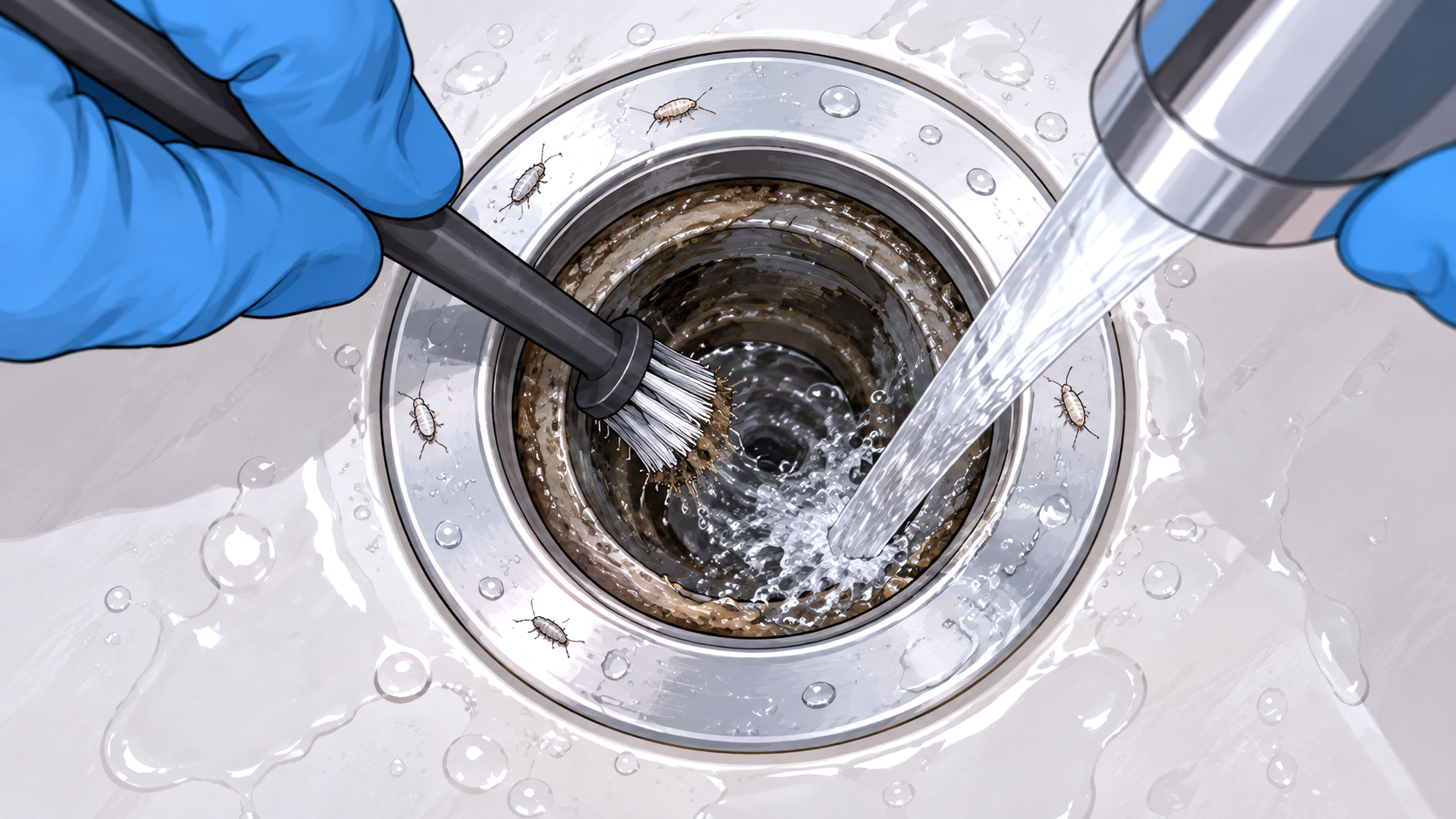
Seeing tiny springtails clustered around a drain makes the drain look like the obvious source. That assumption can send you in the wrong direction. Springtails commonly become trapped in sinks, tubs, and other wet fixtures after entering a home, and they can also gather around floor drains. Their presence points to moisture, but it does not automatically mean they are breeding inside the drainpipe. To get rid of springtails around a drain, wash visible springtails down with water, then find and correct the moisture that is keeping the surrounding area damp. Check for plumbing leaks, condensation, wet materials, and high humidity. Do not pour or spray insecticides down the drain. Persistent springtails usually require moisture control rather than drain treatment.
First, Make Sure the Drain Is Actually Connected to the Problem
Springtails depend on moist environments. Indoors, they often turn up around plumbing leaks and other areas with high humidity or condensation. They can also crawl through a house searching for moisture and become trapped in smooth-sided sinks, washbasins, and bathtubs. Springtails may also occur around floor drains, but the drain’s presence alone does not establish it as their source.
Watch where the insects appear instead of focusing only on the drain opening. Springtails clustering across a wet floor, around the base of a toilet, beneath a sink cabinet, or beside damp grout give you more places to investigate. If they are appearing throughout the room, the broader moisture conditions matter more than whatever is inside the pipe.
This is also worth checking before assuming every tiny bathroom insect is a springtail. Springtails are very small, wingless, and many species jump when disturbed. Our springtail identification guide covers their appearance in more detail.
Wash Springtails in the Sink or Tub Down the Drain
Visible springtails in a sink or bathtub do not require a complicated treatment. You can simply wash them down the drain. This removes the insects that have collected in the fixture without introducing unnecessary pesticides into the plumbing.
However, washing them away is removal, not source control. If another group appears the next morning, repeatedly rinsing the sink will not explain why they keep arriving. At that point, shift your attention from the insects you can see to the moisture conditions around the fixture.
You can also vacuum springtails found on dry surfaces around the room. Physical removal is a practical option for small numbers of springtails indoors, while larger recurring populations call for investigation of the underlying moisture problem. Moisture control is the most effective approach to indoor springtails.
Check the Plumbing Around the Drain
A sink or floor drain gives springtails something they need nearby: water. That does not mean the water has to be coming from inside the drain itself.
Inspect accessible plumbing for leaks. Look beneath the sink, around pipe connections, and anywhere water has been collecting. Springtails indoors are associated with plumbing leaks, excessive humidity, and other damp conditions. Fixing a leak and drying the affected area can eliminate the conditions allowing them to persist.
Do not stop at obvious dripping water. Damp cabinet material, condensation on pipes, or moisture around the surrounding floor can keep a small area humid enough to matter. Persistent springtails around plumbing deserve attention because their continued indoor presence is an indicator of moisture.
For springtails appearing throughout the room rather than just beside the drain, our guide to getting rid of springtails in a bathroom covers the room as a whole.
Dry the Area Around the Drain
Once leaks are handled, let the affected area dry. A fan can help air out a damp room, while a dehumidifier can reduce excessive indoor humidity. These measures are especially useful in bathrooms, basements, and other rooms where moisture remains high for long periods.
Springtails generally become a temporary indoor problem when the excess moisture disappears. They need humid conditions to survive, so drying wet areas with a fan or dehumidifier addresses something the insects actually depend on.
A floor drain in a persistently damp basement deserves a wider inspection for that reason. The useful question is not simply how to kill the springtails sitting beside the grate. It is why that particular part of the building stays damp enough to keep attracting or supporting them.
If humidity is the main issue rather than a plumbing leak, our separate guide examines whether a dehumidifier can help with springtails.
Do Not Pour Insecticide Down the Drain
A pesticide might sound like a stronger version of rinsing the insects away, but drains are not appropriate places for improvised pesticide treatment. Never pour or spray insecticides down drains. Indoor insecticide sprays are also generally unnecessary for springtail management.
This matters because treating the pipe would miss the larger problem anyway. Springtails can continue appearing while moisture remains around the plumbing, floor, walls, or other parts of the room. Pesticide use cannot repair a leak or lower excessive humidity.
We would therefore skip the temptation to turn a springtail sighting into a drain-treatment project. The insects are giving you a reason to inspect the wet environment around the drain, not a reason to start putting pest-control chemicals into your plumbing.
Do Not Assume Springtails Are Drain Flies
Springtails and drain flies can both appear around sinks and drains, but the source-control logic is different. Drain flies are small, fuzzy flies whose larvae can develop in the gelatinous organic film that accumulates inside drains. Their developmental sites can include sink, shower, and bathtub drains.
Springtails are wingless. Many can jump, while drain flies have conspicuous hairy wings and fly. That makes movement and body structure more useful than location when deciding which pest you have.
The difference matters because cleaning organic film from a drain is a standard part of controlling drain flies. You should not automatically transfer that treatment advice to springtails simply because both pests were noticed near the same fixture. For springtails, the priority remains finding and reducing the moisture associated with their presence.
Look Beyond the Drain When Springtails Keep Returning
Recurring springtails can lead homeowners to keep treating the same drain because that is where the insects are easiest to see. We think the better move is to expand the inspection.
Check nearby plumbing, damp wood, cabinets, flooring, baseboards, and other moisture-prone areas. Springtails can maintain indoor populations where high humidity and mold growth provide suitable conditions. Bathrooms and basements are among the indoor locations where this can occur.
Springtails can also enter from outdoors. When outdoor conditions become unfavorable, they may move into buildings through small openings and then crawl toward moisture. That means the insects around your drain could have entered somewhere else entirely. Our guide to how springtails get into a house covers those routes separately.
The pattern can help you decide where to look next. A few springtails that disappear after the area dries are different from a population that returns to the same wet location day after day. Our guide to the signs of a springtail infestation explains how recurring sightings fit into the larger picture.
Treat the Moisture Source, Not Just the Place You Found Them
A drain makes an easy target because it is a visible hole surrounded by water. Springtail control becomes much more straightforward once you stop treating that appearance as proof that the insects originated inside the pipe.
Remove the springtails you can see, then inspect the surrounding plumbing and room. Repair leaks, reduce excessive humidity, and dry persistently damp materials. If springtails continue appearing after those conditions have been corrected, broaden the search for another moisture source or an outdoor entry route.
That approach also fits the larger strategy for getting rid of springtails. The lasting solution is usually environmental correction rather than repeatedly killing the insects that happen to be visible.
Other Questions About Springtails Around Drains
Can springtails come out of a floor drain?
Finding springtails beside a floor drain does not prove that they traveled up through the plumbing. Springtails occur around floor drains because these areas can provide the damp conditions they seek. Investigate moisture around the drain and surrounding room before assuming the pipe itself is the entry route.
Should I clean the drain if I see springtails around it?
Normal drain cleaning is fine for sanitation and plumbing maintenance, but springtail control should not depend on treating drain buildup as their established breeding source. That advice is more directly relevant to drain flies, whose larvae develop in moist organic material inside drains.
Can springtails survive in a dry sink overnight?
Springtails require high humidity and moisture, and indoor springtails generally disappear when those conditions are removed. A recurring population around a sink therefore warrants a search for another moisture source rather than assuming the dry sink itself is sustaining them.
Why are springtails around a drain but nowhere else?
The immediate area may simply offer the most favorable moisture conditions in the room. A small plumbing leak, condensation, or another damp spot around the fixture can concentrate springtails in one location even when the rest of the room appears dry.
When should I investigate beyond the bathroom or kitchen?
Broaden the inspection when springtails continue returning after the room has been dried and accessible plumbing leaks have been corrected. Moisture can exist in less obvious locations, and springtails can also enter from outdoors before moving toward damp parts of a home.
3 thoughts on “How to Get Rid of Springtails in a Drain”