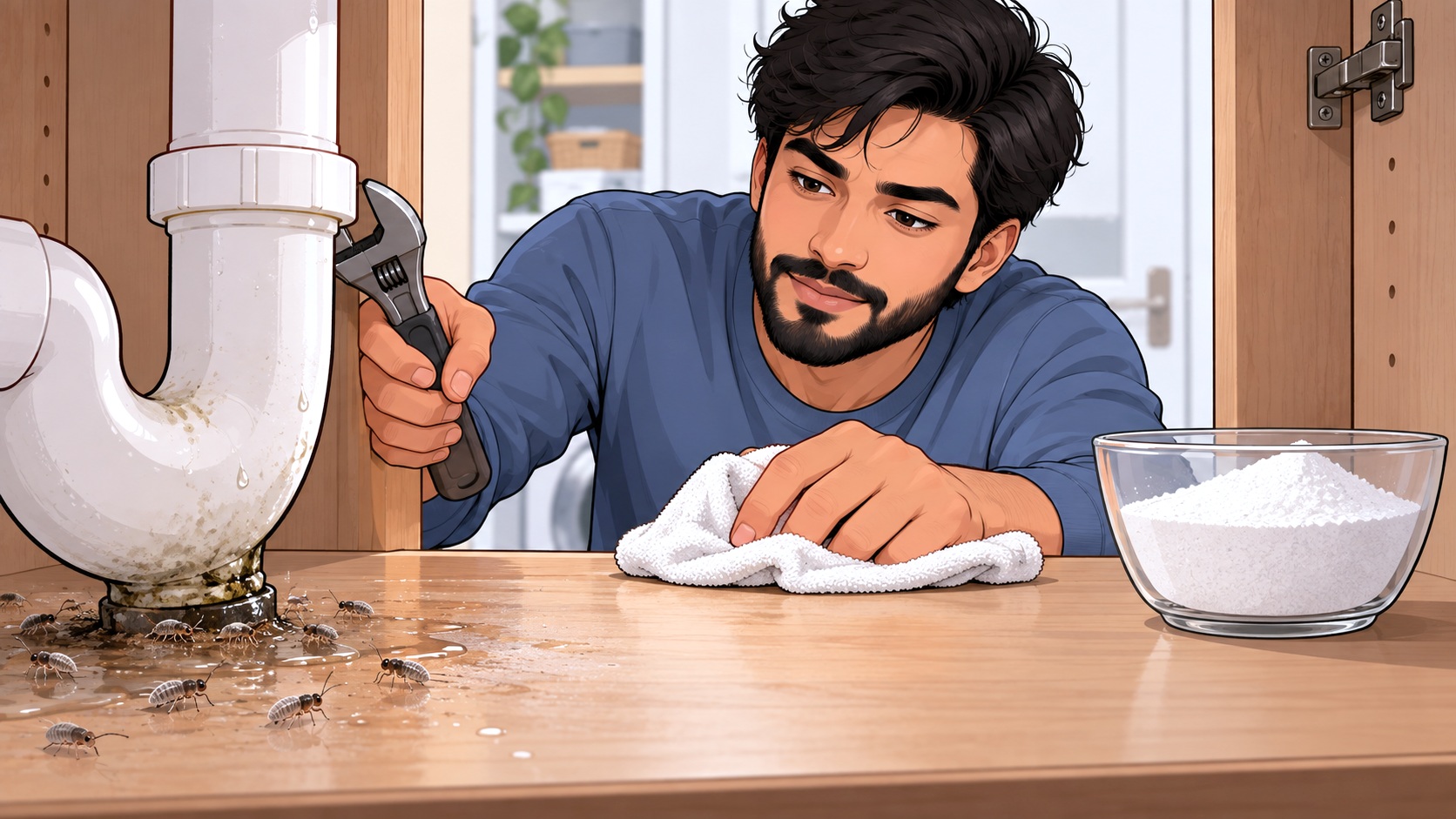
Borax has legitimate insecticidal uses, which makes it tempting to assume that scattering it wherever springtails appear will solve the problem. That conclusion goes too far. Borax-containing pesticides exist, but springtail management guidance does not recommend ordinary household borax as a treatment for springtails. Borax is not a recommended way to kill or control springtails. Although borax is used as an active ingredient in some registered insecticides, that does not mean household borax is an effective springtail treatment. For springtails indoors, the useful approach is removing visible insects and correcting the moisture that allows them to persist.
Borax Can Be an Insecticide, but That Does Not Make It a Springtail Treatment
Borax is sodium tetraborate decahydrate. It belongs to a group of boron compounds that have long been used in certain pesticide products. Some registered products containing borax target pests such as ants, cockroaches, and other insects.
However, pesticide effectiveness depends on much more than whether a substance has insecticidal properties. The pest on the label, formulation, concentration, placement, and way the target pest encounters the product all matter. A registered borax ant bait, for example, is not evidence that sprinkling laundry borax on springtails will control them.
That is the mistake we would avoid here. Borax can have insecticidal uses without being a proven household treatment for every small arthropod. The Environmental Protection Agency’s pesticide records show that borax-containing products are formulated and registered for particular uses, rather than establishing borax as a universal insect killer.
Why Borax Misses the Main Reason Springtails Are There
Springtails are closely tied to moisture. Indoors, they commonly turn up around plumbing leaks, condensation, excessively humid spaces, and overwatered houseplants. Their continued presence can therefore tell you more about the environment than about the need for an insecticide.
This is why a powder-first approach makes little sense. Suppose springtails keep appearing beneath a bathroom sink because a slow plumbing leak has kept the surrounding area damp. Scattering borax where you see them leaves the leak untouched. Even killing some exposed individuals would not correct the condition supporting the problem.
Our guide to what attracts springtails goes deeper into those environmental conditions. For the broader treatment process, see how to get rid of springtails. The better question is not simply what substance can kill an exposed springtail. It is why springtails keep appearing in that particular place.
Borax Is Not the Same Thing as Boric Acid
Borax and boric acid are related boron compounds, but the names should not be treated as interchangeable. EPA pesticide records identify sodium tetraborate decahydrate as borax and list boric acid separately.
That matters when reading pest-control advice online. A recommendation involving a registered boric acid pesticide does not automatically apply to a box of household borax. Likewise, instructions from the label of one borate pesticide should not be transferred to a different product.
We think this distinction is especially important for DIY pest control because “borax,” “boric acid,” and “borate” are often discussed as though they were different names for the same powder. They are not.
Even where a borax-containing product is registered as an insecticide, the label determines what that specific product is intended to control and how it can be used.
Sprinkling Borax Around the House Is Not Necessary for Springtails
Springtails do not require the kind of indoor chemical campaign that their numbers sometimes make people imagine. Hundreds of tiny jumping creatures can look like a serious infestation, but indoor springtail management is unusually dependent on correcting their environment.
Small numbers can simply be removed by hand or with a vacuum. When larger numbers persist, drying wet areas, repairing moisture problems, and addressing damp material provide the important control measures. Indoor pesticides are not recommended for springtails because they do not address those underlying conditions.
The same principle applies when springtails are appearing around sinks, tubs, or other wet surfaces. They can be swept, vacuumed, or washed away rather than surrounded with pesticide dust. Current integrated pest management guidance specifically emphasizes drying affected areas and states that pesticides should not be necessary for long-term springtail management.
For a closer look at immediate killing versus actual control, see what kills springtails instantly.
Do Not Put Borax Into Drains Just Because Springtails Are Near Them
Springtails around a sink can easily make the drain look guilty. However, finding insects in the basin does not prove that the population originated inside the drain.
Springtails seek moist environments, and sinks provide exactly the sort of wet surface where they become conspicuous. Before putting anything into the plumbing, inspect the surrounding area. Look around pipe penetrations, beneath the sink, along damp cabinet material, and anywhere a leak or condensation could be maintaining moisture.
Our guide to getting rid of springtails around drains covers that situation separately.
There is little value in pouring borax into plumbing when the actual problem could be beside the pipe, beneath the cabinet, or somewhere outside the room. Treating the place where you noticed the springtails is not the same as finding where they came from.
Do Not Add Household Borax to Potted Plants for Springtails
Houseplant soil is another place where springtails regularly appear. They favor damp potting soil and often become particularly noticeable after a plant has been watered.
The recommended response is straightforward. Allow the surface soil to dry as much as the particular plant can tolerate without wilting, and avoid keeping the potting mix continuously wet. Pesticides are not needed for springtails in indoor plants.
That makes adding household borax to the pot unnecessary. More importantly, it distracts from the condition you can actually correct, which is excessive soil moisture.
Our dedicated guide to springtails in potted plants covers plant-specific management in more detail.
What Works Better Than Borax for Springtails?
Start with the insects already in front of you. Vacuuming or sweeping springtails provides immediate physical removal without introducing another chemical into the room. In sinks and bathtubs, they can simply be washed away.
Next, trace the moisture. A plumbing leak needs repair. Persistently wet material needs to dry. Excessive indoor humidity can be reduced with ventilation, a fan, or a dehumidifier where appropriate. Overwatered plant soil needs a different watering schedule. These changes make the environment less suitable for springtails instead of merely attacking individuals as they appear.
Our article on using a dehumidifier for springtails explains where humidity reduction helps and where it cannot substitute for fixing a leak.
Finally, consider whether the springtails are entering from outdoors. They are small enough to enter through cracks and other openings, while outdoor populations can occur in damp soil, mulch, leaf litter, and decaying organic material. Reducing excessive moisture near the structure and closing practical entry points can help when migration is driving the indoor sightings.
If that pattern fits what you are seeing, our guide to how springtails get into the house is the more useful next step.
Other Questions About Borax and Springtails
Is borax a pesticide?
Borax can be an active ingredient in registered pesticide products. However, a household product containing borax does not automatically become an appropriate pesticide for any pest you choose to treat. Pesticide products have specific labels defining their intended uses and directions.
Is borax the same as diatomaceous earth?
No. They are different substances. Borax is sodium tetraborate decahydrate, while diatomaceous earth consists largely of the fossilized remains of microscopic aquatic organisms called diatoms. If you are considering the latter for this pest, see our separate look at diatomaceous earth and springtails rather than applying borax advice to it.
Can I mix borax with another product to make a stronger springtail killer?
We do not recommend making homemade pesticide mixtures for springtails. Springtails indoors can usually be managed without insecticide applications, and household mixtures do not come with the tested directions of a registered pesticide product. Where a pesticide is used, follow the actual product label rather than creating a homemade formulation.
Does seeing springtails mean my house is dirty?
No. Persistent indoor springtails point much more strongly toward moisture than ordinary household cleanliness. They can appear around leaks, condensation, damp building materials, and overwatered plants even in a clean home.
Skip the Borax and Trace the Moisture
A box of borax looks like a quick solution because it is inexpensive, familiar, and associated with insect control. For springtails, however, it sends your attention in the wrong direction.
Remove the springtails you can see, then investigate the damp environment that brought them there. Check for leaks, excessive humidity, wet materials, overwatered plants, and possible outdoor entry. Once that underlying condition is corrected, you are dealing with the cause of the recurring problem rather than experimenting with household powders.
For prevention after the immediate problem is resolved, see how to prevent springtails.