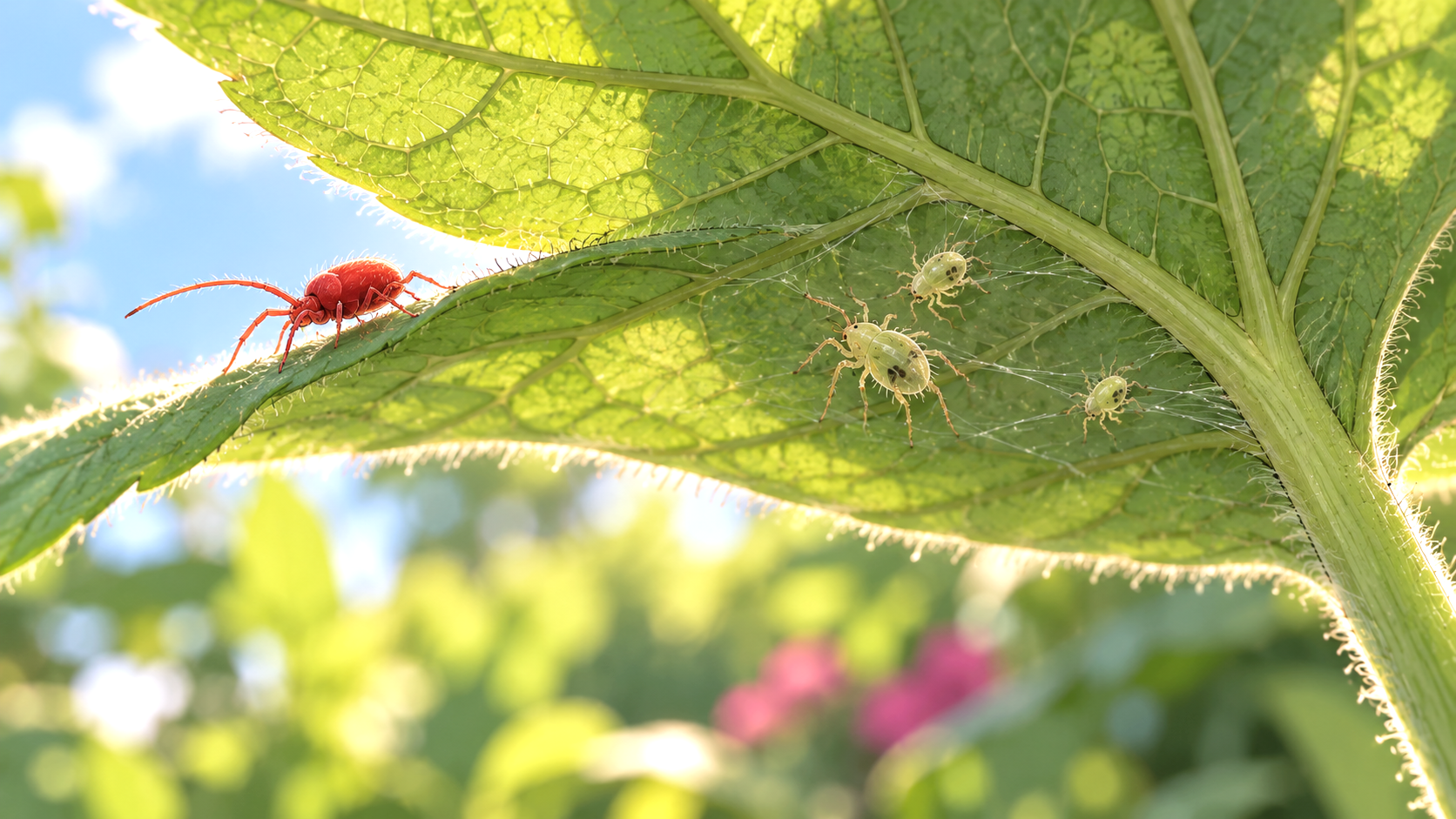
The fine webbing stretched across a leaf is more useful than the mite’s color. Clover mites do not produce silk webbing, while many common spider mites do. Both groups feed on plants, both are arachnids, and clover mites themselves belong to the spider mite family Tetranychidae, so the names make the comparison less straightforward than it first appears. In homes and gardens, “spider mite” usually refers to other tetranychid species such as the twospotted spider mite, which behaves quite differently from the clover mite.
Look at the Plant Before Trying to Judge a Moving Speck
Spider mite colonies commonly occupy the undersides of leaves. Feeding destroys individual plant cells, creating tiny pale dots known as stippling; heavier infestations can produce bronzing, yellowing, drying, premature leaf drop, and silk webbing over leaves and stems. Clover mites can also remove chlorophyll from plant tissue, so feeding may produce silvery streaks or specks on grass, but they do not surround foliage with silken threads. Webbing accompanied by widespread stippling on the undersides of leaves therefore points much more strongly toward spider mites.
Location provides another useful clue. Clover mites are strongly associated with turfgrass and low-growing vegetation and regularly leave their food plants to crawl across foundations, windows, siding, concrete, curtains, and furniture. Their tendency to become indoor nuisance invaders explains why a homeowner may notice hundreds without first seeing obvious plant injury. Spider mites usually remain associated with their host plants, where colonies and feeding damage reveal the infestation. Tiny mites covering a houseplant’s leaf undersides require a different diagnosis from clover mites gathering on window sills or crawling across exterior walls.
Their Bodies Offer a Good Confirmation Under Magnification
The most conspicuous feature of an adult clover mite is its first pair of legs. They extend well beyond the remaining legs and can be mistaken for antennae, producing the characteristic appearance described in clover mite identification. A 10× hand lens is usually enough to reveal them. Clover mites are less than 1 mm long and may be reddish brown, dark green, or other shades rather than uniformly bright red.
Spider mites vary considerably because the name encompasses many species. Twospotted spider mites, for example, are generally around 0.5 mm long and can appear greenish, yellowish, orange, or reddish, often with two dark body markings. Other spider mite species look different, so red versus green is a poor identification test. The broader range of clover mite colors makes color overlap even more likely.
| Clue | Clover mites | Common spider mites |
|---|---|---|
| Webbing | None | Common in many species, especially as populations increase |
| Standout body feature | Very long first pair of legs | No comparable elongated front pair |
| Common feeding location | Turfgrass and low vegetation | Often leaf undersides |
| Typical plant evidence | Silvering or speckling, especially in turf | Stippling, bronzing, yellowing and sometimes leaf drop |
| Indoor pattern | May invade buildings in large numbers | Usually remains associated with plants |
| Seasonal tendency | Often most active in cooler spring and fall conditions | Many pest species increase rapidly in hot, dry conditions |
Their Peak Conditions Can Be Almost Opposite
Clover mites are cool-season mites. Populations are especially active during spring and fall, and their seasonal pattern includes dormant eggs that help the population survive unfavorable temperature extremes. Turf injury associated with clover mites is consequently most characteristic of the cooler part of the growing season.
Many economically important spider mites flourish under hot, dry conditions instead. Twospotted spider mites can reproduce rapidly as temperatures rise, while drought-stressed plants are often more vulnerable to damage. Broad-spectrum insecticides can make outbreaks worse by killing predatory mites and insects that naturally suppress spider mite populations, which is one reason preserving natural enemies is central to spider mite management. Treating every plant-feeding mite infestation identically can therefore work against the biology of the pest actually present.
The Identification Changes What You Should Do Next
Clover mites crossing masonry or entering rooms call for attention to the surrounding landscape and entry points. Crushing them is best avoided because their body contents can leave rusty-red stains. Persistent indoor appearances often originate from outdoor populations near the structure, making clover mite prevention around the home more relevant than spraying indoor surfaces repeatedly.
Spider mites found on plants require plant-focused management. Inspect leaf undersides, consider whether the plant is water-stressed, and preserve beneficial predators whenever possible. Water sprays, horticultural oils, and insecticidal soaps can be appropriate in some situations, but any pesticide must be labeled for the plant and intended use. Spider mites can also develop serious populations on indoor plants, whereas confirmed clover mites on a potted plant call for a different houseplant-specific clover mite approach.
A Few Details That Can Settle a Close Identification
Do clover mites ever count as spider mites?
Taxonomically, yes. Clover mites are members of Tetranychidae, the spider mite family. The practical comparison is between clover mites in the genus Bryobia and other spider mites commonly encountered as plant pests.
Can spider mites be red?
Yes. Some spider mites can be reddish, and coloration can vary with species, life stage, season, and other factors. A red mite should not automatically be identified as a clover mite.
Do both types have eight legs?
Adult clover mites and adult spider mites have eight legs. Their larvae have six, so leg number becomes useful only when the life stage is considered.
Can both damage lawns?
Yes. Clover mites can injure turf, and several other spider mites also attack grasses. Clover mite feeding is specifically addressed by the question of whether clover mites can damage a lawn, while the identity of another turf mite has to be established before its likely damage or control can be judged.