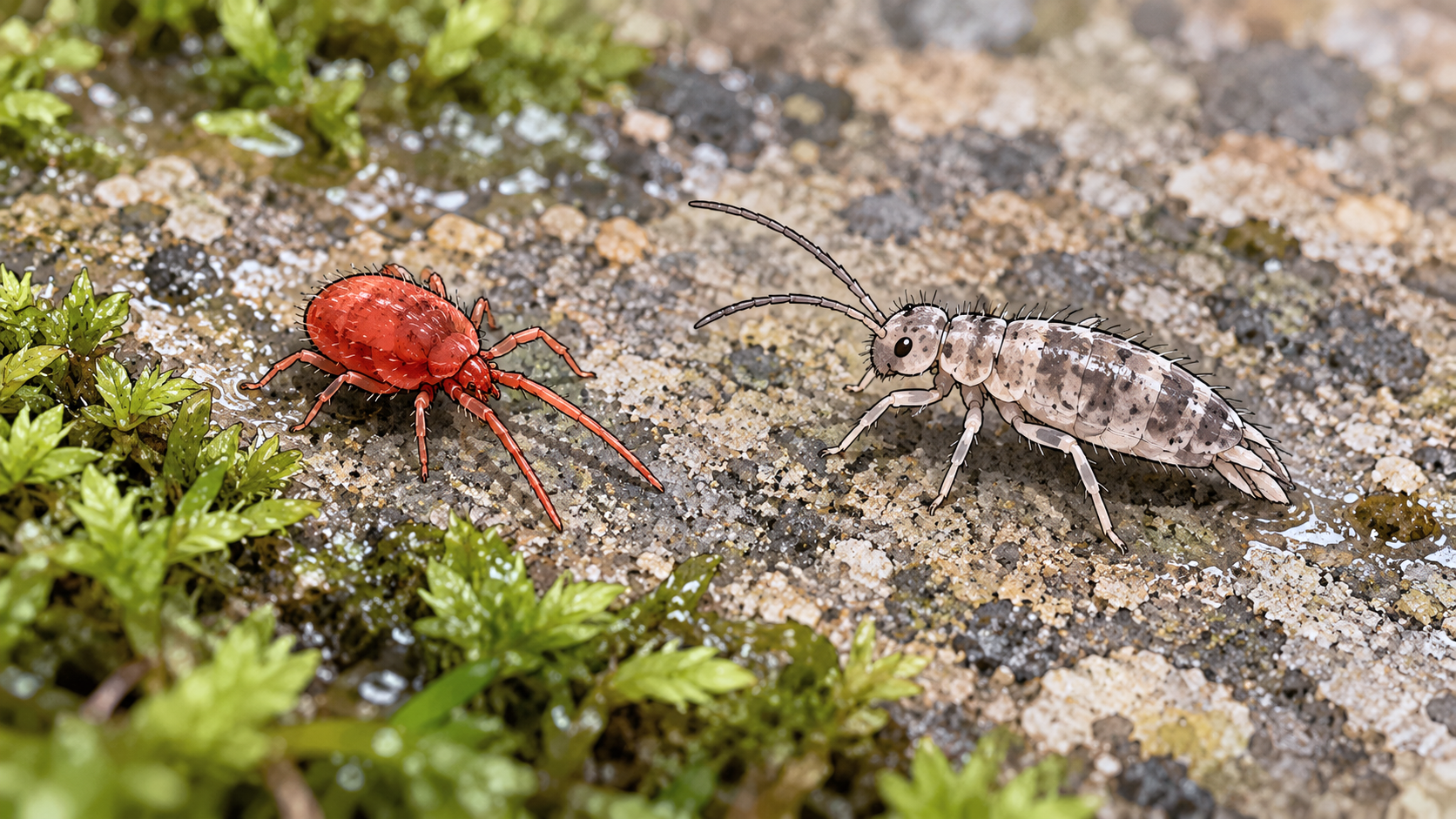
Disturb these tiny creatures and watch what happens. A springtail may suddenly launch itself several inches away. A clover mite keeps crawling. Springtails are six-legged, moisture-dependent arthropods equipped with a jumping structure called a furcula, while clover mites are eight-legged plant-feeding arachnids that cannot jump. That behavioral difference is often easier to see than anatomical details on something barely larger than a speck.
Jumping Is the Fastest Test
Most springtails carry a forked appendage folded beneath the abdomen. When released, this furcula strikes the surface and propels the springtail into the air. The movement can look almost instantaneous, particularly when a cluster is disturbed. They have no wings, so a springtail disappearing from one spot and landing somewhere else has jumped rather than flown.
Clover mites have neither wings nor a springtail-like jumping mechanism. Their movement is entirely by crawling, despite the unusually long first pair of legs that can resemble antennae. Those legs do not enable jumping, and clover mites cannot fly either. A phone camera recording in slow motion can be surprisingly useful when the animals are too small to follow easily by eye.
Moisture Favors Springtails; Vegetation Favors Clover Mites
A damp basement, leaking pipe, wet bathroom, saturated potting mix, soggy mulch, or persistently moist foundation creates much stronger conditions for springtails. They occupy high-humidity environments containing organic debris and commonly feed on fungi, algae, pollen, decaying roots, and other organic material. Large indoor populations often indicate that moisture is available somewhere nearby, although the exact source may be hidden.
Clover mites are tied more closely to living vegetation. They feed on grasses, clover, weeds, and other plants, then may leave those areas and travel across foundations or into buildings. Their outdoor origin explains why they frequently accumulate on concrete beside landscaped areas and sun-exposed window sills. Finding tiny arthropods beside a plumbing leak favors springtails; finding them migrating from lawn edges toward a sunny wall favors clover mites.
A Hand Lens Reveals Two Very Different Bodies
Springtails have six legs and genuine antennae. Many household species are slender and elongated, although globular springtails have a rounded shape. Depending on species, they may be white, gray, brown, black, purple, red, orange, yellow, or patterned, so dark coloration is not universal. Most springtails that enter homes are around 1 to 2 mm long, although the group includes both smaller and substantially larger species.
Clover mites are usually smaller, about 0.75 mm long, with an oval body and eight legs after hatching. Their oversized front pair projects ahead of the body and creates one of their most useful identification features. Clover mite colors range beyond bright red, which removes another tempting shortcut: a red specimen is not automatically a clover mite, and a gray or dark specimen is not automatically a springtail.
A Flowerpot Can Support Either One
Houseplants create an unusual area of overlap. Springtails flourish in excessively damp potting media, especially mixes rich in organic material, and often become conspicuous immediately after watering. Most feed on fungi and decomposing material rather than healthy plant tissue, although a few species can cause minor feeding injury to seedlings. Reducing excessive moisture can make the pot far less suitable for them.
Clover mites around a houseplant require a different diagnosis because their food is the plant itself rather than the damp organic environment around its roots. Before using clover mite control on a houseplant, disturbing a few specimens can provide an immediate clue. Tiny animals springing away from the soil surface strongly favor springtails, while crawling mites with elongated front legs support clover mites.
The Correct Identification Changes What You Fix
Persistent springtails indoors make moisture the first target. Correcting leaks, improving drainage, drying wet materials, reducing excessive irrigation, and lowering persistent humidity remove the conditions supporting them. Moisture reduction is the primary indoor control, and routine indoor pesticide applications do not correct the underlying habitat.
A clover mite invasion directs attention toward the building perimeter instead. Vacuuming indoor mites avoids the red stains they can leave when crushed, while reducing favorable vegetation immediately against the structure and blocking clover mite entry points can limit migration indoors. Large numbers in a room therefore do not justify treating “tiny bugs” generically; the moisture problem supporting springtails and the outdoor plant habitat supporting clover mites require different responses.
Details That Help With Unusual Specimens
Can springtails be red?
Yes. Springtails occur in many colors, including red and orange. Movement and anatomy are more reliable than color for separating them from clover mites.
Can springtails damage plants?
Most are decomposers or fungal feeders and cause little concern, but some species feed on living plant tissue. Garden springtails can produce small holes and surface scarring on young leaves, which differs from typical clover mite feeding damage.
Why are tiny bugs floating on standing water?
Springtails can occur in large numbers on wet surfaces and may collect on puddles, pool surfaces, and other standing water. Their association with moisture makes them a stronger candidate than clover mites when tiny arthropods repeatedly appear directly on water.
Will either one bite people?
Springtails do not bite or sting people, and clover mites do not bite humans either. Unexplained bites or persistent skin lesions should not be assigned to either pest merely because tiny arthropods were found nearby.