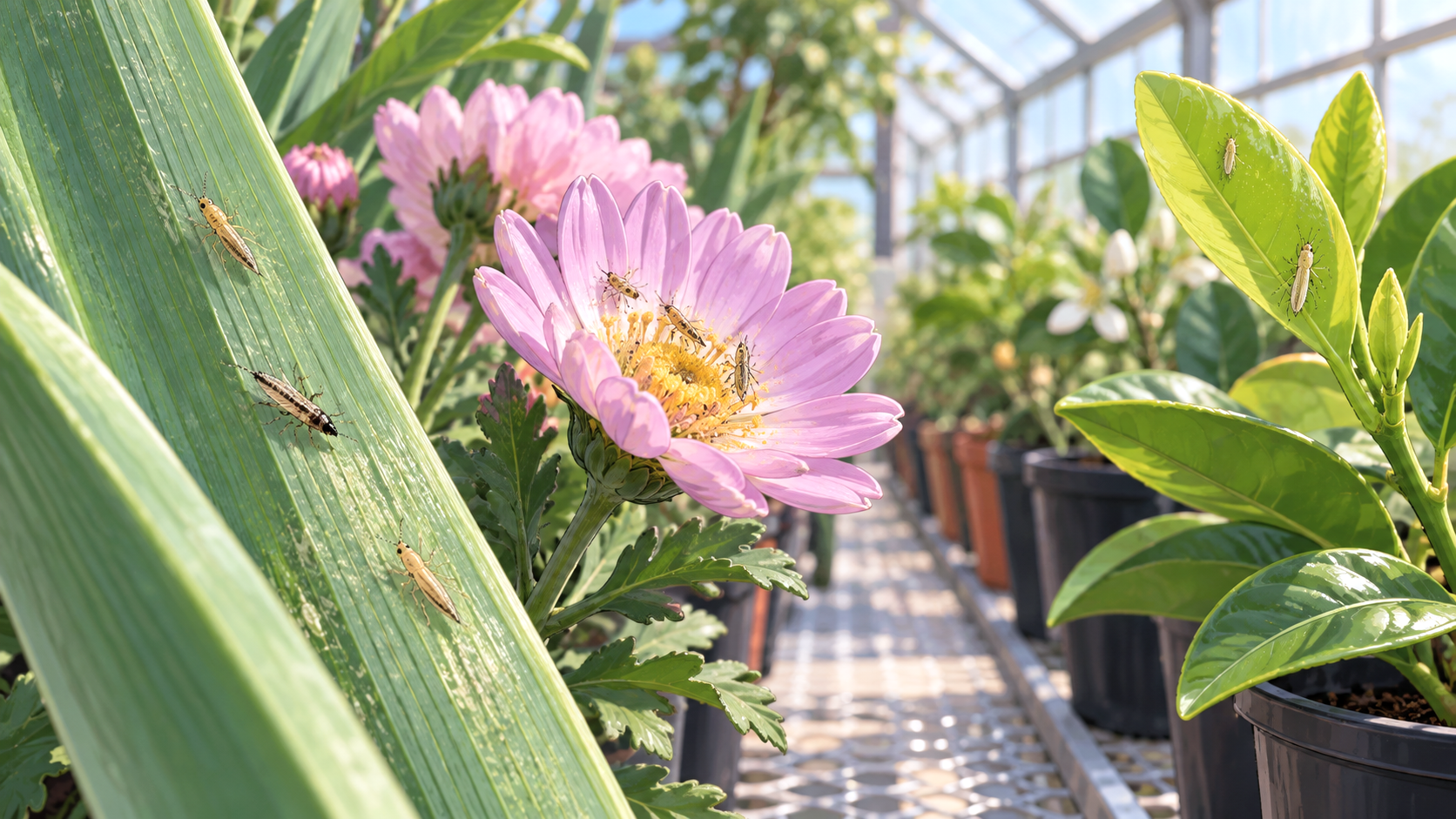
Thrips are not a single species. The name refers to insects in the order Thysanoptera, which includes many species with very different relationships with plants. Some are serious crop and ornamental pests, some specialize on particular plants, and others are predators that feed on mites and small insects. Among the species homeowners and gardeners may encounter are western flower thrips, onion thrips, greenhouse thrips, chilli thrips, citrus thrips, avocado thrips, Cuban laurel thrips, weeping fig thrips, and myoporum thrips.
Knowing that difference matters because finding a thrips does not automatically mean the plant needs treatment. Certain species cause recognizable plant damage, while beneficial predatory thrips can actually contribute to biological pest control. Exact species identification can also be difficult without magnification or expert examination, so host plant, damage pattern, body characteristics, and location all matter more than trying to match one tiny insect to a photograph.
How Different Can Thrips Species Be?
Thrips share the narrow body shape that gives the group its recognizable appearance, but species can differ substantially in color, size, preferred host plants, behavior, and the type of damage they cause. The differences among pest thrips found on landscape plants include black-bodied species, pale species, insects associated with particular hosts, and others that occur across a much wider range of plants.
Those differences are useful, although they have limits. Two species can be nearly impossible to separate with the naked eye even when their biology is different. Western flower thrips and onion thrips, for example, require examination of tiny anatomical structures for confident separation. Meanwhile, Cuban laurel thrips and weeping fig thrips are so similar that expert examination of microscopic hairs can distinguish them. Our overview of what thrips look like is therefore a better starting point when you are only trying to establish whether an unknown insect is a thrips at all.
Western Flower Thrips
The western flower thrips (Frankliniella occidentalis) is one of the most important pest thrips associated with ornamental plants and agricultural crops. It feeds on numerous hosts and can occur in flowers, buds, growing tips, and leaves. Despite the name, its distribution is no longer limited to western North America. The species has become widespread and is a significant pest of greenhouse flowers, vegetables, field crops, and some tree fruits.
Its appearance is more variable than its common name might suggest. Adults can range from pale yellow and orange to brown or very dark forms, while younger stages are generally paler. Western flower thrips also feeds on pollen and plant tissue. More importantly for susceptible crops, it can transmit plant viruses, including Tomato spotted wilt virus and Impatiens necrotic spot virus. Because its host range is broad and its coloration varies, finding a yellow thrips in a flower is not enough to identify this species confidently. That variation is one reason thrips colors should always be considered alongside other identification clues.
Onion Thrips
Onion thrips (Thrips tabaci) are another major plant-feeding species. Despite their name, they are not restricted to onions. They occur on garlic, onions, peppers, various other vegetables, and numerous herbaceous plants. Adults are generally pale yellow to light brown, while immature stages are lighter and lack the fully developed wings of adults.
Onion thrips and western flower thrips provide a good example of why identifying thrips to species can become difficult. Mature onion thrips are about 1.3 millimeters long, while western flower thrips are about 1.5 millimeters. Under a microscope, western flower thrips and onion thrips can be separated by features including thoracic hairs and antennal segmentation. Those details are far beyond what most people can see while looking at a moving insect on a leaf. Consequently, host plant and damage can help narrow the possibilities, but professional identification may be needed when the exact species matters.
Greenhouse Thrips
Greenhouse thrips (Heliothrips haemorrhoidalis) are quite different visually from the pale image many people have of thrips. Adults have dark bodies with translucent to whitish wings, while the immature stages are yellowish or whitish. They tend to feed openly in groups, commonly on the undersides of leaves, and they move relatively slowly compared with western flower thrips.
This species occurs on a variety of broad-leaved plants, including avocado, azalea, rhododendron, photinia, and other ornamentals. Feeding can leave pale, brownish, or yellowish areas on foliage, and dark fecal specks may appear around feeding sites. These marks can become useful supporting clues because the insects themselves are tiny. Greenhouse thrips are among the common pest thrips found in landscapes, but the combination of their dark adults, pale wings, host plant, and feeding pattern provides more information than any one characteristic by itself.
Chilli Thrips
Chilli thrips (Scirtothrips dorsalis) are tiny plant pests with a broad host range. The species occurs in parts of the United States and can attack ornamental plants as well as agricultural crops. Feeding is particularly noticeable around tender plant growth, where damaged foliage can become discolored or distorted.
One of the difficulties with chilli thrips is that several other thrips can resemble them closely. Chilli thrips cannot reliably be identified to species in the field because they resemble avocado thrips, citrus thrips, onion thrips, western flower thrips, and other small species. That makes plant damage useful for detecting that something is wrong, but not sufficient for proving which thrips caused it. A badly distorted shoot may prompt you to inspect for insects, yet an exact species diagnosis can require microscopic examination.
Citrus Thrips
Citrus thrips (Scirtothrips citri) are associated especially with citrus, although they can occur on other hosts. Their importance comes largely from feeding on young plant tissue and developing fruit. Rather than thinking of them as simply another pale thrips, it is more useful to connect the insect with its host and the characteristic injury occurring on susceptible plants.
Citrus thrips also illustrate why species names matter when reading pest information. They belong to the same genus as chilli thrips, but the two are separate species with different host relationships and pest-management implications. Identification resources for common pest thrips include citrus thrips alongside avocado, onion, greenhouse, and western flower thrips, which gives a sense of how many visually similar insects can occur within the broader group.
Avocado Thrips
Avocado thrips (Scirtothrips perseae) are closely associated with avocado. They are small, pale thrips that feed on leaves and developing fruit, where feeding can scar the fruit surface. Their relationship with avocado makes the host plant particularly useful when narrowing down an identification.
However, seeing a tiny pale thrips on an avocado tree still does not make species identification automatic. Other thrips can occur on the same plants, and mature body size is only one clue. The broader identification differences among thrips species show that avocado and citrus thrips adults are smaller than mature western flower and onion thrips. Those differences become more useful under magnification than they are during a casual plant inspection. Our article on how big thrips are looks more closely at how much size varies across the group.
Cuban Laurel Thrips
Cuban laurel thrips (Gynaikothrips ficorum) are dark thrips strongly associated with Indian laurel fig (Ficus microcarpa). Their feeding causes leaves to curl and fold, creating protected areas where the insects can live. Adults are black to dark brown and considerably larger than many familiar plant pest thrips, reaching approximately 1/10 to 1/8 inch in length.
The host plant and leaf distortion can be particularly informative when these thrips are suspected. However, another closely related species creates a complication. Cuban laurel thrips closely resemble weeping fig thrips, and the two Gynaikothrips species require expert examination of microscopic hairs for reliable separation. In other words, even a clear photograph of a dark thrips inside a folded ficus leaf may not be enough to determine the exact species.
Weeping Fig Thrips
Weeping fig thrips (Gynaikothrips uzeli) are closely related to Cuban laurel thrips but differ in their primary host association. Weeping fig thrips infest Ficus benjamina, while Cuban laurel thrips are primarily associated with Ficus microcarpa. Both species can cause leaves to curl or fold as they feed, and both have dark adults with much paler immature stages.
This is one of the clearest examples of why the plant itself can become part of a thrips identification. The insects are extremely similar, but their host associations provide useful context before microscopic characteristics are examined. Even so, host plant alone should not be treated as absolute proof of species. The physical similarities between these two insects are strong enough that exact identification may still require an expert.
Myoporum Thrips
Myoporum thrips (Klambothrips myopori) primarily attack plants in the genus Myoporum. Adults have dark bodies and whitish wings, while immature thrips are much lighter and can become orangish as they develop. Their feeding causes young terminal growth to become tightly bunched, swollen, twisted, and gall-like.
Those distorted terminals provide a sheltered environment where multiple life stages can occur together. As a result, opening affected growth may reveal dark adults alongside much paler immature insects. Someone unfamiliar with the different stages of thrips development could easily assume that two different pests are present. In this case, the host plant, characteristic terminal distortion, and combination of life stages tell a much more useful story than body color alone.
Are All Thrips Plant Pests?
No. Treating every thrips as a pest is one of the easiest mistakes to make when identifying these insects. Certain species are predators that feed on mites, other thrips, and small arthropods. Killing them simply because they belong to Thysanoptera can remove insects that are helping suppress other plant pests.
Sixspotted thrips (Scolothrips sexmaculatus) are one example. These predatory thrips feed on pest mites and can be recognized as adults by three dark spots on each forewing. Franklinothrips species provide another example of predatory thrips. Their larvae and adults prey on thrips and other small arthropods. Therefore, identification is not merely an exercise in naming the insect. It can determine whether removing it from a plant makes sense at all.
Why Exact Thrips Species Can Be Difficult to Identify
Thrips identification gets much harder once you move from “this is a thrips” to “this is exactly Thrips tabaci.” Many species are tiny, similar in overall shape, and variable in color. Some of the features used to separate them include microscopic hairs, antennal segments, wing characteristics, and other anatomical structures that cannot be judged reliably with the naked eye. Specialized thrips identification resources therefore rely heavily on microscopic morphology.
This also means that online photographs have limits. A picture may help you establish that an insect has the general appearance of a thrips, but a blurry phone image should not be pushed into a species-level identification that its details cannot support. We think the better approach is to narrow the possibilities using the host plant, body size, coloration, damage, and behavior, then seek expert identification when knowing the exact species would change what you do next.
Narrow Down the Thrips Before Deciding What to Do
Start with the plant. Record which plant the insects are on, where on the plant you find them, what the insects look like, and whether the plant shows feeding injury. Then examine several specimens rather than relying on one individual. A mixture of adults and immature thrips can look surprisingly diverse, especially when the adults are dark and the younger stages are pale.
Next, decide whether species-level identification is actually necessary. Finding a thrips on an undamaged plant does not automatically establish a pest problem, particularly because some thrips are predators and some plant-feeding species cause meaningful damage only on particular hosts. When the plant itself is showing symptoms, comparing what you found with the signs of a thrips infestation gives you more evidence before you move toward control. If the exact species will affect a crop-management or biological-control decision, professional identification is the more reliable route.
More Questions About Thrips Species
Can several species of thrips live in the same garden?
Yes. A garden can provide flowers, foliage, prey, and host plants suitable for different thrips species. As a result, finding one species does not mean every thrips elsewhere in the garden belongs to the same species.
Are flower thrips one specific species?
No. “Flower thrips” can refer to thrips associated with flowers, and several species in the genus Frankliniella are commonly called flower thrips. Western flower thrips, Frankliniella occidentalis, is one particularly important member of that genus.
Can you identify a thrips species from its host plant alone?
Not reliably. Host association can narrow the possibilities and is especially useful for strongly host-associated species, but different thrips can occur on the same plant. Exact identification may require physical characteristics as well.
Does finding a predatory thrips mean there are other pests nearby?
Predatory thrips feed on small arthropods such as mites and other thrips, but finding one individual does not tell you the size or severity of any prey population. Inspect the plant itself before drawing conclusions about an infestation.
2 thoughts on “The Different Species of Thrips”