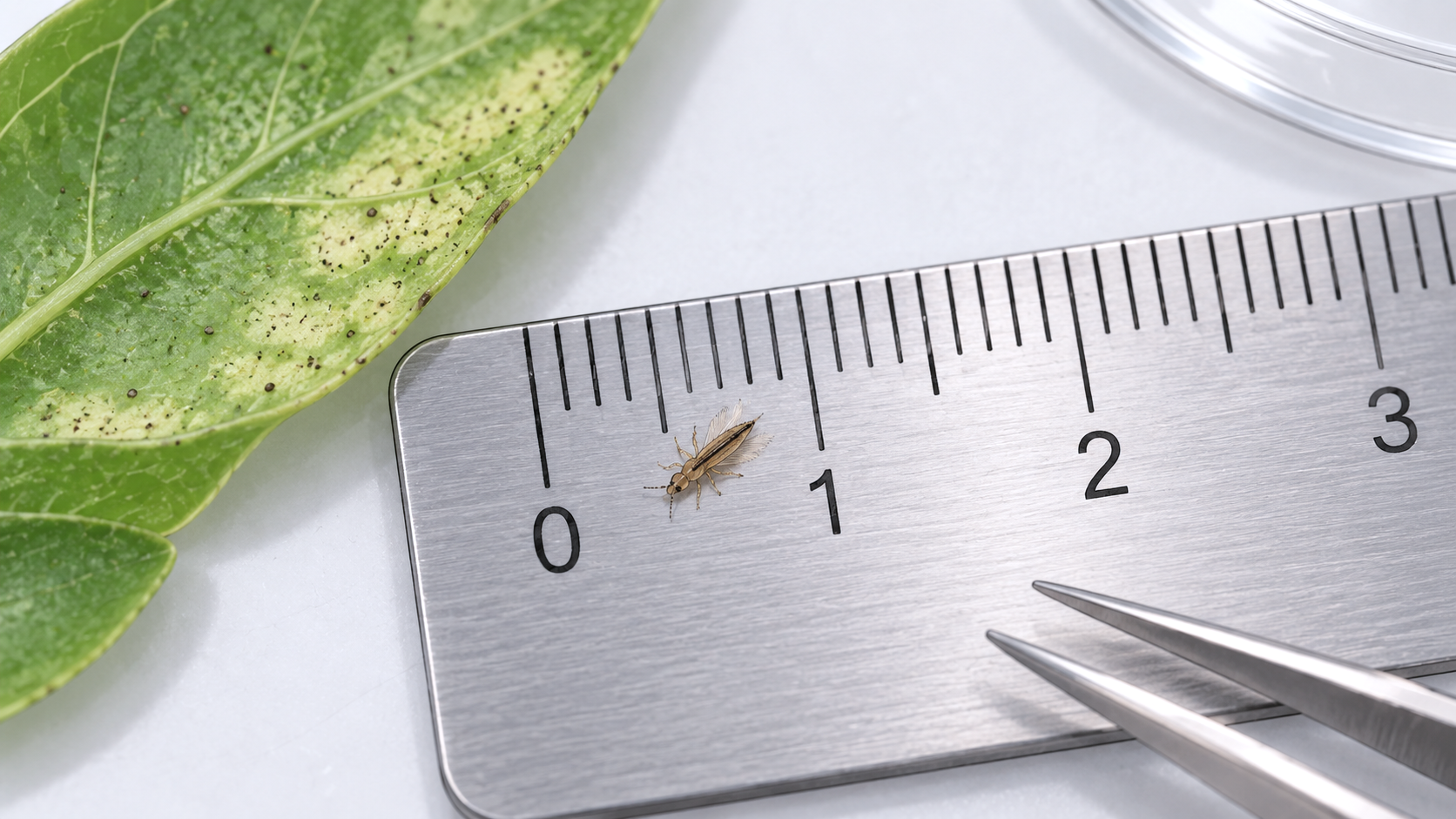
Thrips are tiny insects. Many pest thrips are about 0.5 to 1.5 millimeters (1/50 to 1/16 inch) long, although size varies by species. Some larger thrips reach about 2.5 to 3 millimeters. Their extremely narrow bodies make them look even smaller, which is why a hand lens is often useful for examining them properly.
How Big Is an Adult Thrips?
For the pest thrips commonly encountered on plants, a useful general range is 0.5 to 1.5 millimeters long. That corresponds to about 1/50 to 1/16 inch. This 0.5-to-1.5-millimeter range for thrips covers many of the species encountered on ornamental plants.
However, there is no single measurement that applies to every thrips species. The order Thysanoptera contains many species, and their adult sizes differ.
That variation explains why you may find two insects that clearly have the typical appearance of thrips but are noticeably different in length. Size can support an identification, but it should not become the only feature you use.
How Big Are Western Flower Thrips?
Western flower thrips (Frankliniella occidentalis) are among the better-known plant pest thrips. Mature western flower thrips are about 1.5 millimeters (0.06 inch) long.
That puts them near the upper end of the general 0.5-to-1.5-millimeter range given for many common pest thrips. Their size is also useful when comparing them with some closely related plant pests.
For example, mature western flower thrips measure about 1.5 millimeters, while mature onion thrips are slightly smaller.
The difference is real, but it is only a fraction of a millimeter. You should not expect to reliably separate the two species by glancing at insects moving across a leaf.
How Big Are Onion Thrips?
Adult onion thrips (Thrips tabaci) are about 1.3 millimeters (0.05 inch) long. That makes them slightly smaller than the approximately 1.5-millimeter western flower thrips.
The 1.3-millimeter adult size of onion thrips shows how small the differences between common species can be. Western flower thrips are only about 0.2 millimeter longer based on those measurements.
That is too small a difference to make species identification by naked-eye size practical. Even when two thrips species differ in mature body size, other physical characteristics may be needed to tell them apart reliably.
Our separate look at the different species of thrips covers those species differences without turning size into a substitute for proper identification.
Can Thrips Be Bigger Than 1.5 Millimeters?
Yes. The frequently cited 0.5-to-1.5-millimeter range should not be treated as a maximum for every member of the group.
Myoporum thrips (Klambothrips myopori), for example, have adult body lengths of about 2 to 2.5 millimeters. That already puts them beyond the size of western flower and onion thrips.
Some Gynaikothrips are larger again. Adult Cuban laurel and weeping fig thrips can reach approximately 1/10 to 1/8 inch in length, which is roughly 2.5 to 3.2 millimeters.
Predatory species can also exceed the familiar plant-pest range. Adult Franklinothrips, along with their mature larvae and pupae, are about 2.5 to 3 millimeters long.
So an insect being longer than 1.5 millimeters does not automatically rule out thrips. The species matters.
Why Do Thrips Look Smaller Than Their Measurements Suggest?
Length tells only part of the story.
Thrips are exceptionally slender insects. An insect measuring 1.5 millimeters from head to abdomen is still difficult to notice when its body is little more than a narrow line against a leaf.
Their proportions also explain why descriptions such as “tiny speck” can be misleading. A thrips is not shaped like a compact dot. When you get a close enough view, the body is elongated.
This narrow profile matters when identifying something you found on a plant. Our overview of what thrips are provides the broader biological context, but size makes much more sense once you combine the measurement with their characteristic body shape.
Are Thrips Visible to the Naked Eye?
Adult thrips can be visible without magnification, but seeing one and examining one are very different things.
At around 1 millimeter long, a thrips can register as a moving speck or narrow line on a contrasting surface. However, identifying fine anatomical details is much harder. Guidance for indoor plants describes thrips as very small insects about 1/16 inch long, and a hand lens makes their features considerably easier to inspect.
Contrast matters too. A tiny insect moving across a plain surface is easier to notice than the same insect tucked against a leaf vein or flower structure.
Therefore, failing to notice thrips during a quick inspection does not tell you much about their actual size. Their narrow bodies and the places where they spend time can make them easy to overlook.
Are Young Thrips Smaller Than Adults?
Thrips grow through several immature stages before reaching adulthood, so the smallest individuals in a population are not necessarily adults.
The immature stages retain the slender general body shape, although they lack the fully developed wings of adults. As they develop, their body size increases through successive stages.
That means a plant can carry thrips of noticeably different sizes at the same time. A very small pale individual and a larger winged individual may represent different developmental stages rather than different pests.
Size also becomes much less useful when you are trying to interpret immature insects without magnification. Our article on what thrips larvae and nymphs look like handles those identification differences in detail, while the thrips life cycle explains how those stages fit together.
Are Thrips Eggs Smaller Than Adult Thrips?
Yes. Thrips begin life as eggs, so the eggs are smaller than the adults that eventually develop from them.
However, giving one universal egg measurement would create the same problem as giving one universal adult measurement. Egg size varies among species, and where the eggs are placed also affects whether you are likely to notice them.
Some plant-feeding thrips insert eggs into plant tissue rather than leaving them fully exposed. As a result, looking for something smaller than an adult thrips is not always the most practical way to detect an infestation.
The appearance and placement of the eggs deserve their own treatment, so we cover those details separately in what thrips eggs look like.
Does Thrips Size Help With Identification?
Yes, but mostly as supporting evidence.
An insect several centimeters long clearly is not a thrips. At the scale where thrips actually occur, however, size overlaps with many other tiny arthropods. Measuring an insect at approximately 1 millimeter does not prove that it belongs to Thysanoptera.
Shape, wings, antennae, behavior, life stage, and host plant can provide additional clues. Adult thrips typically have narrow wings fringed with long hairs, while immature stages lack those adult wings.
Species identification can demand even finer details. For western flower and onion thrips, for example, microscopic structures rather than body length alone can separate the species.
We would treat size as a filter, not a verdict. It can tell you whether the insect is in a plausible range, but the rest of the body still has to match.
How to Check the Size of a Thrips You Found
Trying to measure a thrips while it runs around a leaf is unnecessarily difficult. First, get the insect onto a surface where you can see it clearly.
A plain light background makes a dark thrips easier to follow. Then use a hand lens or a close macro photograph with a known scale beside the insect. A millimeter ruler is much more useful here than an inch ruler because the differences between many thrips species are measured in fractions of a millimeter.
Do not stretch a blurry photograph until the insect looks large enough to inspect and then judge its size from the enlarged image. Magnification changes how large the insect appears on your screen, not its actual dimensions. Include a scale in the original image if measurement matters.
Once you have established that the insect falls within a plausible thrips size range, combine that measurement with body shape and other identification features. If several plants contain similar insects, checking the signs of a thrips infestation can help connect what you found with what is happening to the plants.
Other Questions About Thrips Size
Are all adult thrips the same size?
No. Adult size varies by species. Western flower thrips are about 1.5 millimeters long, while some Gynaikothrips species can reach approximately 2.5 to 3.2 millimeters.
Are male and female thrips always the same size?
No. Size differences between sexes occur in some species. For example, male myoporum thrips are slightly smaller than females, although both retain the same general narrow thrips body form.
Can a phone camera make a thrips look much bigger than it really is?
Yes. A macro or enlarged photograph can make a millimeter-scale insect fill most of the screen. Without a ruler or another object of known size in the original image, the photograph alone provides poor evidence of actual body length.
Is an insect 3 millimeters long too big to be a thrips?
No. Although many familiar pest thrips are around 0.5 to 1.5 millimeters long, some thrips reach approximately 3 millimeters. Body shape and other identifying features still need to match.