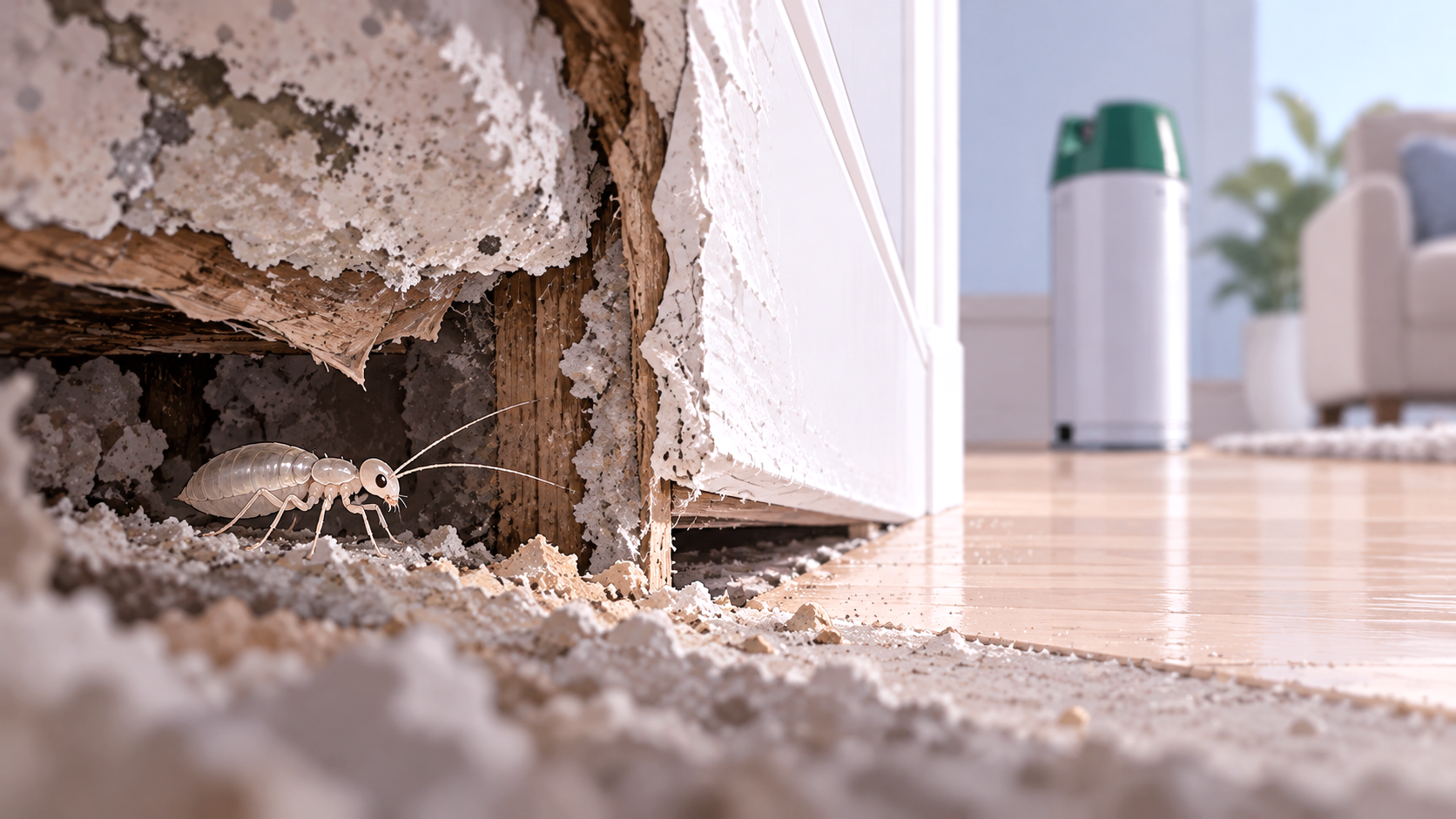
Bug bombs are not a dependable way to eliminate booklice. True professional fumigation can kill psocids when a suitable fumigant reaches a lethal concentration for long enough, but eggs can be much harder to kill than adults and nymphs. For ordinary household booklice, correcting moisture is usually more appropriate than either treatment.
A Bug Bomb Is Not the Same Thing as Structural Fumigation
The two terms are often used interchangeably, but they describe very different treatments. A total-release fogger, commonly called a bug bomb, empties an aerosol pesticide into a room. Many products use pyrethrins or pyrethroids suspended as droplets, and those droplets must reach susceptible insects or treated surfaces to have an effect. Total-release foggers primarily disperse pesticide through exposed room space, so they should not be assumed to penetrate every concealed harborage.
True fumigation fills an enclosed treatment area with an insecticidal gas at a controlled concentration. Gas can penetrate spaces that ordinary spray droplets cannot, but professional fumigation requires specialized products, dosage calculations, monitoring, sealing, aeration, and legal safeguards. It is not the household equivalent of activating several aerosol cans.
That difference is important for booklice because their common hiding places include cracks, wall voids, bindings, cardboard, and stored materials, where surface-directed pesticide droplets may never reach them.
Bug Bombs Are Poor at Reaching the Places Booklice Actually Occupy
A fogger can kill insects that receive enough pesticide, but the aerosol does not necessarily enter deep cracks or enclosed materials at an effective dose. The limitation is well recognized with other concealed household pests: fogger pesticides must contact the target insect, and pests protected in cracks and crevices can survive.
Booklice are exceptionally small and can remain inside narrow construction gaps, behind baseboards, beneath stored cardboard, within shelving joints, or around damp material hidden from the open room. A cloud of pesticide settling across exposed surfaces may therefore produce dead insects without reaching the population responsible for continued sightings.
The visible signs of a booklice infestation are more useful for locating recurring hotspots than treating the entire room indiscriminately. If insects consistently emerge from one cabinet edge or wall section, the source can remain protected even after the surrounding room has been fogged.
More Fogger Does Not Mean Better Penetration
Using extra cans to compensate for poor coverage introduces serious risk without guaranteeing control. Total-release foggers commonly contain flammable aerosol propellants, and excessive product can create fire or explosion hazards. Safe use requires the correct number of foggers for the space, removal of ignition sources, evacuation for the specified interval, and ventilation before reentry. Improper fogger use has caused fires, explosions, and pesticide exposure illnesses.
Foggers also should not be activated inside cabinets, closets, or other small enclosed spaces in an attempt to force pesticide into a booklice hiding place. Those confined applications can create an explosion hazard.
A household infestation rarely justifies increasing pesticide exposure when moisture reduction is normally the most effective booklice control.
Real Fumigants Can Kill Psocids, but Eggs Complicate Complete Control
Stored-product research demonstrates that true fumigation can kill Liposcelis booklice. Sulfuryl fluoride, for example, produced complete mortality of many tested adults and nymphs at relatively modest experimental concentrations. Eggs were considerably more tolerant. In experiments across five psocid species, some eggs survived sulfuryl fluoride concentrations far above those needed to kill mobile stages.
That life-stage difference prevents a simple claim that fumigation automatically eliminates every booklouse. Species also vary. Liposcelis decolor adults required higher sulfuryl fluoride exposure than several other species in the same study, while L. paeta eggs survived even the highest concentration tested.
Booklice develop through egg, nymph, and adult stages, so a treatment that controls adults but leaves viable eggs can be followed by renewed activity after hatching.
Phosphine Works Against Stored-Product Psocids, but Resistance Can Be Strong
Phosphine is another fumigant used extensively in commercial stored-grain protection, not a household booklice treatment. Liposcelis bostrychophila populations with strong phosphine resistance have been documented, and complete control depends on concentration, temperature, humidity, and exposure duration. Resistant L. bostrychophila can require prolonged fumigation for all life stages to be eliminated.
Egg biology adds another complication. Phosphine exposure can delay development in resistant eggs rather than killing them immediately, with research showing that extended exposures may be necessary so surviving eggs hatch into more susceptible nymphs. Phosphine resistance is now a significant issue among stored-product insects more broadly, including pests exposed repeatedly in commercial storage systems. Resistance threatens the reliability of phosphine as a grain fumigant.
None of this makes phosphine an option for a homeowner. Commercial fumigants require trained, licensed handling and controlled treatment conditions.
Fumigation Research on Stored Grain Does Not Create a Household Recommendation
Much of the detailed fumigation literature concerns psocids infesting grain, warehouses, mills, or food-storage systems. Those settings can justify whole-structure or commodity fumigation because large amounts of valuable stored product are at risk and conventional treatments may have failed.
A few booklice on a bathroom wall or bookshelf represent a completely different control problem. Indoor household booklice are usually nuisance pests associated with excessive humidity and fungi rather than insects requiring eradication with a structural fumigant. The relationship between booklice and mold often makes the presence of moisture more important than the number of insects visible at a particular moment.
Even the stored-product literature describes psocid management as unusually difficult because susceptibility varies among species and treatments. A major review of Liposcelis management found that conventional control methods can perform inconsistently against stored-product psocids.
Neither Treatment Fixes the Moisture That Created a Household Infestation
A theoretically perfect fumigation could kill every booklouse in a building and still leave behind the environment that allowed them to thrive. High relative humidity, condensation, leaking plumbing, damp construction materials, and fungal growth can make the same property suitable again once treatment ends.
Booklice depend strongly on atmospheric moisture, and the humidity requirements that allow them to survive are central to household control. Sustained humidity below roughly 45% to 50% becomes unfavorable for many indoor psocids, whereas persistent dampness allows reproduction to continue.
Chemical treatment is correspondingly weak when the moisture source remains. Household insecticides are normally unnecessary and perform poorly when damp conditions persist. A fogged room with a leaking wall is still a suitable booklice habitat after the pesticide dissipates.
Professional Fumigation Would Usually Be Disproportionate for a Home
Structural fumigation can be an intensive process involving evacuation, sealing, specialized equipment, restricted-use pesticides, monitoring, and controlled aeration. Booklice rarely present the kind of structural damage or medical risk that would justify such a response in an ordinary residence.
A professional inspection becomes more reasonable when large populations continue despite sustained drying, the infestation appears to originate from inaccessible building cavities, or the moisture source cannot be identified. The decision about when professional pest control is appropriate for booklice is therefore different from automatically requesting fumigation. A pest professional may recommend no pesticide at all if the insects are being maintained by a building-moisture issue.
Heat Treatment Is Different From Fumigation
Professional heat is sometimes confused with fumigation because both may involve treating an entire enclosed space. Heat uses temperature rather than an insecticidal gas. Research on stored-product psocids shows that sufficient heat can kill them, although eggs can again be more tolerant than mobile stages.
The effectiveness of heat against booklice depends on both temperature and exposure duration, as well as whether protected locations actually reach lethal conditions. Neither heat nor fumigation should be improvised with household appliances or unregistered chemicals.
For small movable items, controlled cold treatment can also be relevant because freezing can kill booklice when the object remains cold enough for sufficient time. That is a separate object-treatment strategy rather than a room-wide substitute for moisture control.
Questions About Bug Bombs, Foggers, and Booklice
Will a fogger kill booklice crawling openly in the room?
It may kill exposed individuals if the pesticide reaches them at a sufficient dose and the product label permits the intended use. Hidden booklice can remain untouched.
Do bug bombs kill booklice eggs?
Do not assume they do. Eggs may be concealed where aerosol droplets do not reach them, and several psocid species have eggs that are substantially more treatment-tolerant than adults.
Can you set off a bug bomb inside a closet full of booklice?
No. Total-release foggers should not be used in small confined spaces such as closets or cabinets because concentrated aerosol propellant can create a fire or explosion hazard.
Would tent fumigation eliminate booklice?
A properly designed professional fumigation using an appropriate registered fumigant can kill psocids, but species and life stages differ in susceptibility. Complete egg control may require more exposure than adult control.
Can fumigation stop booklice from returning?
Not by itself. If excessive humidity, leaks, wet materials, or fungal growth remain after treatment, the building can become suitable for another population.
Are bug bombs better than normal insecticide sprays for booklice?
Not inherently. Foggers trade targeted placement for broad aerosol dispersal, while hidden booklice may still avoid adequate exposure. The best pesticide approach for booklice depends on the label, application site, and whether chemical treatment is warranted at all.
What is usually more effective than a bug bomb?
Remove accessible insects, correct leaks and condensation, discard unsalvageable damp material, and maintain sufficiently low humidity throughout the breeding area. Those measures form the core of getting rid of booklice in a home because they prevent the environment from continuing to support the population.