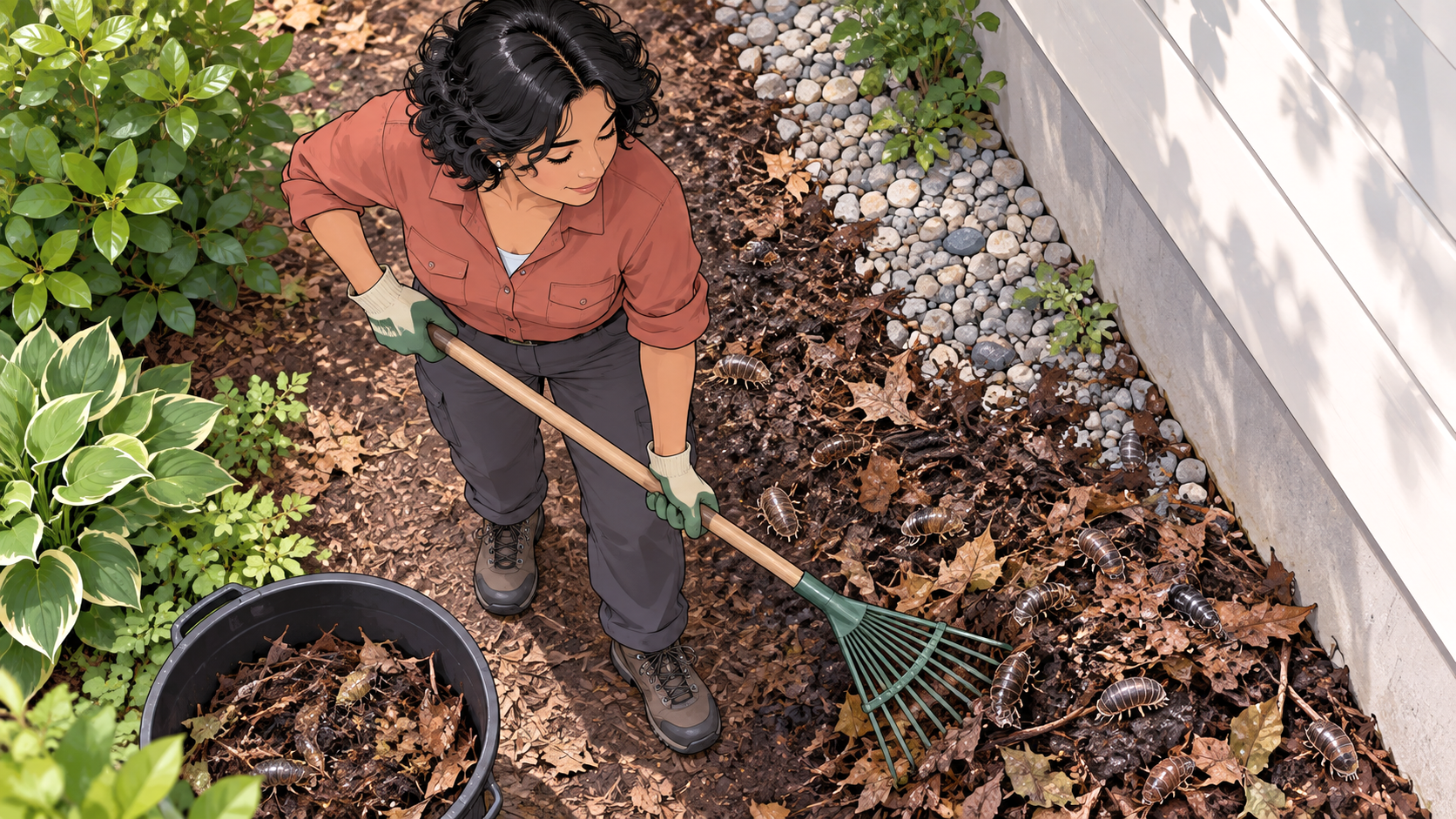
To get rid of roly-polies naturally, reduce excess soil moisture, remove damp hiding places, collect concentrated groups with simple traps, and seal openings that allow them into your home. These methods work by making problem areas less suitable for pill bugs without relying on chemical pesticides. In gardens, protect vulnerable seedlings and fruit while leaving harmless populations elsewhere undisturbed. The common roly-poly (Armadillidium vulgare) is a decomposer, so eliminating every individual is neither necessary nor beneficial.
The most effective approach depends on where the animals are causing trouble. Roly-polies beneath an outdoor compost pile need no intervention, while those repeatedly entering a basement or feeding on strawberries require changes to their immediate surroundings.
Start by Removing the Conditions That Keep Roly-Polies Around
Persistently wet soil and ground-level shelter allow roly-polies to remain active in places where they would otherwise struggle with dehydration. A flowerbed receiving daily irrigation, for example, can support dense concentrations beneath mulch and fallen vegetation. Reducing unnecessary watering makes that location less hospitable without requiring the removal of every animal. The University of California’s pill bug management recommendations advise allowing soil surfaces to dry between irrigations where plant health permits and watering early enough for exposed surfaces to become drier before evening.
Irrigation changes should reflect the plants being grown. Newly transplanted vegetables may require consistently moist root zones, while established ornamentals can have different watering needs. Drip irrigation provides water close to plant roots without repeatedly wetting an entire bed, and correcting leaking hoses prevents small areas of continuously saturated soil. Other moisture-associated creatures, including springtails in potted plants, can become conspicuous under similar conditions. Their presence may help identify an overly wet growing environment, although springtails and pill bugs require different identification.
Shelter removal is equally useful. Clear unnecessary piles of wet cardboard, loose boards, rotting plant debris, and discarded containers from the affected area. Thin excessively dense organic mulch around vulnerable seedlings rather than stripping an entire garden of beneficial ground cover. Dead leaves and decomposing wood support soil organisms, so retain some natural habitat away from buildings and susceptible crops. The Colorado State University guidance on pill bugs and related arthropods identifies moisture control and shelter reduction as the primary nonchemical measures, with pesticide treatment generally unnecessary.
Trap Roly-Polies With Potato Halves or Damp Newspaper
Simple collection traps are useful when numerous pill bugs are concentrated around a small vegetable bed or patio. A hollowed-out raw potato half can attract animals seeking food and shelter. Place it cut-side down on the soil near the affected plants, then lift it the following morning to collect the individuals gathered underneath. Check applicable local rules before moving collected pillbugs outdoors, particularly where non-native species could be introduced into new habitats. Avoid releasing them into natural areas outside their established range.
Rolled, slightly damp newspaper provides another collection method. Place it near areas with visible activity and inspect it the next morning, shaking the contents into a container. The Oregon State University Extension response on pill bugs damaging strawberries describes potato halves, fruit rinds, and rolled newspaper as practical ways to concentrate these animals for collection.
A trap works only on individuals that enter it. It does not eliminate hidden pill bugs throughout the surrounding soil, and leaving food-based traps unattended can attract other organisms or contribute additional decaying material. Empty them regularly and remove them when collection is finished.
For a simple comparison, place one trap beside the affected plants and another in a nearby sheltered area. Count the pill bugs collected at each location under similar conditions. If one trap collects 18 and the other collects 3, the first location has produced six times as many captures. This does not establish the total population, but it helps identify where collection and habitat changes are most worthwhile.
Protect Seedlings, Strawberries, and Other Vulnerable Plants
A healthy garden can contain plenty of roly-polies without experiencing meaningful plant damage. Intervention becomes more useful when they are observed chewing tender seedlings, new roots, or produce resting against moist soil. These feeding situations require targeted protection rather than treating the entire planting area.
Raise ripening strawberries and other low-growing fruit away from direct soil contact using clean supports or appropriate plant-growing materials. Remove damaged or overripe fruit promptly, since deteriorating tissue provides additional food. Seedlings are more difficult to protect because their stems and roots are close to the ground. Where feeding has been confirmed, reduce surrounding debris, collect pill bugs from beneath nearby objects, and consider growing vulnerable transplants in raised containers until they become established.
Garden earwigs also feed on certain vulnerable plants, while slugs and other animals can produce similar damage. Inspect affected plants after dark before assigning responsibility. The University of California’s garden management guidance emphasizes identifying the actual feeding organism and adjusting cultural practices rather than automatically applying treatments to every arthropod present.
Plastic mulch can also reduce pill bug problems in suitable vegetable-growing situations because it offers a different surface environment from decomposing organic mulch. Black plastic mulch is specifically identified as a useful option in pill bug management, although it must be selected with the crop’s moisture and temperature needs in mind.
Keep Roly-Polies Outside Without Spraying Your Home
Indoor roly-poly problems are best addressed at the point of entry. A door sweep that leaves a visible gap, an opening around utility lines, or a crack near a ground-level foundation can provide access. Seal suitable gaps, repair damaged weatherstripping, and inspect basement entrances where soil or landscaping sits close to the doorway. The Environmental Protection Agency’s household pest prevention guidance includes closing entry points, fixing water leaks, and eliminating conditions that provide shelter.
Outside the building, pull mulch and decaying vegetation away from the foundation, particularly near entrances. Redirect irrigation that repeatedly wets exterior walls and correct downspouts discharging beside the house. If pill bugs are collecting beneath wet materials immediately next to a doorway, removing those materials can reduce the number reaching the entrance.
Indoors, collect live animals with a cup and remove dead ones with a vacuum or dustpan. A damp basement or crawlspace may require improved drainage, plumbing repairs, or dehumidification. Springtails appearing in damp bathrooms can indicate comparable moisture problems, although neither pest alone establishes the presence of a plumbing leak. Repeated moisture accumulation should be investigated independently.
The EPA’s prevention-first pest management recommendations favor removing water, shelter, and access routes before using pesticides. Indoor spraying is particularly difficult to justify for animals that ordinarily cannot maintain populations in dry living spaces.
Do Vinegar, Essential Oils, or Diatomaceous Earth Work?
Several frequently suggested home remedies are less useful than habitat modification. Vinegar sprays and essential-oil mixtures are not established, reliable solutions for controlling roly-poly populations. Even when a substance affects an exposed individual, it leaves the moisture and shelter conditions supporting the remaining population unchanged. Concentrated oils and acidic mixtures can also damage sensitive plants or surfaces, making routine application difficult to justify.
Diatomaceous earth is sometimes presented as a natural pest-control powder, but it has important limitations in damp environments. Its desiccating action depends on remaining dry, while the places where pill bugs gather are typically moist. Its effectiveness against these heavily armored terrestrial crustaceans is also less dependable than its use against certain susceptible insects. The National Pesticide Information Center’s diatomaceous earth fact sheet explains its drying action and the potential for respiratory, eye, and skin irritation during exposure.
Food-grade diatomaceous earth should not be treated as a harmless substitute for a registered pesticide. The National Pesticide Information Center’s guidance on food-grade diatomaceous earth recommends selecting a properly labeled pest-control product and minimizing exposure, particularly around children and pets.
There is little reason to introduce dusts or homemade chemical mixtures when the underlying problem can be corrected through drainage, collection, and exclusion. These physical measures also avoid unnecessary exposure of non-target soil organisms.
Keep Roly-Polies From Returning to Problem Areas
After removing a concentrated population, inspect the original location during the next period of wet weather. Repeated activity beneath the same board or planter suggests that the shelter remains favorable, while continued indoor appearances point toward an unresolved entry route or nearby moisture source.
Avoid treating harmless populations elsewhere in the yard. Roly-polies contribute to organic matter decomposition, and keeping some undisturbed leaf litter away from vulnerable plants and foundations allows that ecological function to continue. The EPA’s integrated pest management principles recognize that many organisms require no control unless their numbers or activity create an actual problem.
For recurring garden damage, continue collecting individuals from the affected planting area while protecting vulnerable produce. For repeated household entry, concentrate on the building perimeter and moisture conditions rather than expanding treatment across the lawn. If persistent dampness remains inside a building after ordinary drainage and ventilation problems have been addressed, have the moisture source investigated before considering professional pest treatment.
This post reflects our own research and isn’t a substitute for advice from a licensed pest control professional. Always follow the product label. See our full disclaimer for more.
Meta description: Learn how to get rid of roly-polies naturally using moisture control, potato traps, garden protection, and simple ways to keep pill bugs out of your home.