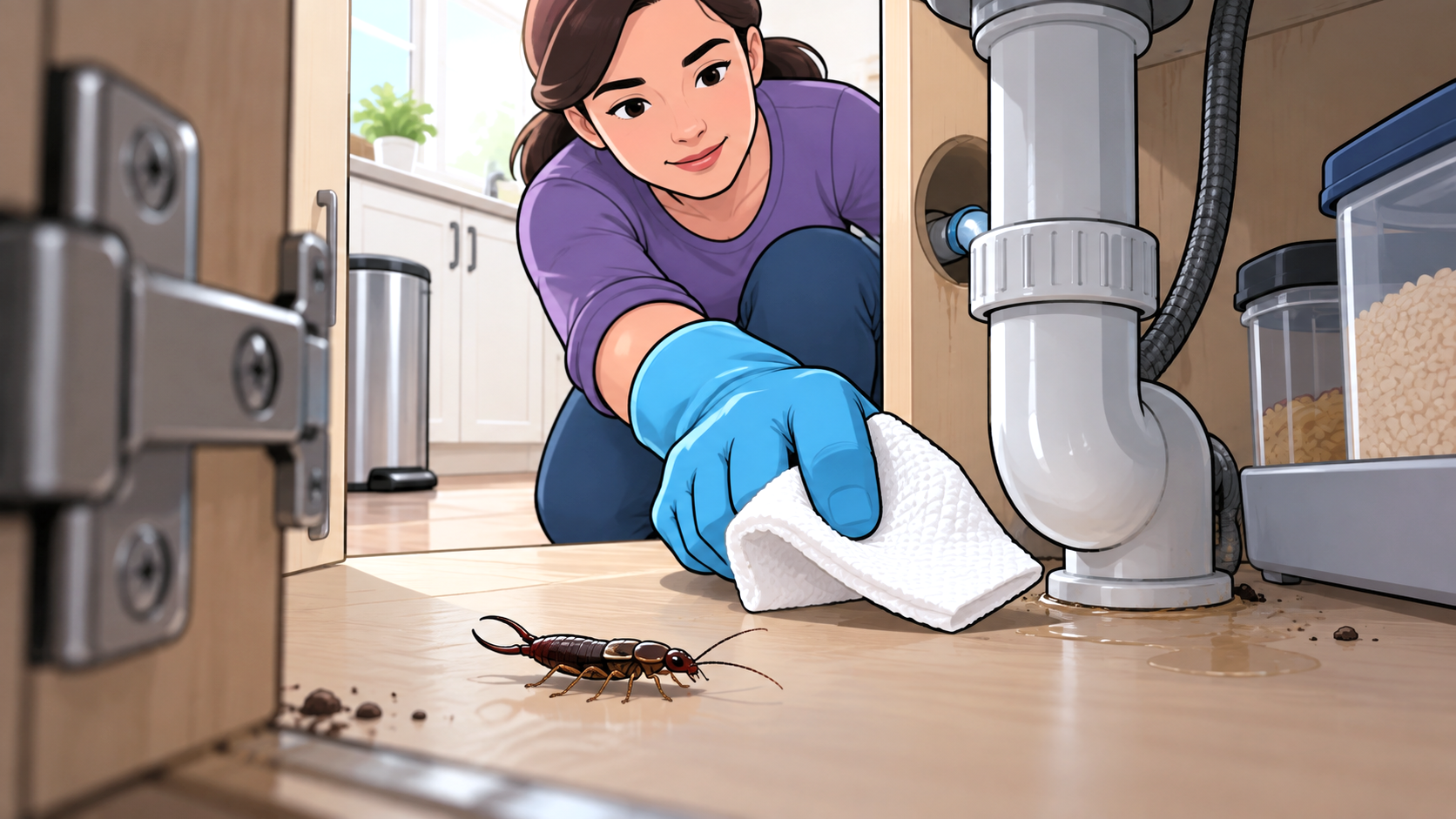
Finding an earwig crawling across a bathroom floor, kitchen counter, or bed can make the insect look like a health threat. Earwigs are not considered disease vectors and are not known to spread diseases to people. They are primarily nuisance and garden insects, not blood-feeding parasites or medically important disease carriers.
That makes their health risk very different from pests such as mosquitoes and ticks.
Earwigs Are Not Known to Spread Disease to Humans
Earwigs are not recognized as insects that transmit human disease. They may wander into houses, sometimes in substantial numbers, but indoor earwigs present no health hazard and are considered nuisance invaders rather than a public-health pest.
That assessment fits what we know about their behavior. Earwigs do not need human blood for food. Instead, they feed on a mixture of plant material, decaying organic matter and other small organisms. The European earwig, one of the species people commonly encounter around homes and gardens, is an omnivore that feeds on detritus, fungi, plants and insects.
Their relationship with people is therefore incidental. They can enter buildings while looking for dark, protected places, but they are not entering because they need a human host.
Indoor earwigs also do not damage people or food. That is an important distinction when you find one in a kitchen. Its presence may be unpleasant, but seeing an earwig near food does not turn it into a disease vector.
Earwig Pinches Do Not Transmit a Known Disease
The pincers on an earwig’s abdomen probably create more concern than any other part of the insect. Those structures, called cerci or forceps, are used for defense and other behaviors. They are not stingers, and they do not function as disease-transmitting mouthparts.
An earwig can use its forceps defensively if it is handled or trapped against the skin. That does not make earwigs recognized vectors of human disease. “Can an earwig pinch me?” and “Can an earwig transmit disease to me?” are separate questions. Physical contact is possible; transmission of an earwig-borne disease is not an established health risk.
The forceps themselves are easier to understand by looking at what earwig pincers are actually for. Their intimidating appearance also contributes to misconceptions about whether earwigs are dangerous to humans.
Earwigs Are Very Different From Disease-Carrying Arthropods
A useful way to understand the risk is to compare earwigs with arthropods that really do transmit pathogens. Mosquitoes can acquire pathogens while blood-feeding and transmit certain pathogens during later feeding. Ticks can similarly transmit several infectious agents while feeding.
Earwigs do not live that way. They are not blood feeders, do not depend on people as hosts and are not recognized disease vectors.
That distinction explains why finding earwigs indoors does not carry the same health implications as discovering certain medically important pests. Their intimidating forceps can make them look dangerous, but appearance is a poor way to judge disease risk.
Identification still matters. If an unfamiliar insect has an elongated body or structures resembling pincers, do not automatically identify it as an earwig simply because it was found near a skin mark. Several bugs can look like earwigs, and correctly identifying the insect is important when evaluating any potential health concern.
Finding Earwigs in the Kitchen Does Not Mean They Spread Disease
A kitchen sighting can make the disease question feel more urgent because people naturally associate insects around food with contamination. Earwigs, however, are not classified as food-infesting pests in the way cockroaches and some stored-product insects are.
They usually arrive indoors from outside. Earwigs prefer dark, damp hiding places and may enter buildings when outdoor conditions become unfavorable. Once inside, they are considered household nuisances, and European earwigs do not reproduce indoors.
Normal food hygiene still makes sense whenever any crawling insect gets directly onto food. Discard food that has been visibly contaminated rather than trying to determine exactly where the insect traveled beforehand, and clean affected food-preparation surfaces normally.
A single earwig in the kitchen, however, is not evidence that your home has become a disease risk. Repeated indoor sightings are more useful as a reason to investigate entry points and favorable conditions around the building.
What to Do if You Keep Finding Earwigs Indoors
Because disease transmission is not the issue, controlling indoor earwigs is mainly about stopping repeated entry and correcting conditions that favor them.
Earwigs prefer protected, moist areas. Outdoors, they commonly shelter beneath mulch, boards, debris and other objects that retain moisture. Indoors, basements, crawlspaces and other damp areas are common places to encounter them. You can reduce indoor earwig problems by removing favorable habitat and sealing entry points around doors, windows, cracks and other openings.
A vacuum or broom is usually enough for individual insects. More importantly, look for excessive moisture and possible entry routes if sightings keep happening. Keeping earwigs out of the house means addressing those routes rather than repeatedly treating individual insects after they have already entered. If the activity becomes frequent, the signs of an earwig infestation can help distinguish an occasional wanderer from a recurring problem.
Disease prevention does not need to drive those decisions. The goal is to remove a nuisance insect and stop more from getting inside.
Other Questions About Earwigs and Disease
Can you get sick from touching an earwig?
Earwigs are not recognized as disease vectors, so simply touching one is not considered a route of earwig-borne disease transmission. Wash your hands after handling insects or working in soil and decaying organic material as a normal hygiene measure.
Do earwigs carry diseases that affect dogs or cats?
Earwigs are not recognized as important disease vectors for household pets. Finding an earwig near a pet therefore does not establish that the insect caused an illness. Direct encounters between pets and earwigs are addressed separately in whether earwigs are harmful to cats and dogs. Unexplained illness in a pet should be assessed by a veterinarian rather than attributed to an insect found nearby.
Can earwigs spread disease through their feces?
Earwigs are not recognized as vectors that transmit human disease through their droppings. Finding droppings or insects indoors may still justify cleaning the area, but it does not establish an earwig-borne disease-transmission risk.
Does an earwig’s bad smell mean it carries disease?
No. Earwigs can release foul-smelling defensive secretions when disturbed. The odor is a defensive characteristic of the insect, not evidence that it is carrying or spreading disease. That defensive response explains why earwigs can smell when killed or disturbed.
Should you worry if an earwig pinches you?
An earwig pinch is generally minor and is not a recognized means of transmitting an earwig-borne disease. If the skin is broken, wash the area normally and monitor it as you would another minor skin injury. Seek medical care if you develop concerning or worsening symptoms.