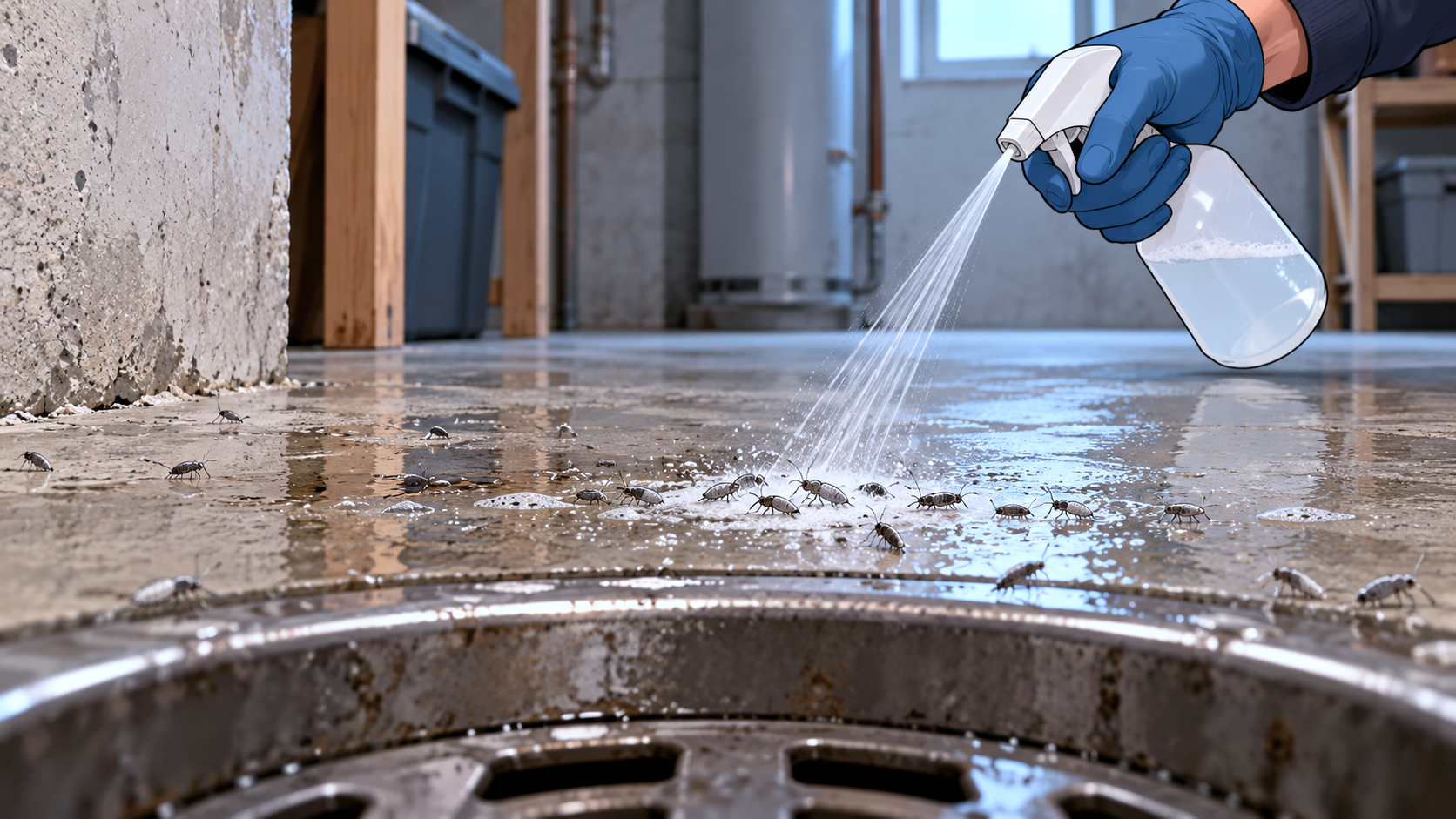
When hundreds of springtails are hopping across a bathroom floor or gathering around a window, killing the ones you can see feels like the obvious priority. The problem is that an instant kill and actual springtail control are two different things. A method can wipe out exposed springtails while doing nothing about the damp conditions supporting the population. Crushing springtails kills individual insects immediately. Some pesticides labeled for springtails can also kill exposed insects, but no chemical treatment should be assumed to work instantly. For indoor infestations, vacuuming is usually more practical than spraying. Long-term control comes from reducing moisture because killing visible springtails alone does not stop more from appearing.
That difference between killing and controlling springtails is the most useful way to approach this question. If you only have a few crawling across a counter, immediate removal may be all you need. If they return every day, what kills them fastest becomes much less important than where they are coming from.
Crushing Springtails Is the Most Literal Instant Kill
Springtails are tiny, soft-bodied arthropods. Physically crushing an individual kills it immediately, although their size and ability to jump can make that an impractical way to deal with more than a handful.
Their jumping ability is also why people sometimes mistake them for fleas. Most springtails possess a forked structure called a furcula that propels them away when disturbed. Our guide to how springtails jump explains that movement in more detail.
We would reserve crushing for the occasional insect rather than treating it as a control method. Once dozens or hundreds are involved, chasing individual springtails around a room wastes time that would be better spent finding the damp area supporting them.
Vacuuming Is Better When You Need Springtails Gone Right Away
A vacuum does not need to poison springtails to solve the immediate problem. It physically removes them from floors, windowsills, baseboards, cabinets, and other accessible surfaces. Vacuuming is specifically recommended for springtails that enter structures, and indoor insecticide applications generally offer little advantage over physical removal.
That makes vacuuming our preferred response to a visible indoor cluster. You can remove a large number quickly without covering indoor surfaces with pesticide. However, vacuuming should not be confused with eliminating the infestation. More springtails can appear if a leak, high humidity, damp building material, wet potting soil, or an outdoor migration remains unresolved.
For a recurring indoor problem, move from removal to the broader steps in our complete springtail control guide.
Will Insecticide Kill Springtails Quickly?
Some pesticide products are labeled for springtail control, particularly for certain outdoor uses. However, springtails can be relatively resistant to insecticides, and chemical control often performs poorly as a long-term solution. Indoor sprays are generally unnecessary, while outdoor applications may provide only temporary relief when favorable habitat remains.
That is why we would not name an insecticide as an “instant” springtail killer without reference to a specific current product label. Kill speed depends on the product, formulation, application site, exposure, and label directions. “Kills springtails” and “kills springtails instantly” are not interchangeable claims.
For readers specifically looking for chemical options, our guide to sprays for springtails covers that question separately. We also have dedicated articles on bifenthrin for springtails and whether Raid kills springtails, rather than squeezing product-specific claims into a general instant-kill article.
Does Water Kill Springtails Instantly?
Plain water should not be treated as an instant springtail killer. Springtails can occur on the surface of puddled water, and large groups may form floating masses. They are also frequently associated with very wet environments.
Water can still be useful for removal. Springtails trapped in sinks and bathtubs can simply be washed down the drain. That gets them out of the fixture, but the method should not be interpreted as proof that contact with water immediately kills them.
This distinction becomes especially important when springtails repeatedly appear around plumbing. Our guide to getting rid of springtails around a drain explains why the place where you find them is not necessarily their source.
What About Bleach, Vinegar, Borax, and Other Home Remedies?
A household cleaner can kill an arthropod under some circumstances without being a sensible pest-control treatment. We would not turn bleach, vinegar, borax, essential oils, or another household substance into an “instant springtail killer” simply because someone can spray it directly on a tiny insect.
The more useful question is whether a remedy has reliable springtail-specific evidence, is appropriate for the surface or location, and solves anything beyond the insects directly contacted. Indoor springtail guidance instead emphasizes physical removal and moisture correction. Indoor insecticide sprays themselves are generally not recommended or necessary, which gives little reason to improvise with household chemicals.
Those remedies also deserve separate treatment because they are not interchangeable. We examine the evidence individually in our articles on bleach and springtails, vinegar and springtails, borax and springtails, and diatomaceous earth for springtails.
The Fastest Kill Can Still Leave You With Springtails Tomorrow
Imagine vacuuming every springtail from a basement floor tonight. The floor looks completely clear afterward. By tomorrow morning, another group has appeared along the same wall.
That does not mean the vacuum failed. It means removing the visible insects never addressed why springtails were concentrated there.
Large indoor populations are strongly associated with moisture. Plumbing leaks, excessive humidity, poor drainage, wet materials, and other damp conditions can create suitable environments. Springtails may also migrate indoors when outdoor habitat becomes unfavorable.
This is where we think the word “instantly” can become a distraction. Killing 100 visible springtails immediately is less valuable than correcting the condition that allowed thousands to develop nearby or continue entering the building.
Moisture Control Is What Actually Ends the Problem
Springtails require moisture, so drying their environment attacks a requirement for survival rather than individual insects. Fix plumbing leaks, improve drainage where needed, reduce excessive irrigation, dry persistently wet indoor areas, and use ventilation or a dehumidifier where excessive humidity is the problem.
Houseplants need a slightly different approach. Springtails commonly live in damp potting media, particularly after frequent watering. Allowing the soil surface to dry as much as the plant safely tolerates can reduce their numbers, and pesticides are not recommended for springtails in indoor plants.
If you would rather avoid pesticide treatments altogether, our guide to getting rid of springtails naturally focuses on these nonchemical methods.
What to Do When You Find Springtails Right Now
For a few springtails, physically remove them and move on. For a large indoor cluster, vacuum the insects you can reach, then inspect the immediate area for moisture. Look under sinks, around plumbing, beside damp walls, near houseplants, and anywhere water regularly collects. Springtails indoors can act as a useful clue that something nearby is staying wetter than it should.
Repeated sightings deserve a broader inspection rather than increasingly aggressive attempts to kill them on contact. Our guide to what attracts springtails can help narrow down the moisture conditions involved. Once those conditions change, indoor springtail populations generally decline without requiring a chemical assault on every insect you see.
Other Questions About Killing Springtails Quickly
Can you squish a springtail?
Yes. Springtails are tiny arthropods and can be physically crushed. Their small size and tendency to jump make this reasonable for one or two insects but inefficient for a large group.
Do springtails die when a room dries out?
Springtails require humid conditions, and indoor populations generally die out when moisture levels fall sufficiently. That is why drying affected areas provides more lasting control than repeatedly killing visible individuals.
Will flushing springtails down a sink get rid of them?
It removes the springtails currently trapped in the fixture. However, recurring springtails around a sink warrant an inspection for moisture around the plumbing and elsewhere in the room rather than repeated drain treatment.
Should I spray every springtail I see?
No. Indoor insecticide sprays are generally not recommended for springtails. Vacuuming or sweeping visible insects avoids unnecessary pesticide use, while correcting excessive moisture addresses the condition associated with recurring populations.
Does killing adult springtails stop an infestation?
Not necessarily. Removing exposed springtails does not correct the moist habitat that allows populations to persist or stop additional springtails from migrating indoors. A recurring problem therefore calls for moisture correction and, where relevant, exclusion rather than contact killing alone.
2 thoughts on “What Kills Springtails Instantly?”