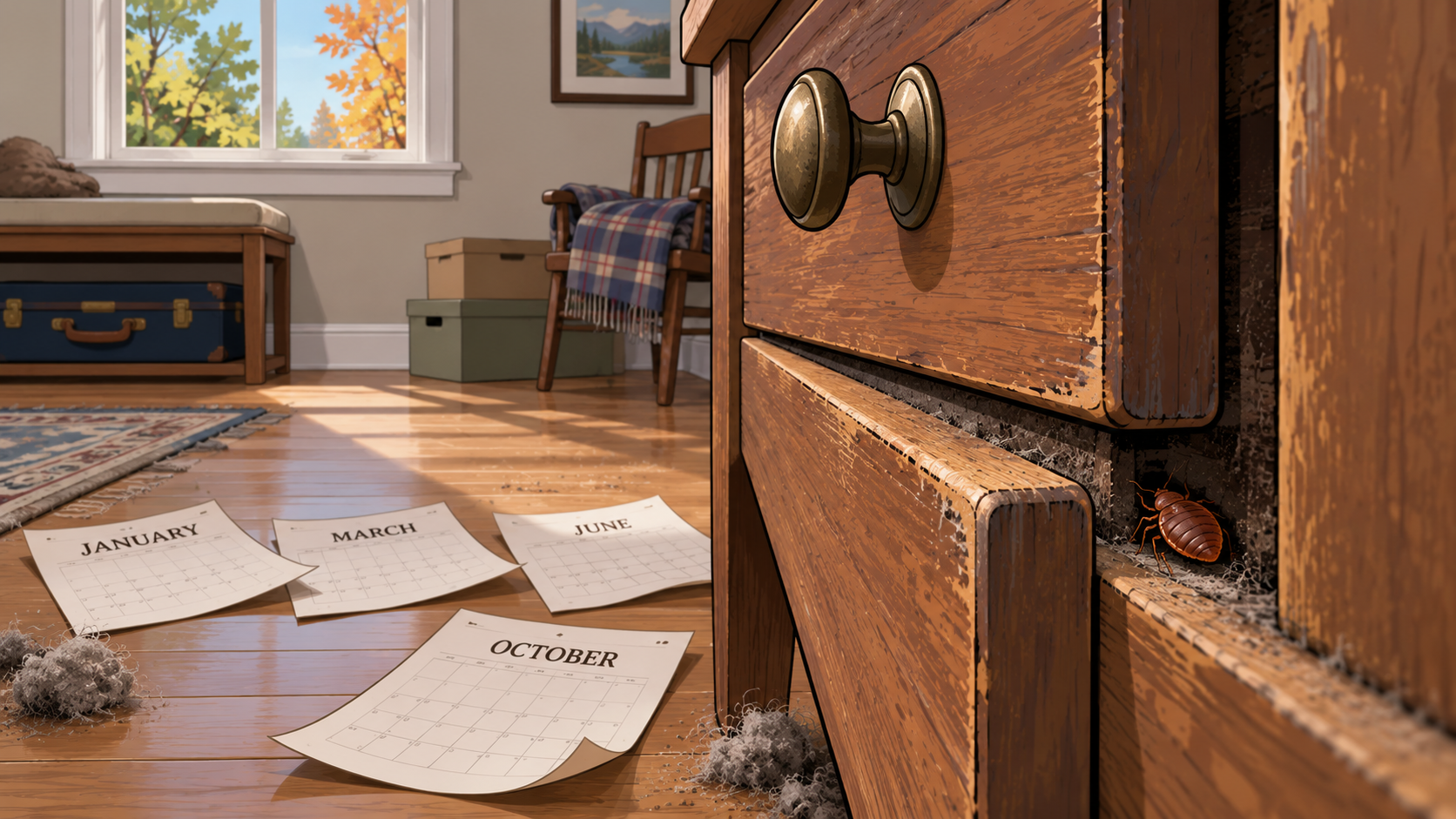
A bed bug can survive for months, but the often-repeated claim that adults normally live for a year or longer gives the wrong impression. Lifespan changes considerably with temperature, feeding, life stage, and environmental conditions, and unusually long survival without food shouldn’t be confused with a typical adult lifespan in an occupied home.
Under normal conditions, adult bed bugs generally live for about two to four months. They can survive considerably longer under favorable conditions, particularly when temperatures are cooler and their metabolism slows. Older nymphs and adults may even survive without feeding for many months, but those extreme starvation-survival figures don’t represent how long every bed bug normally lives.
A Bed Bug’s Normal Lifespan Is Shorter Than Its Maximum Survival Time
The University of Minnesota Extension states that adult bed bugs normally live for about two to four months. In the same guidance, however, it notes that older nymphs and adults can survive without a blood meal for as long as a year under very favorable conditions.
Those statements aren’t contradictory. One describes adult longevity under ordinary circumstances, while the other describes how long some unfed bed bugs can survive under conditions that favor prolonged survival.
Laboratory conditions also matter. A Virginia Tech life-table experiment involving a field-collected strain found an average life expectancy of about 127 days for a newly molted adult, or a little over four months. That sits much closer to the University of Minnesota’s normal adult lifespan than to claims that an adult routinely lives for a year or more.
If the real question is how long an infestation might remain alive in an empty property, how long bed bugs can live without feeding is more relevant than their ordinary lifespan.
Temperature Can Change How Long Bed Bugs Survive
Temperature affects development, reproduction, activity, and survival, which makes it difficult to assign one lifespan to every environment.
Cool conditions can slow bed bug development and metabolism, while sufficiently high temperatures shorten survival. This doesn’t mean ordinary seasonal temperature changes reliably eliminate an infestation. Bed bugs tolerate a broad range of indoor conditions, and lethal temperature exposure depends on both temperature and duration.
Research into prolonged heat stress illustrates how sensitive their biology can become before temperatures are immediately lethal. In one experiment, bed bugs exposed to 34°C, 36°C, or 38°C for two or three weeks experienced increasing mortality as temperature and exposure time rose. Surviving populations also showed poorer reproduction, hatching, molting, and subsequent population growth.
Another experiment found that adult bed bugs exposed to increasingly severe sublethal heat experienced reduced survival and reproduction, with 38.5°C and 40°C eventually producing complete adult mortality under the study’s exposure conditions.
These experiments shouldn’t be converted into DIY treatment temperatures. They demonstrate how temperature changes bed bug survival and reproduction under controlled conditions, not how quickly an entire infestation hidden throughout a home will disappear.
Cold Can Prolong Survival Without Reliably Eliminating Bed Bugs
Cooler conditions create a different problem. Activity and development slow, but the insects don’t necessarily die.
Research on prolonged cold exposure found that both temperature and exposure duration strongly affected survival. Bed bugs could tolerate some subzero conditions for surprisingly long periods, while colder or longer exposures eventually produced much greater mortality.
That is why an unheated room becoming cold for part of the winter isn’t equivalent to eliminating its bed bugs. Our closer look at whether cold weather kills bed bugs covers the temperature-and-time relationship separately.
Bed bugs can also become extremely inactive in cold conditions, which sometimes creates the impression that they have entered a true seasonal hibernation. Bed bug hibernation is a separate question from lifespan, but the slowdown helps explain why waiting through winter isn’t a dependable control strategy.
Feeding Changes Survival and Reproduction Too
Bed bugs depend entirely on blood for nutrition. Nymphs need a blood meal before progressing through each of their five immature stages, while adults continue feeding throughout their reproductive lives.
In an occupied home, access to a host allows the population to continue feeding and reproducing. Removing access to blood changes the survival problem, but it doesn’t produce immediate starvation.
Older nymphs and adults are particularly capable of surviving extended periods between meals. Temperature strongly influences how long that survival can last, which is one reason simply leaving a room or apartment empty isn’t a dependable way to eliminate an infestation.
The distinction matters when interpreting lifespan figures. A bed bug surviving for many months without food is demonstrating starvation tolerance. That doesn’t mean a normally feeding adult should automatically be expected to live for the same length of time.
Insecticide Resistance Doesn’t Mean Bed Bugs Automatically Live Longer
Research into pyrethroid-resistant bed bugs has produced some interesting differences between populations, but those findings need careful interpretation.
A Virginia Tech life-table study compared several strains and found that the highly pyrethroid-resistant Richmond strain had 94% egg-to-adult survival and developed from egg to adult in about 35 days. The susceptible Harlan strain had 79% egg-to-adult survival and took about 40 days to reach adulthood, while another field strain had only 69% survival.
That doesn’t establish that insecticide resistance generally increases bed bug lifespan. The researchers were comparing different strains, and one resistant population outperforming a susceptible laboratory strain in certain life-history measurements isn’t enough to conclude that resistance itself makes every bed bug live longer.
Resistance is still enormously important for control because it can reduce the effectiveness of particular insecticides. That issue is covered separately in why bed bugs are becoming resistant to pesticides.
A Lifespan Estimate Isn’t a Countdown to an Infestation Ending
Knowing that an individual adult may live for several months doesn’t tell you when an infestation will disappear.
A reproducing infestation contains eggs, five nymphal stages, and adults at the same time. New individuals can therefore enter the population while older ones die. The University of Minnesota notes that reproducing populations contain all life stages and can produce three or more generations per year.
That overlapping development makes the lifespan of one adult a poor countdown clock for the population as a whole. Our bed bug life cycle explains how eggs, nymphs, feeding, molting, and reproduction fit together.
The same problem applies to leaving an infested property vacant and waiting. Some bugs may die during that period, but long starvation tolerance means the absence of people doesn’t provide a predictable date when every surviving bug will be gone.
Questions About How Long Bed Bugs Live
Can a bed bug really live for a year?
Under very favorable conditions, older nymphs and adults have been reported to survive without feeding for up to a year. That is better understood as an extreme survival capability than as the normal adult lifespan. Under ordinary conditions, adult life is generally much shorter.
Do bed bugs live longer in winter?
Cooler temperatures can slow their metabolism, development, and activity and may extend survival under some conditions. Ordinary winter temperatures inside a heated home, however, aren’t a reliable way to eliminate or preserve an infestation on a predictable schedule.
Does insecticide resistance make bed bugs live longer?
Not necessarily. Some resistant strains have shown high survival and rapid development in laboratory studies, but that doesn’t establish that resistance itself universally extends adult lifespan. Resistance primarily matters because it can make particular insecticides less effective.
How long do bed bug eggs live?
Eggs shouldn’t be treated as miniature adults with a comparable lifespan. They are a developmental stage that normally hatch rather than remaining dormant indefinitely. Under suitable conditions, University of Minnesota Extension gives a typical hatching period of about six to ten days.
Can you starve bed bugs by leaving a room empty?
Not reliably. Older nymphs and adults can survive extended periods without blood, particularly under favorable conditions. Vacating a room may therefore remove their immediate food source without eliminating the infestation.