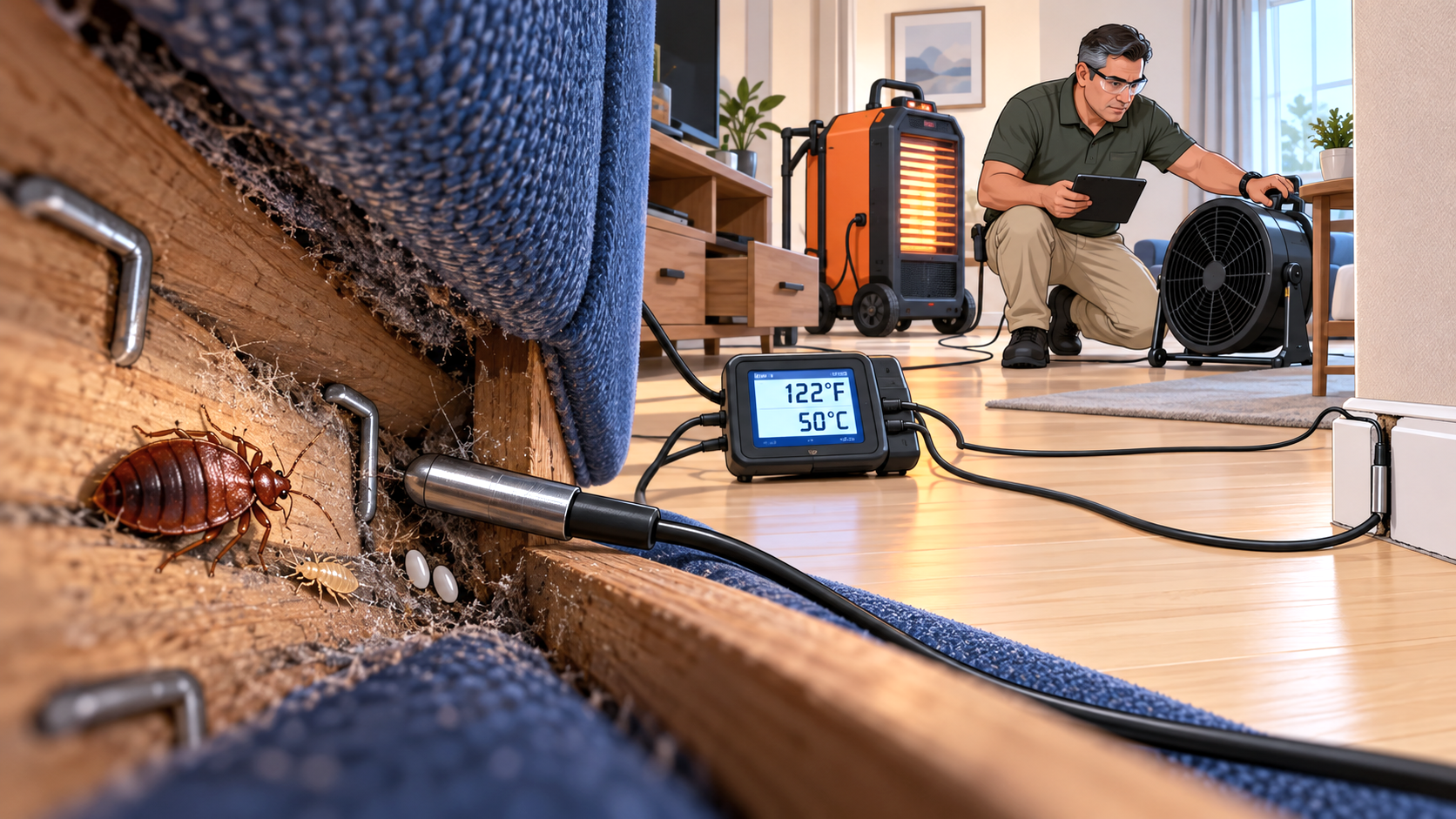
Heat absolutely can kill bed bugs, but a hot room and a lethal bed bug temperature are not the same thing. A thermometer sitting in open air might show an impressive number while a bed bug tucked beneath a baseboard, inside furniture, or under a pile of belongings remains cooler. That difference explains why heat is both one of the most useful bed bug controls and one of the easiest to misunderstand.
Heat kills bed bugs when the insects themselves reach a lethal temperature for long enough. A useful treatment target is at least 120°F (49°C) for 90 minutes when eggs need to be killed too. Higher temperatures can shorten the required exposure, but the heat must penetrate every hiding place. Simply making the surrounding air hot does not prove the treatment worked.
The exact relationship between temperature and time matters. Bed bugs can die at lower temperatures when exposure lasts longer, while their eggs generally require more heat or more time. For that reason, there is no honest answer to “what temperature kills bed bugs?” that gives you one number and ignores how long the bugs actually remain at that temperature.
The Temperature That Kills Bed Bugs Depends on Time
Bed bugs are vulnerable to sustained heat. Their thermal limits are low enough that temperatures achievable with purpose-built treatment equipment, clothes dryers, steamers, and professional heating systems can kill them. However, the exposure time changes dramatically as temperature changes.
Adult bed bugs and nymphs exposed continuously to 113°F (45°C) can die when that exposure lasts 90 minutes or longer. At 118°F (48°C), bed bugs can die much faster. Eggs are harder to eliminate at that temperature and require about 90 minutes at 118°F for complete mortality under controlled exposure conditions.
That egg difference is important. Killing every visible adult while leaving viable eggs behind does not eliminate an infestation. It is one reason professional guidance uses treatment targets designed around all bed bug life stages, rather than stopping at the minimum temperature capable of killing an exposed adult.
For a more conservative practical benchmark, infested objects or areas can be heated to at least 120°F for 90 minutes to ensure eggs are killed. The higher the temperature, the less exposure time is generally required.
Our separate guide to what temperature kills bed bugs goes deeper into the temperature thresholds themselves. For actual treatment, though, the harder problem is getting the hidden bugs to that temperature.
A 120°F Room Does Not Mean Every Bed Bug Is at 120°F
This is the part we think matters more than memorizing a thermal death point.
Imagine a bedroom where the air thermometer reads 120°F. One bed bug is exposed near the surface of a bed frame. Another is deep inside a protected furniture joint. Eggs are tucked into a crack along the floor-wall junction. Those insects can experience very different temperatures even though they are all technically inside the same heated room.
Bed bugs hide in cracks, crevices, mattresses, bed frames and nearby furniture. Materials surrounding those hiding places take time to absorb heat. Furniture, piles of belongings, wall junctions, drawers, and other protected spaces can therefore lag behind the surrounding air.
Professional whole-room treatments account for this by heating the room substantially above the bed bug’s minimum lethal temperature. Systems commonly bring ambient air to around 135°F (57°C) while technicians use fans to circulate heated air and monitor difficult locations. The goal is not to make a bed bug floating in 135°F air die. Bed bugs are not floating in the air. The goal is to push enough heat into their actual hiding places.
That is why we would judge a heat treatment by its coldest relevant hiding locations, not by the hottest thermometer reading in the room.
Bed Bug Eggs Are the Reason You Should Not Aim for the Bare Minimum
An adult bed bug dying at a particular temperature does not mean an egg exposed to the same temperature for the same period will die with it. Eggs are one of the reasons heat-treatment recommendations build in enough temperature and exposure time to cover the entire life cycle.
Research on thermal death points found that bed bug eggs require 90 minutes at 118°F for complete mortality, even though mobile bed bug stages die considerably faster at that temperature. Raising the temperature further reduces the time required.
That difference also changes how you should think about bed bug eggs. They are tiny, stationary, and can be deposited in protected locations. You cannot rely on the bugs moving into a hotter area during treatment. The heat has to reach where the eggs already are.
This is also why briefly pointing a source of hot air toward an infested object is not equivalent to a controlled heat treatment. Surface temperature can rise while the protected interior remains cooler.
A Clothes Dryer Solves a Much Smaller Heat Problem
Whole-room heat treatment has to push lethal temperatures into an unpredictable collection of cracks, furniture, walls, and belongings. A clothes dryer has a much simpler job, which makes it one of the most practical household uses of heat against bed bugs.
Bedding and clothing can be placed in a dryer at high temperature for 30 minutes as a bed bug control measure. The recommendation specifically matters because washing alone generally will not kill bed bugs.
Dryer guidance varies somewhat with the item and load. Clothes and other suitable belongings can also be dried at temperatures above 122°F for at least 20 minutes, while a medium-high setting for about 30 minutes is recommended for a full load of suitable items.
We prefer thinking in terms of the item rather than blindly copying a dryer setting. Different dryers and loads do not heat identically, and an item still has to tolerate the treatment. Our guide to whether a clothes dryer kills bed bugs covers that method separately.
Steam Kills With Heat, but It Is Not Whole-Room Heating
Steam is another heat treatment, but it solves a different problem. Instead of gradually heating an entire room and everything inside it, a steamer delivers intense heat directly to a relatively small area.
That can make steam useful on mattress seams, furniture, cracks, and other accessible surfaces where bed bugs may be hiding. However, steam still has to contact or sufficiently heat the infested location. Passing over a surface while bugs remain protected deeper inside an inaccessible void does not give you the same coverage as treating that void.
This distinction is why using a steamer for bed bugs deserves its own treatment method rather than being lumped together with professional structural heat. Both use temperature to kill bed bugs, but they deliver that heat in very different ways.
A Hair Dryer, Space Heater, or Hot Car Is Not the Same Thing
Once you know bed bugs die from heat, it is tempting to improvise. That is where the temperature numbers can become more dangerous than helpful.
A hair dryer can produce hot air, but that does not mean it can reliably bring an entire bed bug hiding place to the required temperature for the required exposure time. The same problem applies to trying to heat a bedroom with ordinary household heaters. You need controlled heat distribution and temperature verification in the places where bed bugs are actually hiding, not simply a hotter room.
There are also serious safety concerns with improvised structural heating. We would not attempt to reproduce professional heat treatment by combining space heaters or other household heating appliances. Purpose-built systems involve heaters, air movement, temperature sensors, treatment preparation, and active monitoring.
A parked vehicle presents another version of the same mistake. Interior air can become extremely hot in sunlight, but the temperature is not necessarily uniform throughout every item and hiding place. Our guide to whether a hot car kills bed bugs deals with that specific scenario, while hair dryers and bed bugs are better treated as a separate question.
Professional Heat Treatment Is Really a Heat-Distribution Problem
A professional bed bug heat treatment is not successful merely because the technician owns a powerful heater. What matters is whether the equipment can deliver lethal heat throughout the treatment area and whether the technician verifies that difficult locations actually get hot enough.
During structural treatment, fans help circulate heated air. Furniture and belongings may need repositioning as the treatment progresses so previously insulated areas become exposed. Temperatures should also be checked in locations that are slow to heat rather than relying on one sensor in open air.
This is particularly important around floor-wall junctions, furniture interiors, stored belongings, and other insulated spaces. Some hard-to-heat locations can remain below lethal temperature even during several hours of room heating when the equipment or heat distribution is inadequate.
That gives you a useful question if you are considering professional bed bug heat treatment: How will the company verify temperatures in the hardest places to heat?
We consider that much more informative than asking how hot the room will become. A company can make open air extremely hot and still leave a survivable pocket somewhere that matters.
Heat Can Kill Bed Bugs Without Preventing the Next Infestation
Heat has one limitation that has nothing to do with temperature. Once the treated area cools, the heat is gone.
It does not leave behind a residual barrier that continues killing bed bugs arriving later. A successful heat treatment can eliminate bed bugs present during treatment, but it cannot prevent another bed bug from being introduced afterward. That makes heat fundamentally different from a residual control method.
Heat treatment can also fail when bugs survive in locations that never reached the required conditions. Seeing a bed bug after treatment therefore deserves investigation rather than automatically assuming the treatment succeeded and the insect must have been newly introduced.
For an established infestation, heat is best understood as one tool within a complete bed bug control strategy. The important measurement is not how dramatic the heat feels to you. It is whether every bed bug and egg in the treated area received a lethal combination of temperature and time.
Other Questions About Killing Bed Bugs With Heat
Can a heating pad kill bed bugs?
A heating pad is not designed to treat bed bug infestations. It heats a limited contact area and does not provide controlled, verified heating throughout the cracks and protected spaces where bed bugs and eggs may be hiding. Purpose-built heat methods are a better choice when treating infested belongings or structures.
Does sunlight through a window kill bed bugs?
Sunlight can warm surfaces, but ordinary solar heating through a window does not provide a controlled treatment in which every hiding location reaches a verified lethal temperature for the necessary exposure time. A warm or even very hot surface should not be treated as proof that hidden bed bugs were killed.
Can bed bugs escape from heat while a room is being treated?
Bed bugs can move away from unfavorable conditions, which is another reason whole-room heating depends on controlled temperature distribution rather than heating one small part of an infested space. Professional systems use air circulation and monitoring to bring the treatment area and protected hiding locations to lethal conditions.
Can you heat-treat one piece of furniture instead of the whole room?
Yes. Purpose-built heat chambers can treat individual belongings and furniture when the items fit the system and the required temperature reaches throughout them. This can be useful when the treatment target is a particular item rather than an entire infested room.
Can bed bugs come back after a successful heat treatment?
Yes. Heat has no residual effect after the treated area cools, so it cannot prevent a later reintroduction. Bed bugs can also persist when part of the original infestation was in a location that did not reach lethal conditions. Our guide to bed bugs returning after treatment covers those possibilities separately.
One thought on “Does Heat Kill Bed Bugs? Here’s the Temperature You Actually Need”