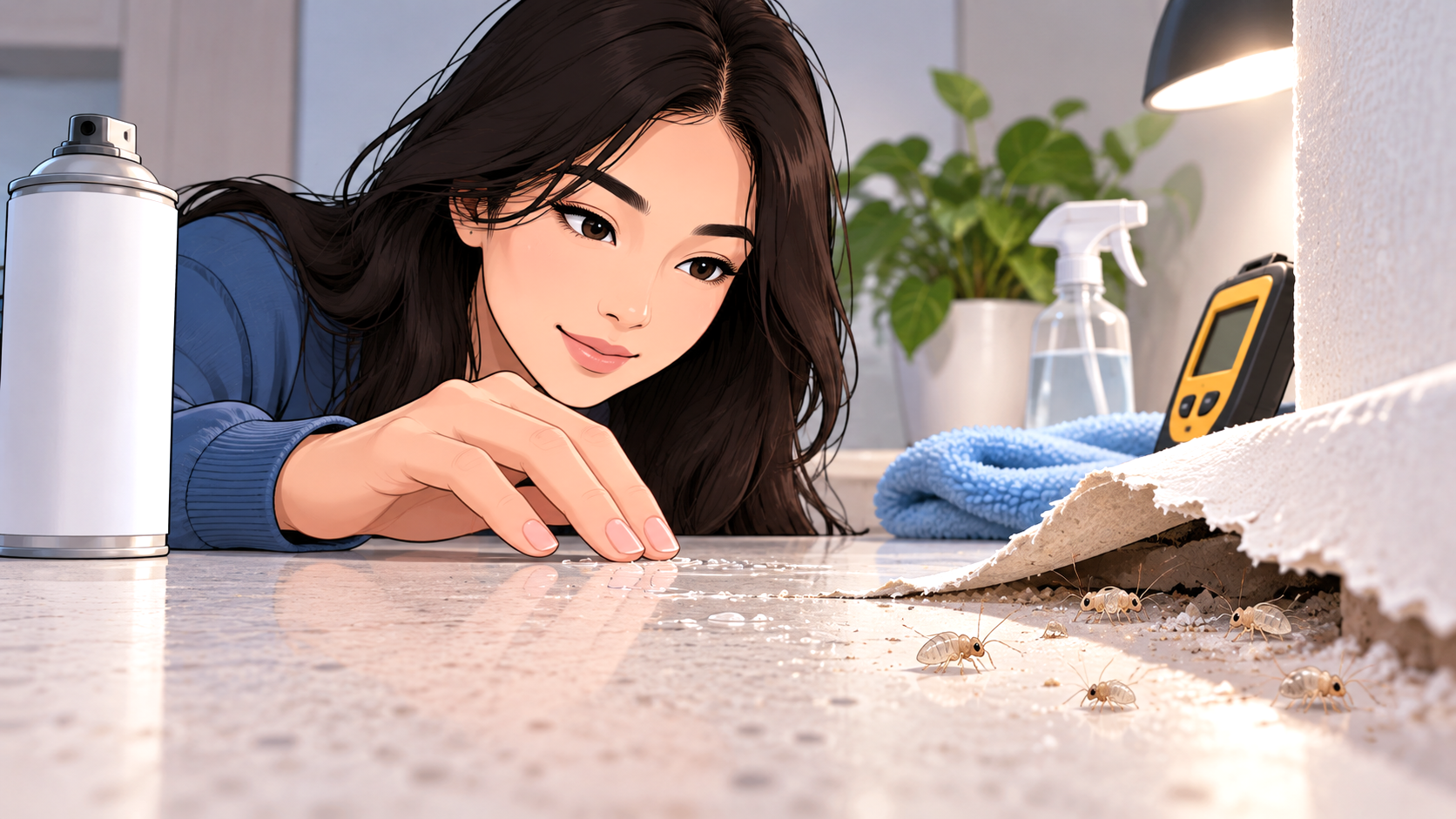
Some Raid insect sprays can kill exposed booklice, but “Raid” is a brand rather than one insecticide, so the answer depends on the exact product. Current Raid sprays use different active ingredients and have different labeled pests and treatment sites. Even when a formulation kills a booklouse that is directly sprayed, it will not reliably eliminate insects and eggs hidden in cracks, damp materials, wall voids, books, or other protected locations.
The Raid Product Matters More Than the Brand Name
Raid Ant & Roach Killer 26 currently contains 0.060% imiprothrin and 0.100% cypermethrin, both pyrethroid insecticides used for rapid contact action against household crawling insects. Its current EPA registration includes indoor residential treatment for crawling insects, while the manufacturer’s current Ant & Roach Killer 26 formulation uses those same two active ingredients.
Other Raid products are chemically different. Raid Multi Insect Killer currently contains d-phenothrin and prallethrin, while Raid Essentials Multi-Insect Killer uses geraniol and lemongrass oil. The current Multi Insect Killer formulation therefore cannot be treated as interchangeable with the Ant & Roach aerosol, and a claim made about one can should not automatically be applied to another.
For booklice, check the exact label on the product you own. A pesticide should only be used for pests and locations permitted by its label, and the broader range of sprays and insecticides used for booklice varies considerably in active ingredient, residual action, and approved application sites.
Direct Spray Can Kill an Exposed Booklouse Without Solving the Infestation
Pyrethroid aerosols act on insect nervous systems and can produce rapid knockdown when enough insecticide reaches a susceptible insect. A booklouse crawling openly across a baseboard or cabinet can therefore be much easier to kill than one concealed several centimeters inside a crack.
Booklice do not necessarily respond to household insecticides as predictably as cockroaches, ants, or beetles. Stored-product research has found that several psocid species show natural tolerance to some aerosol insecticides, with mortality changing according to species, insecticide, exposure method, and life stage. Separate aerosol experiments found that particle size and exposure duration strongly affected psocid mortality.
Seeing one directly sprayed insect die therefore demonstrates contact activity against that individual. It does not establish that the treatment has reached the rest of the population.
Raid Residue Is Less Dependable When Booklice Stay Inside Protected Crevices
Residual insecticide only works where it has been deposited and where insects subsequently contact an effective amount. Booklice can occupy narrow gaps behind baseboards, cupboard joints, stacked cardboard, shelving, wall voids, book bindings, and other protected microhabitats. Their usual hiding locations can keep much of a population away from a treated exposed surface.
Stored-product psocids have also shown greater insecticide tolerance than many other common storage pests. Tests comparing several treatments found that some contact insecticides failed to control Liposcelis populations adequately. More spray is not a reliable answer to that limitation. Increasing the dose beyond label directions increases exposure and residue without guaranteeing penetration into the infestation source.
Raid Should Not Be Sprayed Into Books, Electronics, or Electrical Openings
Aerosol insecticide is a poor choice when booklice are visible on sensitive possessions. Current Raid Ant & Roach guidance warns against application in or on electrical equipment because the formulation contains water, and aerosol products can also contain petroleum distillates and flammable propellants. The current product precautions for Raid Ant & Roach Killer restrict where and how the aerosol should be applied.
Books create a different concern. Spraying pages, bindings, photographs, archival material, or finished shelving can leave residues, stains, odors, or altered surfaces. Booklice occurring around books often reflect humid storage conditions rather than a need to saturate the object with insecticide. Their ability to feed on fungi, starches, and materials associated with damp books makes the storage environment more informative than the surface where an insect happens to be crawling.
Raid Does Not Remove the Moisture Keeping Booklice Alive
A pesticide can kill insects without changing why they are present. Indoor booklice are closely associated with dampness because they require relatively high humidity and commonly feed on microscopic fungi. Sustained humidity below roughly 45% to 50% becomes unfavorable for household psocids, whereas continued dampness supports survival and reproduction. The biological basis for booklice depending on humidity makes moisture correction more important than repeated surface spraying.
Household psocid control is correspondingly centered on reducing moisture. Relative humidity below about 50% prevents booklouse development and suppresses mold growth, while persistent damp conditions make insecticides much less useful. A Raid treatment beside a leaking pipe may kill insects crossing the treated surface while leaving the breeding habitat untouched.
If room humidity itself is elevated, sustained mechanical drying can affect the entire population in a way that a localized aerosol cannot. A properly sized unit can reduce booklice by maintaining unfavorable humidity throughout an affected room.
Spraying Every Booklouse You See Can Hide a Moisture Clue
Repeated booklice in the same location often provide useful information about where moisture is concentrated. If insects continually appear beside one window, under a sink, around a particular cupboard, or along one baseboard, spraying each one as it emerges can remove the visible evidence without explaining the pattern.
The signs of an established booklice infestation become more meaningful when location, frequency, and life stages are considered together. A recurring concentration of adults and nymphs is more consistent with a nearby source than an occasional isolated insect wandering across a dry room.
Vacuuming exposed insects allows the same immediate cleanup without adding pesticide residue and is specifically recommended as a physical option for small household populations. Small numbers of psocids can be removed with a vacuum while the damp area responsible for continued activity is investigated.
Raid Is Unlikely to Reliably Eliminate Hidden Eggs
Booklice eggs can be attached to substrates inside protected spaces, so an aerosol directed across an exposed wall may never contact them. Even insecticides that perform well against mobile stages cannot automatically be assumed to have equal ovicidal activity.
The booklice life cycle allows surviving eggs to produce nymphs after visible adults have been killed. Continued appearance of very small booklice after spraying can therefore reflect untreated immature stages rather than a new infestation entering the home.
Methods specifically capable of killing booklice eggs depend on adequate exposure of the egg to lethal conditions. A quick aerosol application to the surface of a hiding area provides no assurance that concealed eggs received such exposure.
Fogging a Room With Extra Raid Is Not a Better Booklice Treatment
Household aerosol sprays should not be used as improvised total-release fumigants. Pesticide directions specify the application method, location, amount, ventilation requirements, and precautions for a reason. Using more pesticide than the label directs does not improve pest control predictably and can unnecessarily increase exposure to people, pets, surfaces, and indoor air.
This is especially poor tradeoff for booklice because their source is commonly environmental. The most effective approach to getting rid of booklice removes accessible insects while drying the places where the population is reproducing.
Safety note: Raid products are pesticides with formulation-specific labels. Read the complete label before use, apply only to permitted pests and locations, keep people and pets away as directed, protect food and food-contact surfaces, and never increase the application rate beyond label instructions. Pesticide labels specify where, how, and how much of a product may be used.
Questions About Raid and Booklice
Will Raid Ant & Roach Killer kill a booklouse if sprayed directly?
A directly exposed booklouse can be susceptible to the pyrethroid ingredients in some Raid Ant & Roach formulations, although susceptibility varies among psocid species. Use the product only as permitted by its current label.
Does Raid kill booklice instantly?
Some formulations provide rapid knockdown of susceptible crawling insects, but there is no dependable universal instant-kill time for booklice. Exposure amount, product formulation, and species affect the result.
Can I spray Raid on a bookshelf?
Only treat a surface when the particular Raid label permits that application and the material can tolerate it. Protect books and other sensitive objects from unnecessary pesticide residue.
Can Raid be sprayed into wall cracks where booklice are coming from?
Do not improvise crack-and-crevice treatment unless the exact label authorizes that use. Booklice emerging from a wall should also prompt an investigation for concealed moisture.
Will Raid keep booklice from returning?
Not if the location remains favorable for them. Residual insecticide eventually degrades, while persistent humidity or damp material can continue supporting reproduction.
Is Raid better than a dehumidifier for booklice?
Not when excessive humidity is driving the infestation. Raid may kill insects it contacts, while sustained dehumidification can remove a condition required by the population.
Should Raid be used on booklice in the kitchen?
Food and food-contact surfaces require strict adherence to pesticide-label restrictions. A booklice problem in the kitchen can also involve damp cupboards or contaminated dry foods, which need to be addressed directly rather than sprayed indiscriminately.
What should you do if Raid kills the visible booklice but they return?
Stop treating the recurrence as a series of individual insects and locate the source. Check relative humidity, condensation, leaks, damp stored material, and nearby fungal growth before applying more pesticide.