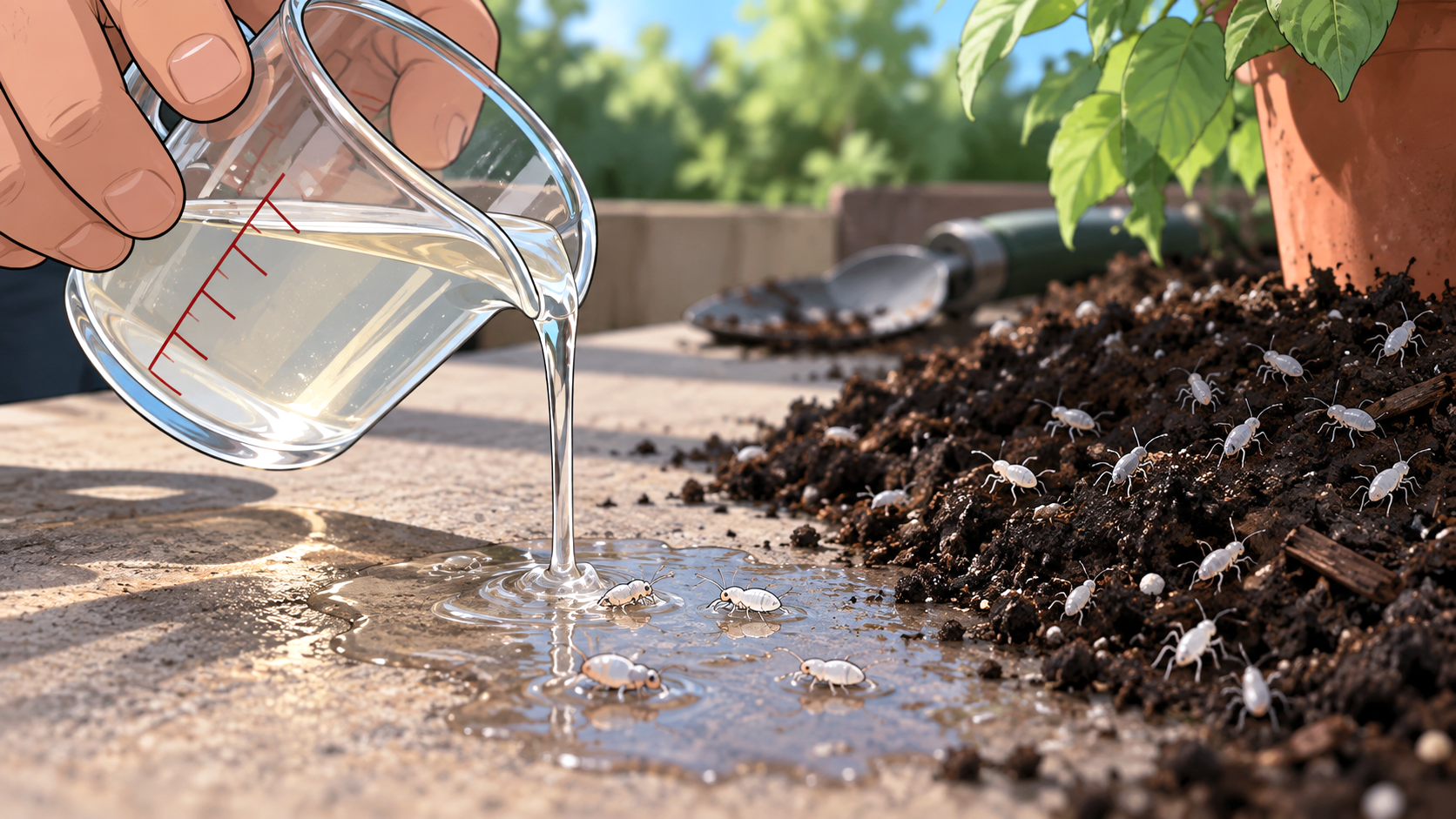
Vinegar shows up in DIY pest advice so often that it can start to look like a universal insect killer. Springtails are a good example of why that assumption causes trouble. Even though household vinegar contains acetic acid, using vinegar as a homemade springtail pesticide is not the control method we recommend. Vinegar is not a recommended treatment for springtails. Household vinegar contains diluted acetic acid, but that does not make it a proven springtail insecticide. Indoors, springtails are best controlled by removing the insects you see and correcting the moisture that allows them to persist, rather than repeatedly spraying them with vinegar.
Why Vinegar Is a Poor Springtail Treatment
Ordinary vinegar is primarily water with a relatively small concentration of acetic acid. Acetic acid does have pesticidal applications, but registered uses and concentrations matter. For example, acetic acid has registered pesticidal uses against weeds, where it works through direct contact with plant tissue. That does not establish household vinegar as an insecticide for springtails.
There is another useful regulatory distinction. Vinegar containing no more than 8% acetic acid can qualify as an inert ingredient in certain minimum-risk pesticide products. However, vinegar is not on the corresponding list of minimum-risk active ingredients. In other words, its presence in a pesticide formulation does not automatically mean vinegar is the ingredient controlling the pest. Vinegar’s status in minimum-risk pesticide products explains that distinction.
For us, that makes the recommendation simple. We would not turn grocery-store vinegar into a homemade springtail spray.
Killing a Few Springtails Is Not the Same as Controlling Them
The bigger weakness with vinegar is that it focuses your attention on the springtails you can see. Persistent indoor springtails usually point toward a damp environment. Plumbing leaks, excessive humidity, condensation, and wet areas can provide the conditions they need indoors. Moisture control is the most effective way to manage springtails.
Imagine finding a cluster beside a leaking pipe. Spraying those springtails with vinegar does nothing to repair the pipe or dry the surrounding material. More springtails can continue appearing while the favorable conditions remain.
That is why our broader guide to what attracts springtails is more useful when they repeatedly gather in one area. If you are already dealing with a larger indoor problem, the complete process belongs in our guide to getting rid of springtails.
Should You Spray Vinegar Directly on Springtails?
We do not recommend it. Household vinegar is not a springtail treatment supported by the springtail-management guidance we use, while simple physical removal already provides a straightforward way to deal with insects that are visible indoors.
Vacuuming works for springtails on floors and other dry surfaces. Meanwhile, springtails gathered in sinks or tubs can simply be washed away. Once those visible insects are gone, attention can shift to the moisture or entry route behind the sightings. Indoor springtail management guidance specifically emphasizes physical removal and moisture control rather than indoor pesticide use.
This distinction also matters when comparing vinegar with substances covered in our guide to what kills springtails instantly. A direct-contact effect and useful infestation control are two different questions.
Do Not Pour Vinegar Down a Drain for Springtails
Seeing springtails in a sink does not prove that they are breeding inside the drain. These tiny arthropods seek moist environments and can become trapped in smooth sinks and washbasins after entering the room from somewhere else.
As a result, pouring vinegar down the drain can target the wrong place entirely. Instead, check beneath the sink for leaks and damp material. Look around plumbing penetrations and other nearby moisture sources as well.
Our guide to springtails around drains covers that problem separately. The useful clue is where the springtails keep reappearing, not simply where you first noticed them.
Vinegar Is Also the Wrong Fix for Springtails in Houseplants
Springtails often live in damp potting soil, where they feed largely on fungi and decaying organic material. They can become especially noticeable after watering. However, their presence usually does not justify treating the soil with a homemade pesticide.
Instead, allow the soil surface to dry between waterings as much as the plant can tolerate. That changes the damp conditions supporting the springtails without adding vinegar to the pot. Indoor plant guidance also states that pesticides are not needed for springtails in houseplants. Springtail management in indoor plants.
Our dedicated guide to springtails in potted plants goes further into managing that particular source.
Stronger Vinegar Is Not a Better Springtail Solution
Increasing the acetic acid concentration does not solve the basic problem with this approach. Concentrated acetic acid products are not simply stronger bottles of harmless kitchen vinegar.
Acetic acid concentrations above 8% can cause severe eye damage and skin burns, and higher-strength acetic acid has pesticidal uses as a herbicide. The EPA’s guidance on vinegar and acetic acid concentrations specifically distinguishes ordinary vinegar from stronger acetic acid solutions.
So we would not recommend buying concentrated vinegar and experimenting with it against springtails. A stronger concentration adds meaningful safety concerns without fixing the moisture problem that commonly drives indoor springtail activity.
Natural does not automatically mean appropriate for pest control. A substance still needs to fit the pest, location, and intended use.
What Works Better Than Vinegar for Springtails?
Start by removing the springtails that are already visible. Vacuum or sweep them from dry surfaces, and remove those trapped around wet fixtures. This gives you the immediate result people often expect from spraying vinegar, without turning a household food product into an improvised pesticide.
Then inspect the area where they keep appearing. Springtails indoors are associated with high moisture, so check for plumbing leaks, condensation, persistently damp material, high humidity, and overwatered plants. Drying the affected area or correcting a leak can eliminate the conditions allowing them to remain indoors. Indoor springtail moisture management supports this source-first approach.
A dehumidifier for springtails can make sense when excessive room humidity is the actual problem. It cannot substitute for repairing an active leak.
Finally, consider outdoor migration when the inside of the home is dry. Springtails can move indoors while seeking moisture, so repeated sightings near doors, windows, or other exterior openings may require an entry-point inspection rather than another indoor treatment. Our guide to how springtails get into a house covers those routes in detail.
Put the Vinegar Away and Follow the Springtails
Rather than spraying the next springtail you see, remove it and pay attention to where the next ones appear. A repeated cluster beneath a sink points you toward a moisture inspection. Activity around a plant makes the potting soil worth checking. Repeated sightings along an exterior edge shift attention toward outdoor populations and possible entry points.
That information is more useful than testing another vinegar mixture. Once you identify the condition supporting the springtails, correct it and keep the area dry. For the longer-term side of the problem, our guide to preventing springtails covers the next steps.
Other Questions About Vinegar and Springtails
Does the smell of vinegar repel springtails?
Vinegar should not be treated as a springtail repellent. If your goal is to stop springtails from returning, removing excess moisture and addressing their route into the home are more useful strategies. Our separate guide examines smells claimed to repel springtails without turning this article into a repellent roundup.
Can I mix vinegar with bleach to kill springtails?
No. Never mix vinegar with chlorine bleach. Combining an acid such as vinegar with chlorine bleach can release dangerous chlorine gas. Springtails do not warrant taking that risk, particularly when indoor infestations can usually be addressed through physical removal and moisture correction.
Will cleaning floors with vinegar prevent springtails?
Do not rely on vinegar cleaning as a springtail-prevention method. Springtails are associated with moisture rather than ordinary household dirt, so a clean floor can still have springtails nearby when damp conditions or an entry route remain.
Why do springtails return after I wipe them away?
Repeated sightings usually mean the conditions bringing them into that location have not changed. Indoors, that makes moisture and possible entry routes more useful things to investigate than repeatedly treating each new group.
This post reflects our own research and isn’t a substitute for advice from a licensed pest control professional. Always follow the product label. See our full disclaimer for more.
Does Vinegar Kill Springtails?
Vinegar shows up in DIY pest advice so often that it can start to look like a universal insect killer. Springtails are a good example of why that assumption causes trouble. Even though household vinegar contains acetic acid, using vinegar as a homemade springtail pesticide is not the control method we recommend.
Vinegar is not a recommended treatment for springtails. Household vinegar contains diluted acetic acid, but that does not make it a proven springtail insecticide. Indoors, springtails are best controlled by removing the insects you see and correcting the moisture that allows them to persist, rather than repeatedly spraying them with vinegar.
The important distinction is between something that might affect an insect on direct contact and something that actually controls the springtail problem.
Why Vinegar Is a Poor Springtail Treatment
Ordinary vinegar is primarily water with a relatively small concentration of acetic acid. Acetic acid does have pesticidal applications, but registered uses and concentrations matter. For example, acetic acid has registered pesticidal uses against weeds, where it works through direct contact with plant tissue. That does not establish household vinegar as an insecticide for springtails.
There is another useful regulatory distinction. Vinegar containing no more than 8% acetic acid can qualify as an inert ingredient in certain minimum-risk pesticide products. However, vinegar is not on the corresponding list of minimum-risk active ingredients. In other words, its presence in a pesticide formulation does not automatically mean vinegar is the ingredient controlling the pest. Vinegar’s status in minimum-risk pesticide products explains that distinction.
For us, that makes the recommendation simple. We would not turn grocery-store vinegar into a homemade springtail spray.
Killing a Few Springtails Is Not the Same as Controlling Them
The bigger weakness with vinegar is that it focuses your attention on the springtails you can see. Persistent indoor springtails usually point toward a damp environment. Plumbing leaks, excessive humidity, condensation, and wet areas can provide the conditions they need indoors. Moisture control is the most effective way to manage springtails.
Imagine finding a cluster beside a leaking pipe. Spraying those springtails with vinegar does nothing to repair the pipe or dry the surrounding material. More springtails can continue appearing while the favorable conditions remain.
That is why our broader guide to what attracts springtails is more useful when they repeatedly gather in one area. If you are already dealing with a larger indoor problem, the complete process belongs in our guide to getting rid of springtails.
Should You Spray Vinegar Directly on Springtails?
We do not recommend it. Household vinegar is not a springtail treatment supported by the springtail-management guidance we use, while simple physical removal already provides a straightforward way to deal with insects that are visible indoors.
Vacuuming works for springtails on floors and other dry surfaces. Meanwhile, springtails gathered in sinks or tubs can simply be washed away. Once those visible insects are gone, attention can shift to the moisture or entry route behind the sightings. Indoor springtail management guidance specifically emphasizes physical removal and moisture control rather than indoor pesticide use.
This distinction also matters when comparing vinegar with substances covered in our guide to what kills springtails instantly. A direct-contact effect and useful infestation control are two different questions.
Do Not Pour Vinegar Down a Drain for Springtails
Seeing springtails in a sink does not prove that they are breeding inside the drain. These tiny arthropods seek moist environments and can become trapped in smooth sinks and washbasins after entering the room from somewhere else.
As a result, pouring vinegar down the drain can target the wrong place entirely. Instead, check beneath the sink for leaks and damp material. Look around plumbing penetrations and other nearby moisture sources as well.
Our guide to springtails around drains covers that problem separately. The useful clue is where the springtails keep reappearing, not simply where you first noticed them.
Vinegar Is Also the Wrong Fix for Springtails in Houseplants
Springtails often live in damp potting soil, where they feed largely on fungi and decaying organic material. They can become especially noticeable after watering. However, their presence usually does not justify treating the soil with a homemade pesticide.
Instead, allow the soil surface to dry between waterings as much as the plant can tolerate. That changes the damp conditions supporting the springtails without adding vinegar to the pot. Indoor plant guidance also states that pesticides are not needed for springtails in houseplants. Springtail management in indoor plants.
Our dedicated guide to springtails in potted plants goes further into managing that particular source.
Stronger Vinegar Is Not a Better Springtail Solution
Increasing the acetic acid concentration does not solve the basic problem with this approach. Concentrated acetic acid products are not simply stronger bottles of harmless kitchen vinegar.
Acetic acid concentrations above 8% can cause severe eye damage and skin burns, and higher-strength acetic acid has pesticidal uses as a herbicide. The EPA’s guidance on vinegar and acetic acid concentrations specifically distinguishes ordinary vinegar from stronger acetic acid solutions.
So we would not recommend buying concentrated vinegar and experimenting with it against springtails. A stronger concentration adds meaningful safety concerns without fixing the moisture problem that commonly drives indoor springtail activity.
Natural does not automatically mean appropriate for pest control. A substance still needs to fit the pest, location, and intended use.
What Works Better Than Vinegar for Springtails?
Start by removing the springtails that are already visible. Vacuum or sweep them from dry surfaces, and remove those trapped around wet fixtures. This gives you the immediate result people often expect from spraying vinegar, without turning a household food product into an improvised pesticide.
Then inspect the area where they keep appearing. Springtails indoors are associated with high moisture, so check for plumbing leaks, condensation, persistently damp material, high humidity, and overwatered plants. Drying the affected area or correcting a leak can eliminate the conditions allowing them to remain indoors. Indoor springtail moisture management supports this source-first approach.
A dehumidifier for springtails can make sense when excessive room humidity is the actual problem. It cannot substitute for repairing an active leak.
Finally, consider outdoor migration when the inside of the home is dry. Springtails can move indoors while seeking moisture, so repeated sightings near doors, windows, or other exterior openings may require an entry-point inspection rather than another indoor treatment. Our guide to how springtails get into a house covers those routes in detail.
Put the Vinegar Away and Follow the Springtails
Rather than spraying the next springtail you see, remove it and pay attention to where the next ones appear. A repeated cluster beneath a sink points you toward a moisture inspection. Activity around a plant makes the potting soil worth checking. Repeated sightings along an exterior edge shift attention toward outdoor populations and possible entry points.
That information is more useful than testing another vinegar mixture. Once you identify the condition supporting the springtails, correct it and keep the area dry. For the longer-term side of the problem, our guide to preventing springtails covers the next steps.
Other Questions About Vinegar and Springtails
Does the smell of vinegar repel springtails?
Vinegar should not be treated as a springtail repellent. If your goal is to stop springtails from returning, removing excess moisture and addressing their route into the home are more useful strategies. Our separate guide examines smells claimed to repel springtails without turning this article into a repellent roundup.
Can I mix vinegar with bleach to kill springtails?
No. Never mix vinegar with chlorine bleach. Combining an acid such as vinegar with chlorine bleach can release dangerous chlorine gas. Springtails do not warrant taking that risk, particularly when indoor infestations can usually be addressed through physical removal and moisture correction.
Will cleaning floors with vinegar prevent springtails?
Do not rely on vinegar cleaning as a springtail-prevention method. Springtails are associated with moisture rather than ordinary household dirt, so a clean floor can still have springtails nearby when damp conditions or an entry route remain.
Why do springtails return after I wipe them away?
Repeated sightings usually mean the conditions bringing them into that location have not changed. Indoors, that makes moisture and possible entry routes more useful things to investigate than repeatedly treating each new group.
2 thoughts on “Does Vinegar Kill Springtails?”