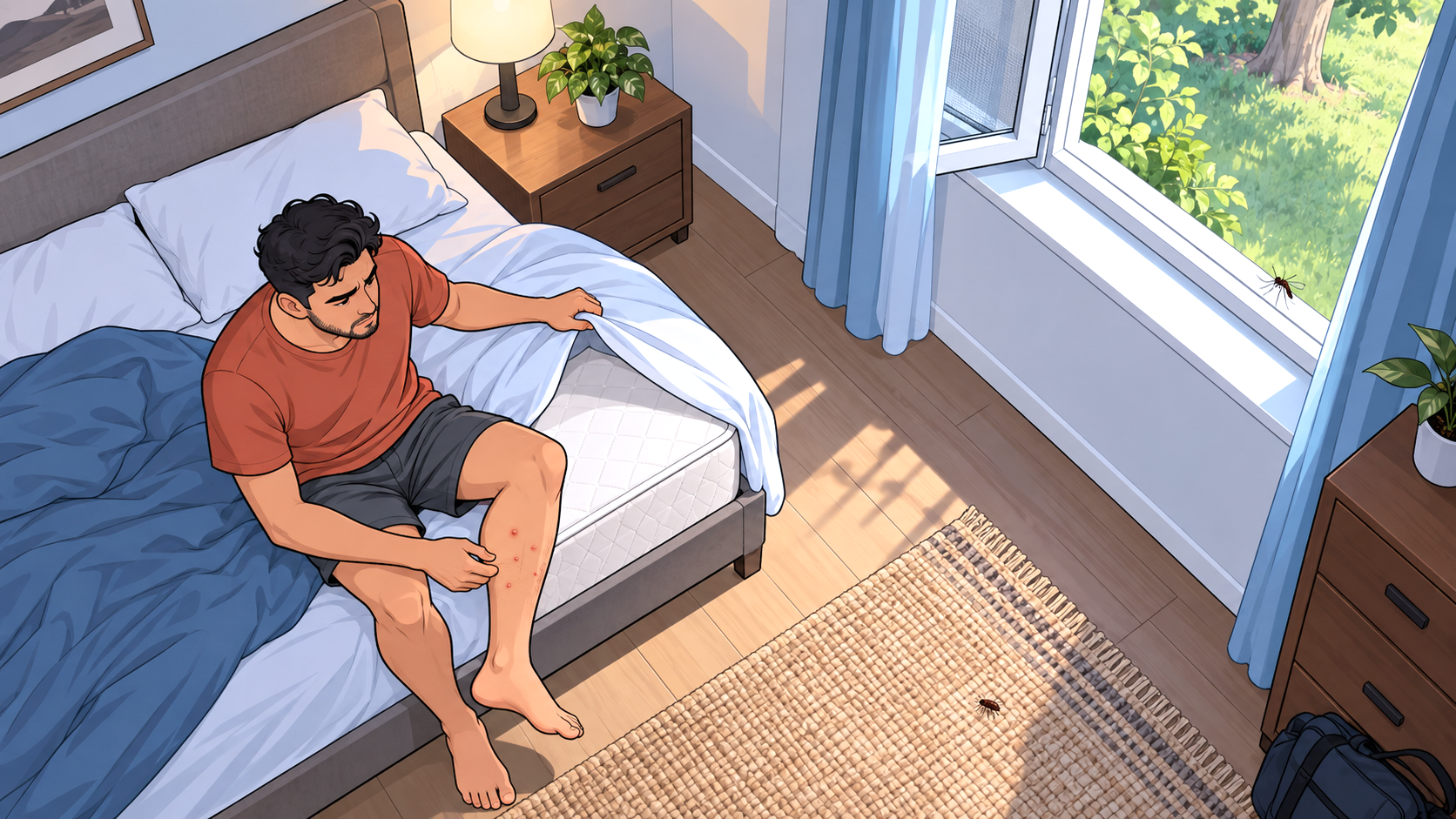
You change the sheets, inspect the mattress seams, shine a flashlight around the headboard, and find nothing. The next morning, there are more itchy marks. At that point, it is tempting to assume the bed bugs are simply hiding too well. Sometimes they are. But there is another possibility worth taking seriously: the marks may not be bed bug bites at all. If you are waking up with bite-like marks but cannot find bed bugs, possible causes include mosquitoes, fleas, other biting arthropods, hives, eczema, contact dermatitis, or another skin condition. A small bed bug infestation can also be difficult to detect, so inspect for physical evidence rather than identifying the cause from the marks alone.
The challenge is that your skin records inflammation, not the identity of whatever caused it. A red itchy bump does not arrive with a label telling you whether it came from an insect, an allergic response, or irritated skin. Instead of repeatedly searching for an invisible bed bug, it helps to reopen the investigation and ask what else fits the evidence you actually have.
First, Decide Whether You Are Really Being Bitten
This sounds like an odd place to begin when new marks appear after sleep, but “I woke up with bites” already contains an assumption. Unless you saw an insect feeding or have other convincing evidence, what you actually know is that you woke up with marks on your skin.
EPA guidance is unusually clear on this point. Bites are a poor indicator of a bed bug infestation because they can resemble mosquito and chigger bites as well as eczema, fungal infections, and hives. Some people with genuine bed bug infestations develop no visible bite reaction whatsoever. Bed bug bites can resemble several other skin problems
Timing adds another complication. Bed bug reactions do not necessarily become visible immediately after feeding. The CDC notes that marks may appear one to several days after the bite, and in some people the delay can be considerably longer. Waking up and noticing a new mark therefore does not prove that something bit you during the previous night. Bed bug reactions may be delayed after the actual bite
That uncertainty is why our guide to having bites but no signs of bed bugs focuses on gathering evidence from both the skin and the room instead of treating the bumps as the diagnosis.
If Something Is Biting You, Bed Bugs Are Only One Candidate
Mosquitoes are an obvious alternative, particularly when one can enter the bedroom unnoticed. Their bites can produce swollen, itchy areas that resemble bed bug reactions closely enough that appearance alone may not settle the question. The CDC specifically describes bed bug bites as looking similar to mosquito or flea bites.
Fleas deserve more attention when pets are present, although a home without pets does not automatically exclude them. The useful clues come from the larger situation rather than trying to distinguish two tiny red bumps. Finding jumping insects, investigating pets and their resting areas, and considering where the marks occur can move the investigation forward. Our bed bug bites vs. flea bites comparison goes into those differences without pretending that every bite can be identified from a photograph.
Other biting arthropods can also complicate the picture. EPA specifically mentions chiggers as one example of bites that may resemble bed bug reactions. Where you have recently been matters here. Marks that appear after outdoor exposure, travel, contact with animals, or time in another building should not automatically be blamed on the bed simply because you first noticed them the next morning.
Sometimes the Missing Bug Is Missing Because There Was Never a Bug
Now the investigation changes direction. Instead of asking which insect produced the bumps, consider whether an insect was involved at all.
Hives can produce intensely itchy raised bumps or swollen patches that appear suddenly. Individual hives commonly disappear within 24 hours while new ones can develop elsewhere, which can create the impression that fresh “bites” keep appearing. Hives have numerous potential triggers, including allergies, infections, medications, heat, cold, pressure, stress, and insect bites themselves. Sometimes the cause is never identified. Hives can suddenly produce itchy bumps and raised patches
Watch what individual marks do rather than only counting how many appear each morning. A raised welt that disappears within hours and is replaced by another somewhere else behaves differently from a persistent bite reaction. This does not provide a home diagnosis, but it gives a healthcare professional more useful information than a single photograph taken after waking.
If your marks resemble raised welts more than discrete bites, our comparison of bed bug bites and hives explores that possibility in more detail.
Your Bedding Can Irritate You Without Containing Any Insects
A bedroom contains plenty of things capable of touching the skin for hours. Laundry detergent, fabric products, lotions, fragrances, clothing materials, and other substances can contribute to contact dermatitis in susceptible people. Contact dermatitis can be itchy and sometimes painful, and finding its trigger can require working through what has been touching the affected skin. Contact dermatitis can develop after skin encounters an irritant or allergen
This possibility becomes particularly interesting when something recently changed. Perhaps you switched detergent, started using a fragranced fabric product, bought new sleepwear, changed a skincare product, or introduced different bedding. None of those details proves contact dermatitis, but they are worth remembering when an insect search repeatedly produces no insect evidence.
The distribution can also offer context. A reaction concentrated where fabric or a product repeatedly contacts the skin tells a different story from finding an actual bed bug, shed skins, eggs, and fecal spotting around the mattress. A dermatologist can evaluate persistent or unexplained rashes when the cause remains uncertain.
The Bed Itself Can Be Innocent Even When the Problem Appears Every Morning
Sleeping creates a convenient observation point. You spend hours in one place, then inspect your skin when you wake up. That naturally makes the mattress seem responsible for anything you notice.
But the overnight pattern can be misleading. Hives may come and go. Contact reactions can develop after prolonged exposure. Some insect-bite reactions can become visible after a delay. Existing irritated areas can also feel more noticeable when you wake up and start paying attention to them.
For bed bugs specifically, the better question is whether the room supports the theory. Our guide to early signs of bed bugs covers the evidence that can accompany an infestation. If repeated inspections reveal none of those signs, that does not instantly eliminate bed bugs, but it should stop the skin marks from being treated as proof.
Before You Rule Out Bed Bugs, Give the Room a Proper Search
There is a reason bed bugs remain on the list even when you have never seen one. Low-level infestations are harder to detect than established ones, and the insects spend much of their time concealed. EPA guidance specifically warns that small infestations can be challenging to find and identify correctly.
A proper inspection is much narrower and more deliberate than glancing at the top of the mattress. Examine seams, piping, tags, the box spring, cracks and joints in the frame, and the headboard. Nearby furniture and crevices become relevant as well. You are looking not only for a live insect but also for rusty or reddish stains, dark fecal spots, eggs, eggshells, and shed skins. EPA lists the physical evidence used to find bed bugs
Our bed bug mattress inspection gives that search more structure. If you have already inspected once and remain uncertain, bed bug monitors can also be part of a longer detection strategy rather than repeatedly dismantling the room whenever another mark appears.
What you should not do is spray the bedroom simply because you have unexplained bumps. Misidentification can expose people to unnecessary pesticides while leaving the real cause untouched. First establish whether there is a pest to treat.
A Photograph of the Rash Is More Useful as a Record Than as a Pest ID
Taking photographs can still help, just not in the way people often expect. A series of photos can show when marks appeared, whether individual lesions remained in the same location, how quickly they faded, and whether the overall problem changed. That history can be useful if you eventually need medical evaluation.
What photographs cannot reliably do is transform a nonspecific skin reaction into a confirmed bed bug diagnosis. CDC laboratory guidance states that the inflammatory response to bed bug bites is not specifically diagnostic for bed bugs. Confirmation is better achieved by identifying actual bed bugs collected near the area where the person was exposed. The skin reaction itself is not diagnostic for bed bugs
The same caution applies to online image comparisons. Even our guide showing what bed bug bites look like should be used to understand possible appearances, not as a substitute for finding pest evidence or obtaining medical evaluation when a rash is concerning.
When the Search Keeps Coming Up Empty, Change What You Are Tracking
After several mornings, it helps to stop recording only “more bites.” Keep track of where the marks appear, when you first notice them, how long each one remains, whether they move or disappear, whether you slept somewhere else, and whether anything touching your skin recently changed. At the same time, continue looking for objective pest evidence rather than assuming every new mark resets the investigation to bed bugs.
This approach allows the possibilities to separate naturally. Finding a live bed bug or characteristic infestation evidence moves the pest explanation forward. Finding fleas or another biting arthropod changes the target. A recurring rash with no pest evidence may justify medical evaluation rather than increasingly aggressive pest treatment.
If you eventually find an unfamiliar insect, identification comes before control. Our guide to bugs that look like bed bugs can help prevent a different household insect from being mistaken for the answer simply because you desperately want the mystery solved.
When the Skin Needs Attention Before the Bedroom Does
An unexplained rash should not be left indefinitely in the pest-control category. Persistent, worsening, painful, infected-looking, widespread, or otherwise concerning skin symptoms are reasons to seek advice from a qualified healthcare professional. A clinician can consider conditions that no mattress inspection can diagnose.
Get urgent medical care for symptoms suggesting a serious allergic reaction. The American Academy of Dermatology advises urgent or emergency care when hives occur with swelling of the face, mouth, or throat, trouble swallowing or breathing, faintness, or a racing heart. Severe hives can require emergency medical care
This does not mean abandoning the bed bug question. You can investigate the room and the skin separately. Our guide on when to see a doctor for suspected bed bug bites covers the medical side in greater detail, while pest confirmation should continue to depend on what you actually find in the environment.
Questions to Ask When You Keep Waking Up With Unexplained Marks
Could bed bugs still be there even if I have searched several times?
Yes. A small infestation can be difficult to locate, and bed bugs can fit into narrow cracks around beds and furniture. Repeated failure to find evidence does not prove they are absent, but neither does it justify assuming they are present forever. A systematic inspection and appropriate monitoring are more informative than repeatedly judging the bumps.
Why am I getting marks while the person sleeping next to me has none?
Different reactions do not rule bed bugs in or out. Some people develop noticeable marks after bed bug bites, while others show no physical signs. If bed bugs are responsible, two people sharing a bed therefore do not have to look the same the next morning.
Can stress make something look like insect bites?
Stress can trigger hives in some people, and hives can appear as itchy raised bumps or patches. That does not mean every unexplained rash during a stressful period is hives. If marks keep recurring without pest evidence, their timing and behavior are useful details to discuss with a healthcare professional.
Should I call an exterminator if I cannot find a single bug?
A professional inspection can be reasonable when there is a persistent reason to suspect bed bugs despite careful searching, especially after known exposure or when other physical clues appear. However, unexplained skin marks alone cannot confirm the infestation. If you are deciding whether professional help is warranted, our guide on when to call an exterminator for bed bugs explains what makes that step more useful.
Could I be seeing old bites rather than new bites every morning?
Possibly. Bed bug bite reactions can be delayed, and people do not all react on the same schedule. That means the moment a mark becomes visible does not necessarily reveal the night or location where the exposure occurred.
7 thoughts on “Waking Up With Bites but No Bed Bugs? Here’s What Else It Could Be”