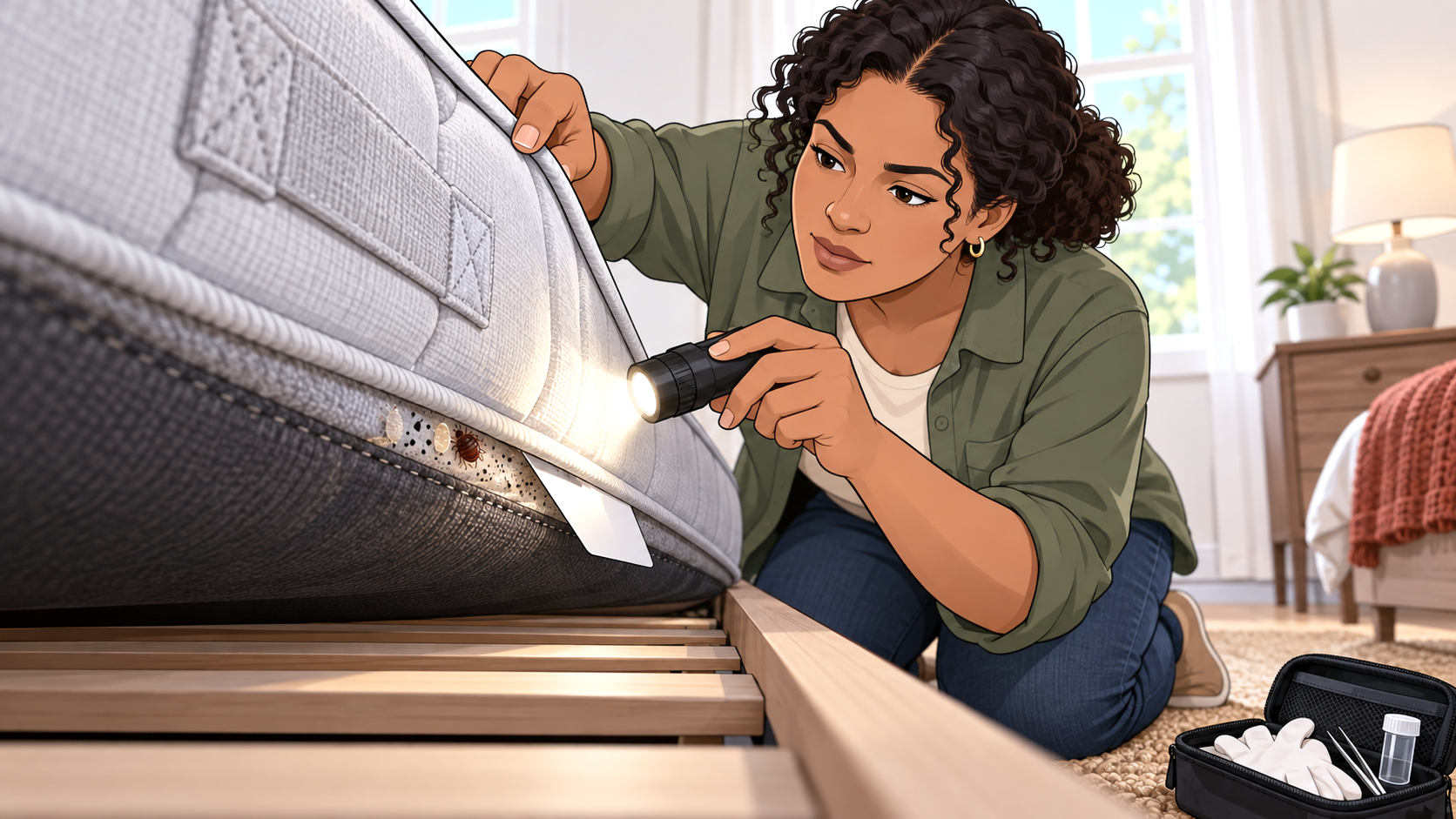
Checking a mattress for bed bugs is easy to do badly. A quick glance at the top sheet tells you almost nothing. Bed bugs spend much of their time hidden in narrow, protected spaces, so the parts of a mattress that look perfectly clean from above can still conceal insects along seams, piping, labels, folds, and nearby bed components. To check a mattress for bed bugs properly, strip the bed and inspect the mattress slowly from the outer seams inward, then turn your attention underneath it. Look for live bugs, eggs, shed skins, and dark fecal spotting rather than relying on bites alone. Continue into the box spring and frame if the mattress itself appears clear.
The inspection works best when you treat the mattress less like one object and more like a collection of hiding edges.
Before You Lift Anything, Look at the Bed as It Is
Do not begin by immediately dragging the mattress across the room. The undisturbed bed can contain clues that disappear once bedding and furniture start moving.
Start with the sheets, pillowcases, and exposed mattress surface. You are looking for anything that deserves a closer inspection, particularly dark spotting, shed skins, or an actual insect. Rusty or reddish stains can also occur when bed bugs are crushed on bedding. These signs are among the physical clues associated with bed bug activity.
Keep their limitations in mind. One random brown speck on a sheet is not a diagnosis, and blood on bedding has many possible causes. What matters is whether multiple signs begin pointing in the same direction.
This is also the point where we would set bites aside. People often inspect a mattress only after waking with itchy marks, but skin reactions cannot establish that bed bugs are present. Bite reactions vary greatly between people and can resemble mosquito or flea bites. Our guide to having bites without finding bed bug evidence explains why the inspection has to stand on physical evidence rather than the rash.
Once you have observed the bed undisturbed, remove the bedding carefully so you can reach the mattress itself.
Follow the Mattress Edge Before Inspecting the Middle
A bare mattress can be visually overwhelming because there is so much surface area. Fortunately, the broad flat center is usually not the smartest place to spend most of your attention.
Start at one corner and follow the entire perimeter. Work slowly along the piping and seams where different pieces of fabric meet. Bed bugs favor narrow protected spaces, and mattress seams are specifically recognized as common hiding locations. They also hide under mattress labels and around handles.
A flashlight makes this much easier. Direct the beam almost parallel to the mattress rather than straight down whenever possible. Side lighting can make raised insects, eggs, shed skins, and irregular material along a seam easier to notice.
Do not randomly jump from corner to corner. Pick a starting point and follow the seam all the way around until you return to it. That simple method reduces the chance of repeatedly inspecting the obvious spots while accidentally skipping an entire side.
For a more detailed breakdown of where evidence tends to appear on the bed itself, our article on bed bug signs on a mattress covers those clues separately.
The Stitching Deserves More Attention Than the Fabric
Once you reach a seam, inspect the seam itself rather than merely looking beside it.
Mattress stitching creates small recesses where an insect can sit partly concealed. Tufts, folds, buttons, fabric overlaps, labels, and piping deserve the same kind of close examination. Bed bugs commonly occupy tufts, folds, buttons, mattress seams, and nearby bed structures.
The insects you are looking for will not all look identical. Adults are reddish-brown and flattened when unfed, while nymphs are smaller and lighter. Bed bugs range from very small early nymphs to adults several millimetres long, so limiting your search to something “apple-seed sized” can make you overlook younger insects. Our actual bed bug size guide shows why life stage matters during an inspection.
Eggs are another reason to slow down. Bed bug eggs are small, pale, and attached to surfaces. They are much easier to miss than an adult walking across fabric. Finding eggs in a protected seam is stronger evidence than discovering an unidentified white crumb lying loosely on the middle of the mattress.
A magnifier can help with tiny questionable objects, but a flashlight and patient inspection matter more than expensive equipment.
Dark Spots Need a Second Look, Not an Immediate Verdict
Dark specks around a mattress seam often trigger the strongest reaction because bed bug fecal spotting is a recognized infestation sign.
Bed bugs can leave dark reddish-brown fecal spots or smears on sheets, mattresses, and nearby surfaces. The material consists of digested blood, and spotting may occur around areas where the insects hide. This type of evidence is described in bed bug inspection guidance for sleeping areas.
Still, not every dark mark is fecal material. Mattresses collect dirt, lint, ink, fabric debris, mold-like staining, and countless mystery marks over years of use. A single dark dot therefore deserves investigation, not a diagnosis.
Context makes the clue stronger. Several dark spots concentrated inside a seam, especially alongside shed skins, eggs, or live insects, mean far more than one isolated stain on an exposed panel.
Our guide to bed bug fecal spots goes further into what this evidence can look like. Keeping that subject separate is useful because fecal spotting is one clue in a mattress inspection, not the whole inspection.
Turn the Mattress Over Only After Finishing the Top Side
The underside gets skipped surprisingly often.
Finish the perimeter, seams, labels, folds, and upper mattress features first. Then carefully lift or rotate the mattress so you can see underneath it. Bed bugs do not care which side humans consider the “bottom.” A dark, quiet surface resting against another structure can provide exactly the kind of protected environment they use.
Inspect the underside with the same discipline you used on the top. Trace the perimeter rather than scanning randomly. Pay particular attention to seams, labels, fabric folds, and any recesses created by the mattress construction.
The point here is not that bed bugs prefer the underside of every mattress. The point is that inspecting only the sleeping surface leaves half the object unexamined.
If the mattress sits directly on a platform, look closely at the areas where the mattress contacts the platform. If it rests on a box spring, the next stage of the inspection becomes even more important because the mattress may turn out to be the simplest part of the bed.
A Clean Mattress Does Not Clear the Box Spring
This is where many mattress inspections stop too early.
Bed bugs are often found in box springs, and the internal construction creates many protected hiding spaces. Inspect the upper edges, corners, seams, and fabric folds after removing the mattress. Then examine the underside carefully.
Many box springs have a thin fabric dust cover stretched across the bottom. Bed bugs can hide around the edges of that fabric and within the structure behind it. Inspection guidance specifically identifies the underside and dust cloth of box springs as areas worth checking.
This changes how we interpret a spotless mattress. It is encouraging, but it does not eliminate bed bugs when the support structure underneath has not been examined.
Look for the same evidence you were searching for on the mattress: live bugs, pale shed skins, eggs, and dark spotting. Our guide to bed bug shed skins can help distinguish an empty cast skin from a living insect or unrelated debris.
The more convincing findings often come from combinations. An adult bug beside several shed skins and clustered spotting in a protected box-spring corner tells a very different story from an isolated speck.
Then Leave the Mattress Completely
A mattress inspection that never goes beyond the mattress can still miss the infestation.
Bed bugs tend to live around sleeping and resting areas, but that includes much more than bedding. They can hide in bed frames, headboards, furniture, cracks, and crevices. They generally remain relatively close to where people sleep, although they can move farther when necessary.
After checking the mattress and box spring, inspect every joint in the bed frame. Pay attention to screw holes, gaps where pieces of wood or metal meet, recessed hardware, cracks, and surfaces hidden behind the headboard. A headboard against a wall deserves inspection on both sides if it can be accessed safely.
The difference between the mattress and the frame is important. A mattress gives bed bugs seams. A frame gives them structural cracks. A box spring gives them both.
For that reason, finding nothing on the mattress but skipping the frame can create false reassurance. Our broader guide on how to check for bed bugs throughout a sleeping area covers the areas beyond the bed once this mattress-focused inspection is complete.
Know What a Bed Bug Looks Like Before You Decide You Found One
Mattresses collect objects that become surprisingly insect-like when someone is already worried about bed bugs.
Lint, scabs, carpet beetle material, seeds, crumbs, fabric fibers, and bits of debris can all become suspicious under a flashlight. Before reacting to a speck, check whether it has the anatomy of an insect.
An adult bed bug has six legs, antennae, and a broad oval body that is flattened from top to bottom when unfed. Adults are brown to reddish-brown. Nymphs resemble smaller versions of the adults but can be much paler, particularly before feeding. Bed bugs do not have functional wings and cannot fly or jump.
When a specimen is unfamiliar, preserve it rather than crushing it. A small clear container, sealed bag, or piece of clear tape can keep the insect available for identification. Destroying it first and trying to identify the stain afterward throws away your strongest evidence.
Our visual guide to bugs that resemble bed bugs is useful at this stage because the goal has shifted from finding something suspicious to confirming what that something actually is.
Finding Nothing Is a Result, Not Proof
A careful mattress inspection can end without finding a single bed bug.
That does not automatically prove the home is bed bug-free. Small infestations can be difficult to locate, and bed bugs do not have to hide inside the mattress itself. Eggs and young nymphs are particularly easy to overlook because of their size, which is one reason travelers are advised to inspect not only mattresses but also box springs, bedding, and surrounding furniture.
What matters next depends on why you inspected. One unexplained skin mark with no physical pest evidence is very different from repeated suspicious marks plus spotting around a headboard. Likewise, finding a confirmed bed bug anywhere near the sleeping area changes the situation even if the mattress itself remains clean.
When suspicion remains after a thorough inspection, monitoring can provide information over time. Bed bug interceptors placed beneath appropriate bed legs can catch insects attempting to climb the bed and are also used for post-control monitoring.
Avoid responding to an inconclusive inspection by immediately spraying random household chemicals around the mattress. Identification comes first. Treatment decisions become much easier once you know what is actually present.
Let the Evidence Determine Your Next Move
A mattress inspection has three useful outcomes, not just “bugs” or “no bugs.”
The clearest result is finding a recognizable bed bug. Preserve the specimen, inspect the rest of the sleeping area, and move from detection into an appropriate bed bug control plan. If you find one insect and are unsure how much that tells you, our article on finding a single bed bug covers that situation separately.
The second outcome is finding indirect evidence such as clustered fecal spotting, eggs, or shed skins without immediately seeing a live insect. That evidence deserves further investigation rather than dismissal simply because nothing moved.
The third outcome is finding nothing suspicious. In that case, expand the search beyond the mattress rather than repeatedly inspecting the same seam. Check the box spring, bed frame, headboard, nearby furniture, and other resting areas. When no physical bed bug evidence emerges, keep other explanations for unexplained skin symptoms open.
That is what a good mattress inspection should accomplish. Its purpose is not to make you stare harder at every speck. It is to steadily narrow the possibilities until you have evidence strong enough to act on.
Other Questions About Checking a Mattress for Bed Bugs
Can bed bugs be inside a mattress rather than on the seams?
Bed bugs use accessible cracks, folds, seams, and protected spaces rather than burrowing through solid mattress material. However, damaged mattresses can contain openings that provide access to internal spaces. This is why every tear, zipper area, opening, and structural gap deserves attention during the inspection.
Should I throw away a mattress if I find bed bugs on it?
Finding bed bugs does not automatically mean the mattress must be discarded. Bed bug control commonly includes treatment, monitoring, and the use of suitable bed bug-proof encasements. Throwing furniture away without addressing the rest of the infestation can leave bed bugs elsewhere in the room and does not solve the source.
Is a mattress encasement useful for finding bed bugs?
An appropriate bed bug-proof encasement can reduce hiding places on a mattress and box spring and trap insects already enclosed inside. It can therefore make future monitoring simpler, but it does not prove that other parts of the room are bed bug-free.
Can I check a mattress during the daytime?
Yes. Bed bugs often hide during the day, which is exactly why a detailed inspection of seams, folds, labels, box springs, frames, and other harborages can find them. You do not need to wait until the middle of the night before inspecting the bed.
What should I do with a bug I find during the inspection?
Capture it without destroying the body if possible. A clear sealed bag, container, or transparent tape can preserve useful identifying features. Correct identification matters because several household insects can be mistaken for bed bugs, and treatment should follow identification rather than precede it.
5 thoughts on “How to Check a Mattress for Bed Bugs”