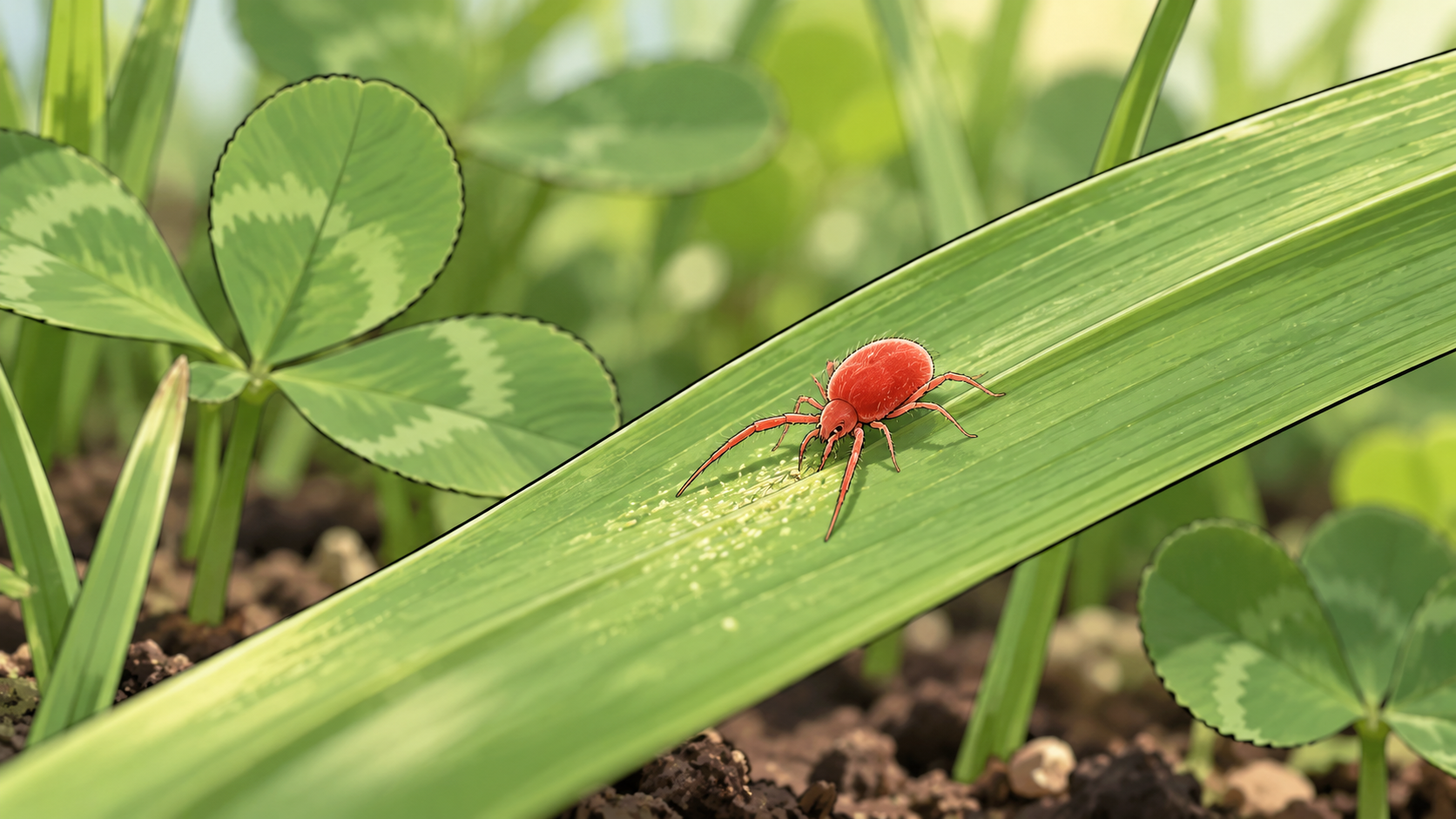
Clover mites eat plant material, especially grasses and clover. They feed by piercing plant tissue with their mouthparts and sucking out the contents of the damaged cells. Despite their name, they are not limited to clover. Their diet includes lawn grasses, weeds, flowering plants, crops, and some woody plants.
They are plant feeders throughout their active feeding stages. They do not switch to blood, insects, stored food, or household materials for nourishment.
Clover Mites Feed by Piercing Plant Cells
A clover mite does not chew pieces from a leaf. Its mouthparts puncture plant cells so it can withdraw the contents. This feeding method is why descriptions of clover mite diets often refer to them as sucking plant juices or sap.
On a leaf, repeated feeding removes cell contents from many tiny points rather than taking visible bites from the edge. In sufficiently high numbers, that feeding can produce pale or silvery areas where plant cells have been damaged. Bryobia mites feed by puncturing plant cells and sucking out their contents, which is a more precise description of what “feeding on sap” means in this case.
Feeding begins early. Clover mite larvae start feeding on plants after hatching, and the later nymphal and adult stages remain plant feeders. The developmental sequence itself belongs in the clover mite life cycle, but their food source remains plant tissue rather than changing to an animal-based diet as they mature.
Grasses and Clover Are Major Foods
Grasses are among the most common clover mite foods. They feed on lawn grasses as well as clover, which explains the common association between these mites and turf. Kentucky bluegrass, perennial ryegrass, and fescues are documented hosts, while other extension sources describe grasses and clover more broadly as important foods.
The name “clover mite” can therefore be misleading if taken too literally. Clover is certainly on the menu, but the mite does not depend on it. A population can feed perfectly well where grasses are abundant and clover is scarce or absent.
We think this is the most useful misconception to clear up. Finding clover mites does not give you evidence that clover must be growing somewhere nearby. Their diet is much too broad for that conclusion.
Clover Mites Eat Many Other Plants Too
The menu extends well beyond turf. Clover mites have been recorded feeding on more than 200 species of plants, including numerous grasses and herbaceous plants. Documented hosts include beans, tomatoes, strawberries, sweet peas, violets, shepherd’s purse, and other broadleaf and grassy weeds.
Other records add ornamental flowers, shrubs, trees, and legumes to the list. Alfalfa, peas, clovers, lawn grasses, weeds, ornamentals, shrubs, and trees can all serve as hosts.
There is some biological complexity hidden behind that long list. Mites traditionally identified as Bryobia praetiosa are now thought to include a species complex, and different populations may favor different host plants. Some are associated mainly with grasses, while others feed on woody ornamentals. That makes a universal list of “favorite” plants less useful than recognizing the broader pattern: clover mites are plant feeders capable of using many hosts.
Clover Mites Do Not Eat People, Pets, or Household Materials
Their diet remains plant-based. Clover mites do not obtain food by biting people or pets, and they do not feed on blood. They also do not consume furniture, clothing, paper, stored foods, or the structure of a building.
That point matters because a mite seen away from vegetation can easily create the wrong impression about what it is eating. Its location does not change its diet. Clover mites are plant feeders and do not feed indoors, so finding one on a wall, windowsill, carpet, or piece of furniture does not mean that material has become a food source.
If the question is why certain lawns or properties support particularly large populations, that moves beyond diet. Soil fertility, plant vigor, landscaping, and other property conditions belong in what attracts clover mites rather than being treated as additional foods.
Other Questions About What Clover Mites Eat
Do clover mites eat only clover?
No. Clover is one host, but clover mites also feed on grasses and many other plants. More than 200 plant species have been reported as hosts.
Do clover mites eat grass?
Yes. Lawn grasses are major food sources. Documented hosts include Kentucky bluegrass, perennial ryegrass, and fescues.
Do clover mites eat other insects?
No. Clover mites are plant feeders rather than predatory mites. Their food comes from plant tissue.
Do clover mites drink blood?
No. They do not feed on the blood of people or animals. Their piercing mouthparts are used to feed on plant cells.
14 thoughts on “What Do Clover Mites Eat?”