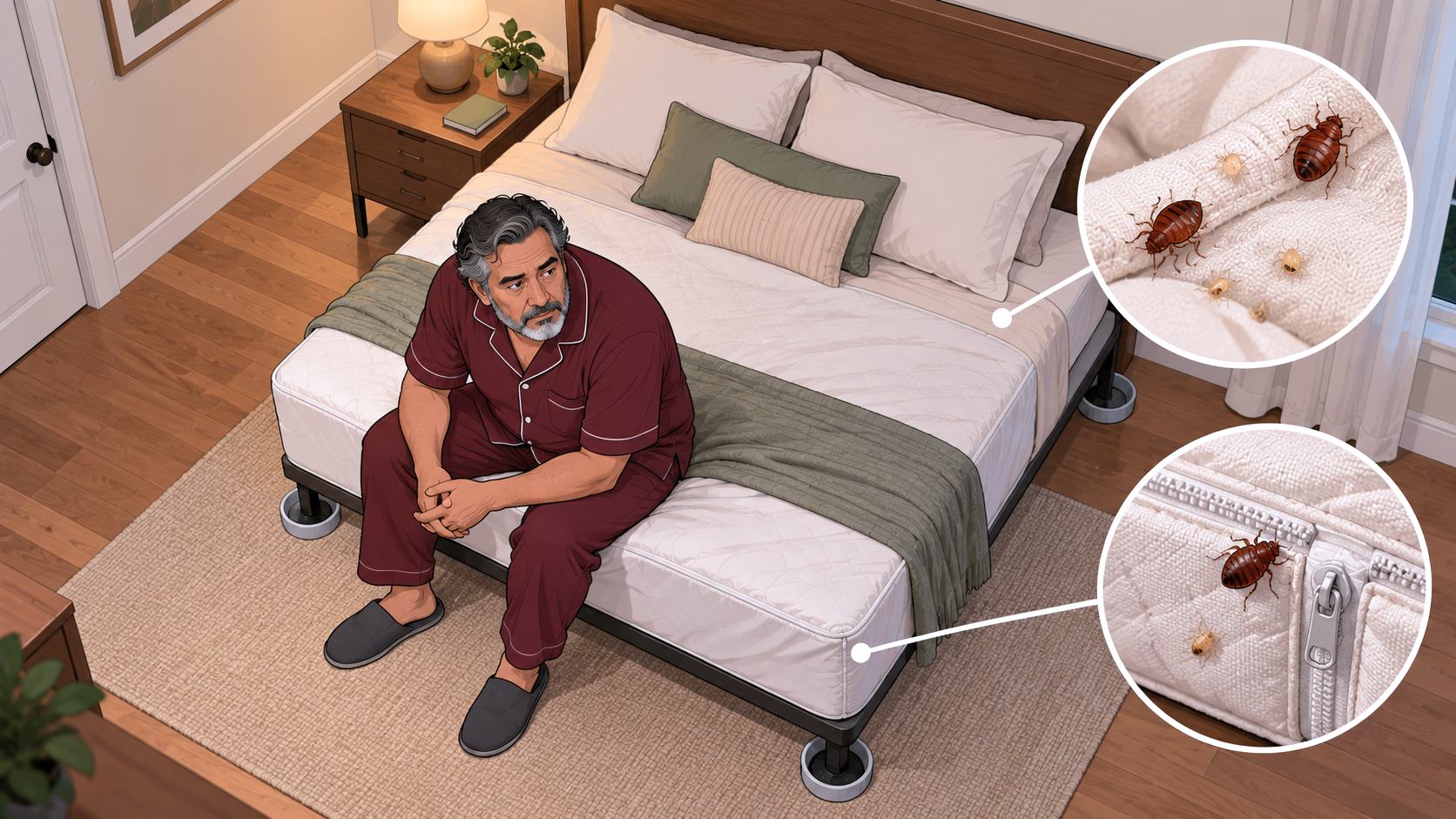
During an active bed bug infestation, continuing to sleep in your usual bed is often preferable to moving to another room, unless your pest-control professional or treatment instructions require otherwise. Sleeping elsewhere can give hungry bed bugs a new host location to search for, potentially complicating monitoring and spreading activity beyond the original sleeping area. Remaining in the bed does mean bites can continue until control succeeds. The aim is not to tolerate an infestation indefinitely, but to keep your normal sleeping location stable while isolating the bed, monitoring activity and eliminating the bugs.
Moving to the Couch Can Give Bed Bugs Another Place to Find You
Bed bugs concentrate around places where people regularly sleep and rest because those locations provide predictable access to blood meals. They respond to several host-associated signals, including carbon dioxide, body odors and warmth. Experiments have demonstrated strong attraction to carbon dioxide, while heat contributes to orientation at much shorter distances. Combined host cues can produce substantial movement toward a potential feeding source.
Changing bedrooms does not remove those cues. It changes where they originate.
A hungry bug remaining in the original bedroom will not necessarily stay beside an empty mattress indefinitely. Bed bugs are capable of traveling away from established harborages, and their distribution can shift as they search for feeding opportunities. Research examining host-seeking behavior found that unfed bed bugs became increasingly responsive to human-associated signals after several days without feeding, with both sexes moving toward a carbon dioxide source from their harborages.
Sleeping on a living-room couch every night can consequently establish another predictable feeding location. A few insects reaching the couch may then shelter in its seams, folds or frame rather than making the return journey immediately. An infestation that was concentrated around one bed can become harder to manage when bed bugs begin occupying more than one room.
Occasionally falling asleep somewhere else is not proof that bugs will colonize that room. The concern is deliberately relocating regular sleep during an established infestation and giving host-seeking insects a reason to explore additional parts of the home.
Make the Bed a Controlled Feeding and Monitoring Zone
Continuing to sleep in the room does not mean leaving the bed exactly as it was. An isolated bed can make access more difficult while turning the area around it into a useful monitoring point.
Move the bed away from the wall, keep blankets and sheets from touching the floor, and remove objects that create bridges between the bed and nearby furniture. A bed-bug-proof encasement can simplify the mattress exterior and contain insects already trapped inside when used correctly. Federal preparation guidance recommends creating this type of isolated sleeping area and placing interceptors beneath each suitable bed leg.
Interceptors take advantage of bed bug movement rather than attempting to make the sleeper invisible. Field research found passive interceptors useful for detecting small populations, including cases where they outperformed visual inspection at detecting low-level infestations. Another apartment study found that continuous interceptor use reduced populations and contributed to elimination in some lightly infested units even without conventional insecticide treatment during the study period.
Correct bed bug interceptor placement matters because bedding touching the floor or furniture touching the bed can provide alternate routes. Keep the bed accessible to the treatment program rather than surrounding it with improvised barriers, loose pesticide powders or unapproved repellents.
Staying in the Bed Does Not Guarantee You Will Stop Getting Bitten
Bed isolation can reduce access routes, but it cannot promise a bite-free night. Bugs already occupying the mattress, box spring or frame may begin inside the barrier created by interceptors. Others may find routes that were missed.
Bed bugs normally feed while people are sleeping, and bites can produce itching, sleep loss and, rarely, allergic reactions. They are not known to transmit disease to people, but scratching itchy lesions can damage the skin and contribute to secondary infection. Bite reactions also vary greatly between individuals, including people who develop little or no obvious itching.
Repeated scratching deserves attention because scratched bed bug bites can become increasingly irritated. Most uncomplicated bites require little more than symptomatic care and good hygiene, while severe reactions or suspected secondary infections warrant medical advice. Clinical guidance notes that topical corticosteroids or antihistamines may sometimes help more severe itchy reactions, depending on the individual situation.
Someone experiencing extensive reactions, significant sleep disruption or another medical concern may need advice from a healthcare professional in addition to pest control. The recommendation to maintain a stable sleeping location is a pest-management consideration, not a requirement to endure medically significant symptoms.
Do Not Try to Make Yourself Unavailable to Starve Them
Moving away for a few nights is not an effective starvation strategy. Bed bugs can survive far longer without feeding than a weekend away or a short stay elsewhere. Vacating the bedroom can reduce immediate access to a host, but it does not reliably eliminate the insects.
Their ability to persist without feeding varies with life stage, temperature and other conditions, so bed bugs can survive extended periods without a blood meal. Federal prevention information similarly notes that they can survive for months without feeding. An empty bedroom for several nights therefore creates no dependable endpoint for an infestation.
Avoid carrying pillows, blankets and other untreated bedroom possessions to the couch or spare room as well. Bed bugs are effective hitchhikers and can travel in bedding, clothing, luggage and other belongings. Moving infested objects can spread them more directly than host-seeking movement ever would.
Treatment Instructions Can Override the Usual Advice to Keep Sleeping There
Professional treatment can temporarily require you to leave the bedroom or the entire property. Pesticide labels establish re-entry requirements after certain applications, while professional heat treatment requires occupants to leave the treatment area during heating.
Follow those instructions exactly. Do not remain in a treated room simply because keeping a consistent sleeping location is otherwise useful. Once the pest-control professional says re-entry is permitted, ask whether normal sleeping should resume that night.
The same applies when a technician has deliberately changed the room setup. Do not move the bed back against the wall, remove monitors, wash treated surfaces or rearrange furniture without checking the required steps after bed bug treatment. The sleeping area may have been configured to channel moving bugs across interceptors or treated surfaces.
Avoid Turning the Bed Into an Improvised Chemical Barrier
Spraying insect repellent, household chemicals or extra pesticides around the bed can interfere with the treatment plan and create unnecessary exposure. Products used against bed bugs need to be registered for the intended application and used exactly according to their labels.
Repellent odors are especially unreliable as a substitute for control. Even substances that alter bed bug behavior do not create a dependable protective zone around a sleeping person. Attempts to surround the bed with products based on smells that bed bugs dislike can redirect movement without eliminating hidden insects.
The useful barrier is physical and observable: an appropriately prepared bed, limited access routes, encasements where suitable, and monitors that record movement. Integrated pest-management research has combined encasements, steam, interceptors and targeted treatments successfully, with interceptors contributing substantially to population monitoring during control.
When Sleeping in the Bed Becomes Too Difficult
Severe itching, repeated waking and anxiety can make continued sleep in an infested room difficult even when remaining there would simplify pest management. Bed bug infestations are associated with sleep loss, and persistent lack of sleep deserves attention in its own right.
If sleeping there has become intolerable, speak with the pest-control professional before permanently relocating to another room. A different arrangement may need to be incorporated into the treatment plan rather than improvised night by night. The effects of bed bugs on sleep and fatigue can become significant even though the insects are not disease vectors.
Whatever alternative is chosen, avoid carrying untreated bedding and possessions into the new sleeping area. The priority is to protect your health without unintentionally establishing another bed bug harboring area.
Questions About Sleeping With Bed Bugs
Should you sleep with the lights on?
Leaving the lights on is not a reliable way to prevent feeding. Bed bugs are generally more active during darkness, but hungry insects can alter their activity and are capable of feeding when opportunities occur outside their usual nighttime pattern.
Can you put your mattress on the floor until treatment is finished?
That can make isolation more difficult because interceptors cannot be installed beneath bed legs and more of the mattress may contact surfaces accessible to bugs. Keeping an intact bed frame can provide a more controllable setup.
Should pets sleep somewhere else during an infestation?
Do not move a pet’s bedding from an infested room into a clear room without inspecting or appropriately processing it. Bed bugs primarily feed on humans when available but can take blood from other warm-blooded animals.
Can you sleep in a hotel until the exterminator gets rid of the bed bugs?
Temporarily staying elsewhere may be necessary for personal or medical reasons, but belongings leaving an infested home need careful handling. Bed bugs can hitchhike in luggage, clothing and bags, creating a risk of carrying them to the temporary accommodation.