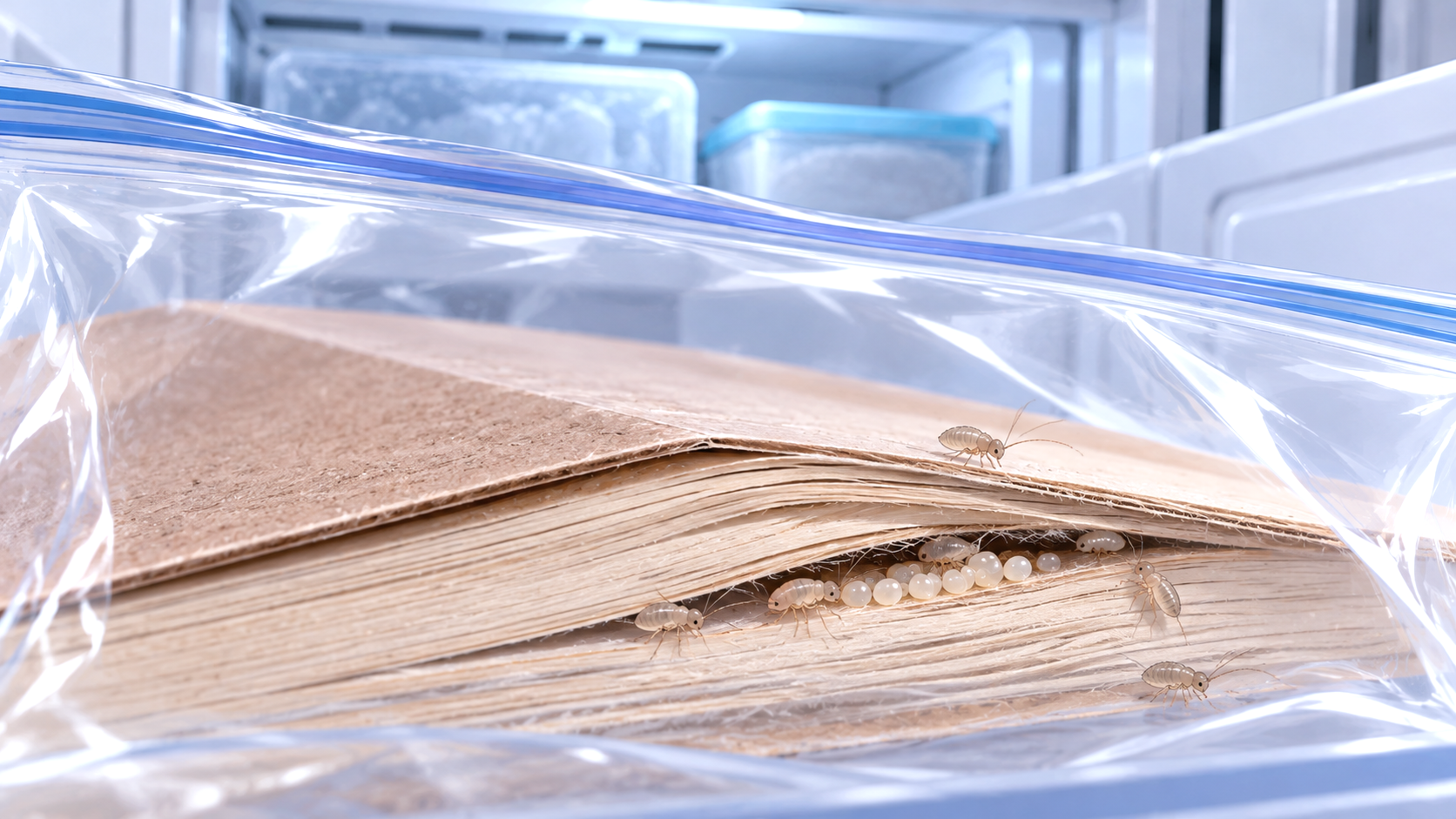
Booklice eggs can be killed by sustained heat, prolonged freezing, and sufficiently dry conditions. Eggs are often the most treatment-resistant life stage, so killing visible adults does not prove the eggs are dead. Effective control depends on reaching the eggs for long enough, including those hidden in cracks, bindings, cardboard, stored products, or other protected material.
Eggs Are Often the Last Life Stage to Die
Booklice undergo incomplete metamorphosis, progressing from egg to nymph to adult, and the egg behaves differently from the mobile stages during treatment. Laboratory heat experiments with Liposcelis bostrychophila, L. decolor, and L. paeta found that eggs were generally the most heat-tolerant developmental stage. Cold-treatment experiments reached a similar result, with eggs surviving freezing substantially longer than nymphs and adults.
That resistance changes how an infestation should be judged. Adults disappearing immediately after treatment says little about eggs concealed nearby. Their extremely small size and inconspicuous placement, described in more detail by the appearance of booklice eggs, also makes it unrealistic to locate and treat every egg individually.
Controlled Heat Can Kill Booklice Eggs
Heat is one of the best-documented direct methods for killing psocid eggs. Experiments across several Liposcelis species show that egg mortality increases as temperature and exposure duration increase, although species differ considerably in tolerance. Effective disinfestation has been studied within approximately 43°C to 51°C (109°F to 124°F), and USDA material places psocid heat treatment more broadly around 45°C to 55°C (113°F to 131°F).
There is no single temperature that can be described as an instant egg-kill point. An exposure near the lower end of that range can require far longer than one near the upper end, and the egg itself must reach the required temperature. A room thermometer showing 120°F does not establish that eggs inside a cardboard fold, stack of books, cabinet joint, or wall cavity are equally hot. The specific relationship between temperature, exposure time, and protected locations is central to using heat to kill booklice.
Improvised heating with hair dryers, space heaters, ovens, or other household appliances is not a reliable substitute for controlled treatment. It can leave cool refuges untreated while creating fire or material-damage hazards.
Freezing at 0°F Can Kill Eggs, but Some Need Several Days
A household freezer operating around 0°F (-18°C) can kill booklice eggs when exposure lasts long enough. Research comparing four stored-product species found large differences in cold tolerance. Complete egg mortality occurred after approximately 2 hours for L. entomophila, 12 hours for L. decolor, and 24 hours for L. paeta under the experimental conditions, while young L. bostrychophila eggs showed scattered survival even after 120 hours at -18°C. The study identified young L. bostrychophila eggs as the most cold-tolerant stage tested.
Those differences make short freezing periods unreliable when the species is unknown. The entire object must also cool to the target temperature before the effective exposure period can really begin. A dense stack of books, boxed materials, or another insulated object may remain warmer internally for many hours after being placed in a freezer.
The practical limitations behind freezing booklice are particularly important for books, electronics, artwork, and moisture-sensitive objects that may not tolerate condensation or freeze-thaw cycles safely.
Sustained Low Humidity Can Kill Eggs and Prevent More From Being Laid
Drying works more slowly than heat or freezing, but it can affect both existing immature stages and future reproduction. Controlled experiments exposing four Liposcelis species to 43% or 50% relative humidity found that combinations of eggs and early nymphs reached complete mortality within approximately 8 to 16 days, depending on species and humidity. L. paeta survived longest in those tests, reaching complete mortality by 16 days at 50% RH, while other species died sooner under the same experimental framework. The dehumidification study included eggs, early nymphs, adults, and mixed life stages.
Low humidity also suppresses reproduction before every existing egg has died. Indoor psocids stop laying eggs when humidity becomes sufficiently unfavorable, and prolonged dryness eventually exhausts their ability to maintain body water. A dry atmosphere below the critical humidity can ultimately eliminate Liposcelis populations even though individual insects may initially survive by drawing on internal water reserves.
The physiological reason behind booklice needing humidity to survive makes drying especially useful in homes because it prevents surviving eggs from simply producing another generation in the same favorable habitat.
Normal Cool Temperatures Are Not Enough
Refrigeration or a chilly room should not be confused with freezing treatment. Development slows as temperatures fall, but booklice eggs can remain viable at temperatures that are too cool for rapid population growth. Liposcelis paeta, for example, showed a much longer egg-to-adult development period at lower experimental temperatures, reaching about 45 days at 22.5°C compared with 11.5 days at 37.5°C.
Slowing development can make an infestation appear less active without killing the eggs. The booklice life cycle can continue when conditions become favorable again unless treatment actually makes the environment lethal or prevents successful development.
Contact Insecticides Should Not Automatically Be Assumed to Kill Eggs
A product that rapidly kills an exposed adult is not necessarily strongly ovicidal. Booklice eggs are attached to substrates and can be concealed in narrow spaces that sprays never reach. Stored-product psocids also show variation in susceptibility to conventional insecticides, and some populations have demonstrated reduced susceptibility to several chemical classes. Published work on Liposcelis bostrychophila notes that conventional insecticide performance can vary substantially among strains.
Any pesticide used against booklice must be labeled for the intended pest and application site. The sprays and insecticides used for booklice should therefore be judged by their label directions rather than by assuming that a fast adult kill also sterilizes every egg.
Treating books, mattresses, food-storage surfaces, electronics, or other sensitive belongings with an unlabeled household pesticide creates additional exposure and material-damage concerns without guaranteeing egg control.
Vinegar, Bleach, and Household Sprays Are Poor Egg Treatments
There is no good basis for treating vinegar, bleach, rubbing alcohol, essential oils, or ordinary household cleaners as reliable ovicides for concealed booklice eggs. Directly soaking an exposed egg may damage it, but household infestations do not consist of conveniently exposed eggs waiting on a washable counter.
Booklice females place eggs individually within suitable environments rather than producing a large visible egg mass. Canadian grain information records females laying eggs randomly within the food source, while indoor populations can use cracks, paper materials, stored products, and other protected substrates.
Adding liquids to paper, cardboard, drywall, furniture, or porous building materials can also increase moisture. The limitations of vinegar against booklice become even more significant when the target is a microscopic concealed egg rather than an exposed adult.
Discarding an Infested Disposable Item Removes the Eggs With It
Some egg problems are easier to solve by removing the substrate rather than treating it. A badly damp cardboard box, inexpensive heavily infested dry-food package, or disposable moldy material can contain eggs in folds and seams that are difficult to reach individually.
Stored-product psocids can infest grain and food commodities throughout storage environments, and several Liposcelis species are established stored-product pests capable of reproducing within food materials. Discarding a contaminated disposable product removes adults, nymphs, eggs, and food simultaneously instead of requiring an ovicidal treatment to penetrate every hiding place.
Valuable books, documents, furnishings, and other irreplaceable objects require a different calculation and should not be discarded simply because booklice eggs may be present.
Egg Control Is Successful Only if Newly Hatched Nymphs Stop Appearing
Because the eggs are difficult to see, treatment success is usually judged indirectly. Continued appearance of tiny nymphs after adult numbers have fallen suggests that eggs survived, another untreated site exists, or reproduction continued after the first intervention. The appearance of baby booklice can therefore be more useful after treatment than searching for individual eggs.
Complete clearance also takes longer than the time needed to kill an exposed adult. The expected timeline for getting rid of booklice depends on whether the treatment reaches all life stages and whether the habitat remains unsuitable afterward.
Questions About Killing Booklice Eggs
Does boiling water kill booklice eggs?
Extreme heat can kill insect eggs, but pouring boiling water onto household materials is not an appropriate booklice treatment. It can cause burns, damage belongings, and add moisture to the area.
Can a hair dryer kill booklice eggs?
A hair dryer may heat an exposed surface, but it cannot reliably verify the temperature or exposure time inside cracks and objects where eggs are hidden. It should not be relied upon for complete egg control.
Will washing kill booklice eggs on clothes?
Appropriate laundering and machine drying can physically remove insects and expose washable textiles to heat, but treatment should follow the garment’s care instructions. Clothing itself is not a normal primary food source for booklice.
Can booklice eggs survive a night in the freezer?
Some species may not, but L. bostrychophila eggs have survived much longer than one night at -18°C in experiments. A short overnight freeze should therefore not be treated as universally reliable.
Does diatomaceous earth kill booklice eggs?
Desiccant dusts are primarily useful against mobile insects that contact the material. There is not strong evidence supporting ordinary household diatomaceous earth as a dependable direct ovicide for concealed booklice eggs, so diatomaceous earth for booklice should not be judged by egg control alone.
Will low humidity stop eggs from hatching?
Sufficiently dry conditions can kill eggs and early nymphs over time, and low humidity also suppresses further reproduction. The effect is not instantaneous, and species vary in how long they survive.
Do you have to kill every egg individually?
No. A successful booklice control strategy makes the entire breeding environment unsuitable, allowing hidden eggs and emerging nymphs to die without locating each one individually.