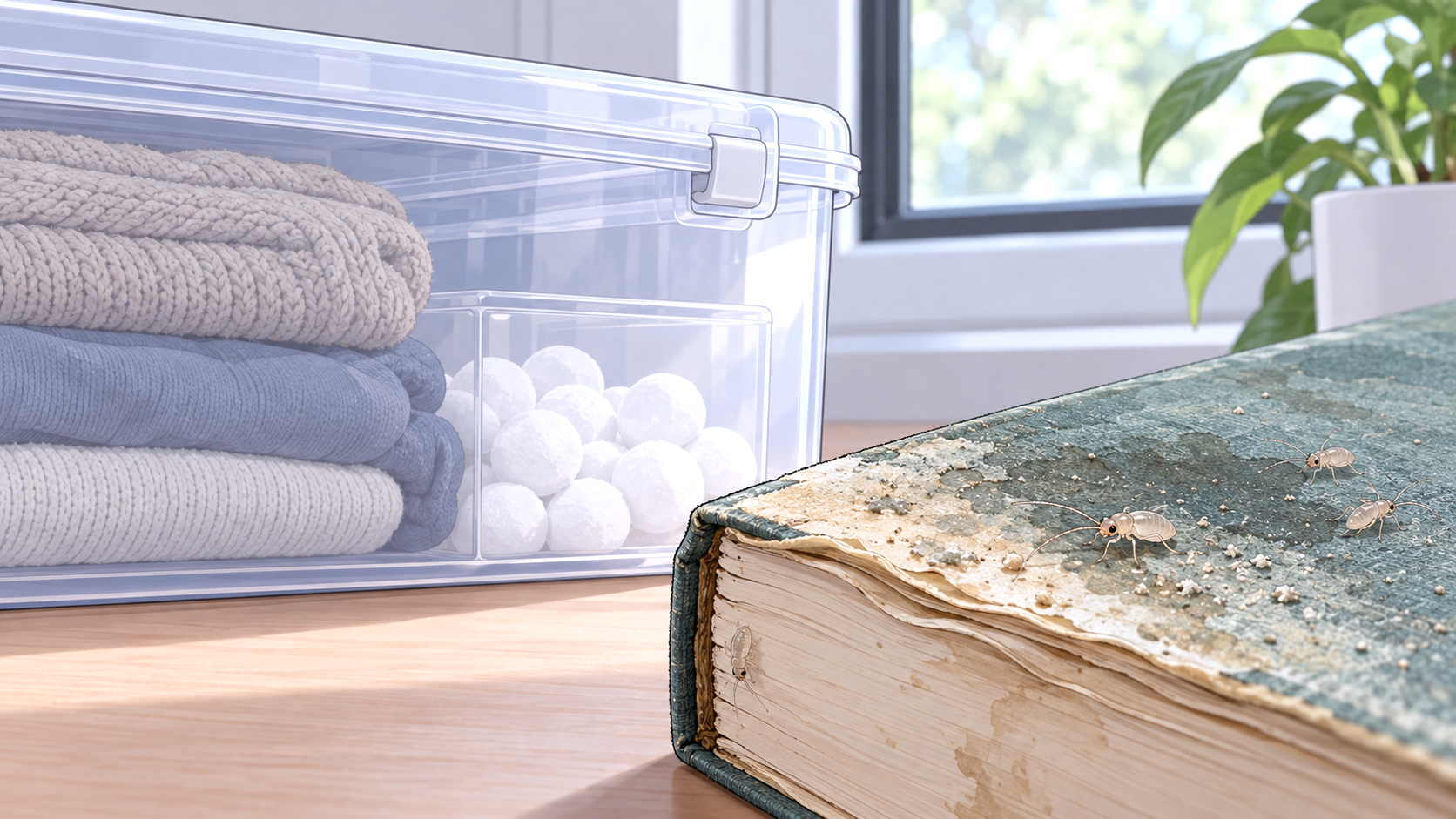
Mothballs release insecticidal vapors, so sufficiently concentrated naphthalene or paradichlorobenzene fumes may be toxic to booklice. That does not make mothballs an appropriate booklice treatment. Mothball products are designed for specific labeled pests and enclosed storage uses, and scattering them around rooms, bookshelves, wall voids, basements, or cabinets can expose people and pets without reliably controlling the infestation.
Mothballs Work by Building Up Toxic Vapor
Modern mothballs usually contain naphthalene or paradichlorobenzene, solid pesticides that gradually turn directly into gas at room temperature. Their established use depends on trapping that vapor at a sufficiently high concentration inside a tightly closed container. Mothball fumes kill susceptible insects when confined inside sealed storage spaces, while the same product used in an open room disperses into a much larger volume of air.
That delivery method is poorly matched to household booklice. These insects can occupy tiny cracks, wall cavities, cardboard folds, shelving joints, stored foods, and other locations where an open mothball cannot maintain a predictable fumigant concentration. The places where booklice commonly hide also make room-scale vapor treatment fundamentally different from protecting clothing inside a sealed container.
A Mothball Label Does Not Automatically Cover Booklice
Mothballs are pesticides, not general-purpose insect repellents. Their legal uses are defined by the product label, including which pests can be treated and where the product may be placed. Current mothball products are primarily intended for clothes moths and, on some labels, other fabric pests in enclosed storage. Using a pesticide for an unlabeled pest or in an unlabeled location can create unnecessary exposure and violate its directions.
Booklice should therefore not be added to a mothball’s target list simply because the active ingredient is capable of harming insects. When chemical treatment is genuinely warranted, a product among the insecticides labeled for booklice or the appropriate treatment site is a more defensible choice than improvising with a pesticide designed around garment storage.
Scattering Mothballs Around an Infested Room Is Not Fumigation
Putting several mothballs beside baseboards, under furniture, behind books, or inside an open closet may create a strong odor without producing the controlled vapor concentration associated with their labeled use. Mothball active ingredients are intended to accumulate in an airtight or tightly closed space; using them in open areas allows those vapors to enter occupied air instead. Mothballs have little or no dependable effect when improvised as open-air repellents.
The smell itself is not a measure of an effective dose. Humans can detect some mothball vapors at concentrations far below those needed for insect control, so a room smelling strongly of mothballs does not establish that hidden booklice have received a lethal exposure. It establishes that pesticide vapor has entered the room.
The Vapors Can Harm People Before They Solve a Booklice Problem
Naphthalene exposure can occur by breathing contaminated air or handling mothballs. Reported effects include irritation, headaches, dizziness, respiratory symptoms, and damage to red blood cells under sufficiently significant exposure. Naphthalene from mothballs can affect the respiratory, neurological, and blood systems, making deliberate open-room exposure difficult to justify for a nuisance insect that usually responds to moisture correction.
Children and pets create additional concerns because mothballs can be touched or swallowed. EPA specifically warns about illegal or improperly labeled mothball products posing a hazard to young children. Storage products should remain in their original packaging and be used exactly as directed rather than distributed around living spaces.
A persistent mothball odor after misuse can also remain in fabrics and furnishings. Proper use limits vapor to enclosed storage rather than allowing it to circulate continuously through occupied rooms.
Putting Mothballs With Books Is Usually a Poor Tradeoff
The name “booklice” can make it tempting to seal affected books with mothballs. A book, however, is not automatically compatible with every pesticide vapor, and the objective is rarely to fumigate one volume in isolation. Booklice associated with books often reflect damp storage and fungal growth rather than an insect population that exists because the book itself is uniquely attractive.
Their relationship with paper, bindings, fungi, and other book-associated food means the storage environment deserves attention before a pesticide is introduced. Valuable books, archival material, photographs, coated papers, adhesives, and other sensitive objects can also retain odors or react unpredictably to improvised chemical treatment.
For individual infested books, approaches specifically suited to the material, including controlled drying or where appropriate freezing books to eliminate booklice, are more targeted than placing an unlabeled pesticide beside them.
Mothballs Do Not Correct the Condition That Lets Booklice Reproduce
Even a vapor concentration capable of killing exposed booklice would leave the environmental cause untouched. Indoor booklice thrive where humidity remains high enough to support their water balance and fungal food. Sustained relative humidity around the high-40% range or lower becomes unfavorable for many household psocids, while dampness allows populations to continue.
That dependence is why humidity has such a strong effect on booklice survival. A mothball can gradually evaporate without changing a wet basement wall, leaking pipe, condensation problem, or damp stack of cardboard. Once the vapor disappears, a suitable habitat remains available for surviving or newly introduced insects.
Correcting moisture also suppresses mold that can serve as booklice food, affecting both the insects and one of the resources supporting the population.
A Dehumidifier Is More Relevant Than a Mothball in a Humid Room
When excessive room humidity is the source, mechanical drying directly alters the environment in which booklice are living. Maintaining sufficiently low relative humidity can eventually kill adults, nymphs, and eggs while reducing fungal growth. The effect takes time, but it operates across the room rather than relying on insects entering a small cloud of pesticide vapor.
The effectiveness of using a dehumidifier against booklice still depends on whether the actual breeding area becomes dry. A concealed leak cannot be corrected by either a dehumidifier or mothballs, so persistent insects around one specific wall, pipe, cabinet, or window remain a reason to investigate water intrusion.
Do Not Put Mothballs in Wall Voids, Attics, or Crawlspaces for Booklice
These locations may seem ideal because booklice can occur in concealed spaces, but mothballs are not meant to be improvised as structural fumigants. Vapors released into attics, wall cavities, crawlspaces, vehicles, or similar spaces can migrate into occupied areas, and open or structural use outside the product label can expose people to pesticide fumes.
A concentration strong enough to smell through walls is not evidence that the hidden infestation is being treated effectively. Booklice repeatedly emerging from a wall are more useful as a clue that moisture may exist behind the surface. The pattern and location of repeated booklice sightings can help narrow that search.
Questions About Mothballs and Booklice
Will the smell of mothballs repel booklice?
Do not rely on it. Mothballs are designed to produce insecticidal vapor under specific enclosed conditions, not to create a general household repellent odor. Open-air repellency is unreliable.
Can I put mothballs in a cardboard box containing booklice?
Only use mothballs according to the exact product label and for the pests and storage conditions it specifies. A damp cardboard box is better treated as a possible booklice habitat than converted into an improvised fumigation chamber.
Will naphthalene kill booklice?
Naphthalene is toxic to insects at sufficient vapor concentrations, so booklice could be susceptible. That toxicological possibility does not establish a safe, effective, or labeled household method for treating booklice with naphthalene mothballs.
Will paradichlorobenzene kill booklice?
Paradichlorobenzene is also a fumigant insecticide whose vapor is toxic to insects. Paradichlorobenzene mothballs are formulated primarily for clothes-moth control in enclosed containers, so they should not be repurposed for booklice unless a specific product label permits it.
Can mothballs kill booklice eggs?
Mothball vapors are capable of killing the eggs of their labeled target pests when the required concentration is maintained, but that cannot be extended automatically to hidden booklice eggs. The separate methods with evidence for killing booklice eggs depend on reaching the egg with an effective treatment for sufficient time.
Are mothballs safer than spraying insecticide for booklice?
Not inherently. Mothballs are themselves concentrated pesticides and release toxic vapor. Safety depends on the product, label, exposure route, treatment site, and correct use rather than whether the pesticide begins as a solid ball instead of a spray.
What should I use instead of mothballs?
Vacuum accessible insects, remove badly damp disposable material, correct leaks or condensation, and keep the affected environment sufficiently dry. These measures address the conditions supporting the population and form the basis of getting rid of booklice without filling occupied air with mothball vapor.