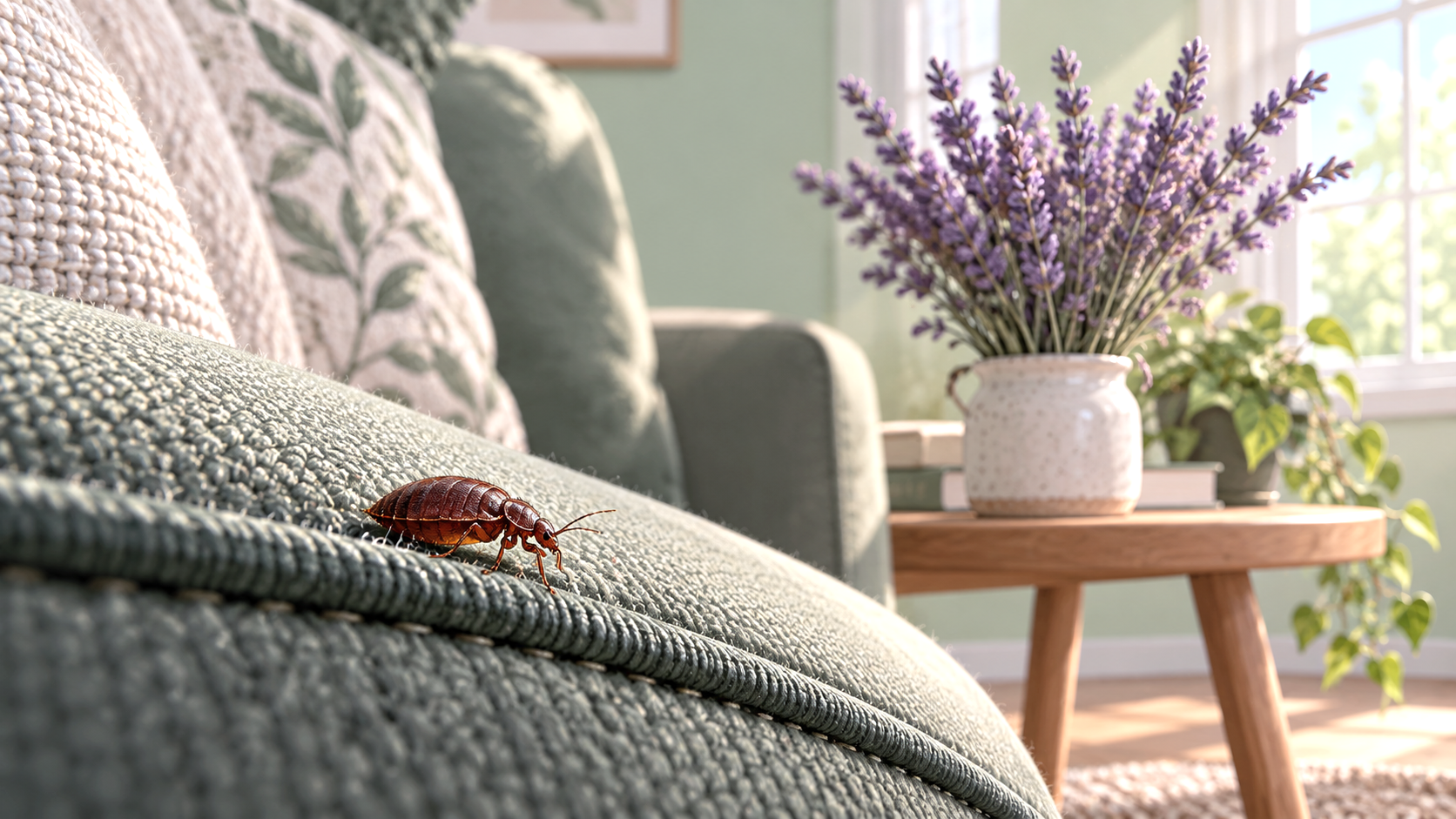
Lavender is not a reliable way to kill bed bugs. One of its major fragrance compounds, linalool, can affect the bed bug nervous system and has shown toxicity under controlled laboratory exposure, but that does not mean household lavender oil, diluted sprays, sachets, or diffusers can eliminate an infestation.
Lavender Oil and Linalool Are Not the Same Treatment
Lavender essential oil is a mixture of volatile compounds whose proportions vary with the plant variety, production method, age, and formulation. Linalool is one important component, but testing a purified chemical under controlled conditions is very different from spraying a homemade lavender mixture onto furniture.
Laboratory research found that linalool had measurable topical and fumigant toxicity against adult bed bugs. Its topical potency was nevertheless substantially lower than the strongest essential-oil constituents tested, while conventional comparison insecticides were dramatically more potent. A bottle of lavender oil therefore should not be treated as though it reproduces a laboratory dose of purified linalool.
The difference is particularly relevant when comparing lavender with chemicals specifically used to kill bed bugs, where formulation, concentration, application site, and label directions determine whether a product has a legitimate pest-control role.
Laboratory Toxicity Does Not Mean a Lavender Spray Will Clear a Bedroom
Bed bug mortality in laboratory studies often depends on directly applying a measured dose to an insect or confining bugs with a known vapor concentration. A bedroom infestation behaves differently. Bed bugs spend much of their time inside mattress seams, box springs, furniture joints, screw holes, baseboards, and other protected locations where an improvised spray may never reach them.
Tests of commercial plant-based bed bug products illustrate how much formulation matters. Among multiple essential-oil and detergent products, only two produced greater than 90% mortality in direct-spray laboratory tests, while most performed poorly. Those better-performing formulations contained combinations of active ingredients and other substances designed to improve spreading and penetration. Neither result establishes plain lavender oil as an equivalent treatment.
The difficulty of delivering an effective dose into every concealed bed bug harborage is more important than whether a visible insect can be harmed by concentrated oil.
Lavender Scent Should Not Be Confused With Bed Bug Repellency
A strong smell does not prove that bed bugs will avoid an area. Studies examining plant-derived compounds have found behavioral effects from some essential-oil constituents, but linalool did not behave like a dependable barrier. In overnight tests, bed bugs actually aggregated in harborages treated with aged linalool residues, while several other plant compounds produced greater avoidance.
Host-seeking changes the picture further. Even compounds that generated some avoidance in laboratory arenas did not reliably stop bugs from reaching a warmed blood source. Smell alone therefore cannot be used as a protective perimeter around a mattress.
Other odors commonly claimed to deter bed bugs have similarly uneven evidence, so smells associated with bed bug avoidance should not be treated as substitutes for population control.
A Lavender Diffuser Does Not Create an Insecticidal Vapor Dose
Essential-oil fumigant studies place known amounts of purified compounds inside sealed experimental chambers. A household diffuser releases a much smaller and poorly controlled amount into a ventilated room, where the vapor disperses continuously.
In controlled testing, linalool required a relatively high airborne concentration to kill half of exposed adult male bed bugs over 24 hours. The study’s fumigant LC50 for linalool was about 51.2 mg/L, a laboratory value that should not be interpreted as a DIY target for an occupied bedroom.
Running several diffusers or adding more essential oil does not solve the delivery issue. It increases human and pet exposure while still providing no way to confirm that insects inside a mattress, wall crack, or box spring received a lethal dose.
Lavender Is Especially Weak as an Egg-Control Strategy
A bed bug treatment needs to account for eggs as well as crawling stages. Many plant-derived sprays that affected nymphs in direct-contact testing had little effect on eggs, and most essential-oil products evaluated against bed bugs showed poor egg mortality.
That limitation is relevant to lavender because bed bug eggs can be hidden deep in seams and crevices, where a surface application is unlikely to coat them evenly. Killing an exposed adult while leaving attached eggs untouched can create the appearance of progress without eliminating the population.
A treatment should not be judged successful because dead bugs appear immediately after spraying. Egg hatch and surviving hidden stages determine whether the infestation returns.
Homemade Lavender Sprays Have No Standard Bed Bug Dose
Recipes using lavender oil mixed with water, alcohol, vinegar, soap, or another carrier vary widely in concentration and chemistry. Essential oils do not mix evenly with plain water without suitable formulation, so a homemade bottle can also deliver inconsistent amounts from one spray to the next.
There is no established household lavender-oil concentration that can be applied around beds and expected to eradicate an infestation. Current pest-control guidance warns that DIY essential-oil recipes are rarely dependable bed bug treatments and may cause insects to scatter without solving the infestation.
If a product makes pesticide claims against bed bugs, use it only according to its actual label. EPA maintains a database of registered consumer bed bug pesticides, allowing the treatment site and approved directions to be checked before application.
“Natural” Does Not Automatically Mean Safe on Skin or Bedding
Lavender oil is widely used in fragrances and personal-care products, but concentrated essential oil can irritate skin or trigger sensitization in some people. A preparation formulated for aromatherapy is not automatically suitable for soaking mattresses, sheets, pillows, or sleeping surfaces.
Applying unregistered mixtures repeatedly around the bed also creates unnecessary exposure without evidence that the infestation is being controlled. General pesticide safety principles still apply to plant-derived products, and home-remedy treatments can carry risks that regulated products are designed to address.
Do not apply lavender essential oil directly to your skin as a bed bug bite preventative. Repelling insects from the body is a different use from treating an infestation, and bed bugs can continue reaching exposed skin despite many improvised repellents.
Lavender Should Not Delay Methods That Actually Reach the Infestation
Bed bug management works best when methods are chosen for the specific places insects occupy. Dryer heat can treat appropriate clothing and bedding, steam can kill bugs on suitable furniture surfaces and shallow crevices, encasements simplify mattresses and box springs, vacuuming physically removes exposed insects, interceptors assist with monitoring, and registered pesticides can target labeled harborages.
The National Pesticide Information Center recommends an integrated approach that combines inspection, heat, vacuuming, encasements, monitoring, and appropriate pesticides rather than depending on home-remedy sprays. The same approach underlies the broader process of eliminating bed bugs from a home.
Lavender fragrance may make a room smell pleasant, but scent intensity provides no information about how many bed bugs remain.
Questions About Lavender and Bed Bugs
Will putting lavender sachets under the mattress keep bed bugs away?
There is no reliable evidence that dried lavender creates a protective barrier around a sleeper. Bed bugs responding to host cues can still move across scented areas.
Can you spray pure lavender oil directly on a bed bug?
A concentrated oil may injure an insect it directly coats, but direct-contact mortality of one visible bug does not establish infestation control. Undiluted essential oil can also damage surfaces or irritate skin.
Does lavender kill bed bug nymphs?
Components associated with lavender can affect bed bugs experimentally, but household lavender preparations do not have a validated dose for reliably killing nymphs in real harborages.
Does lavender stop bed bug bites at night?
Do not rely on it. Bed bugs use heat, carbon dioxide, odors, and other host-associated cues, and essential-oil barriers have not reliably prevented feeding in experimental tests.
Can lavender oil be added to laundry to kill bed bugs?
Lavender oil is unnecessary for bed bug treatment in laundry. For dryer-safe items, adequate dryer heat provides the relevant lethal treatment.
Will lavender sprayed on a mattress prevent reinfestation?
No dependable residual protection has been established for household lavender spray. Bugs can approach from the frame, headboard, baseboards, furniture, or other harborages after the odor fades.
Are commercial essential-oil bed bug sprays the same as lavender oil?
No. Tested products can contain several active ingredients, detergents, solvents, surfactants, or other formulation components. Research on a formulated essential-oil pesticide in apartments showed substantial population reductions but complete elimination occurred in only a minority of treated apartments, reinforcing that a formulated product should not be equated with plain essential oil.
How can you tell whether lavender treatment failed?
New live insects, eggs, cast skins, or characteristic spotting indicate continuing activity. Checking for physical signs of bed bugs is more informative than judging treatment by whether bites temporarily decline or the room still smells strongly of lavender.