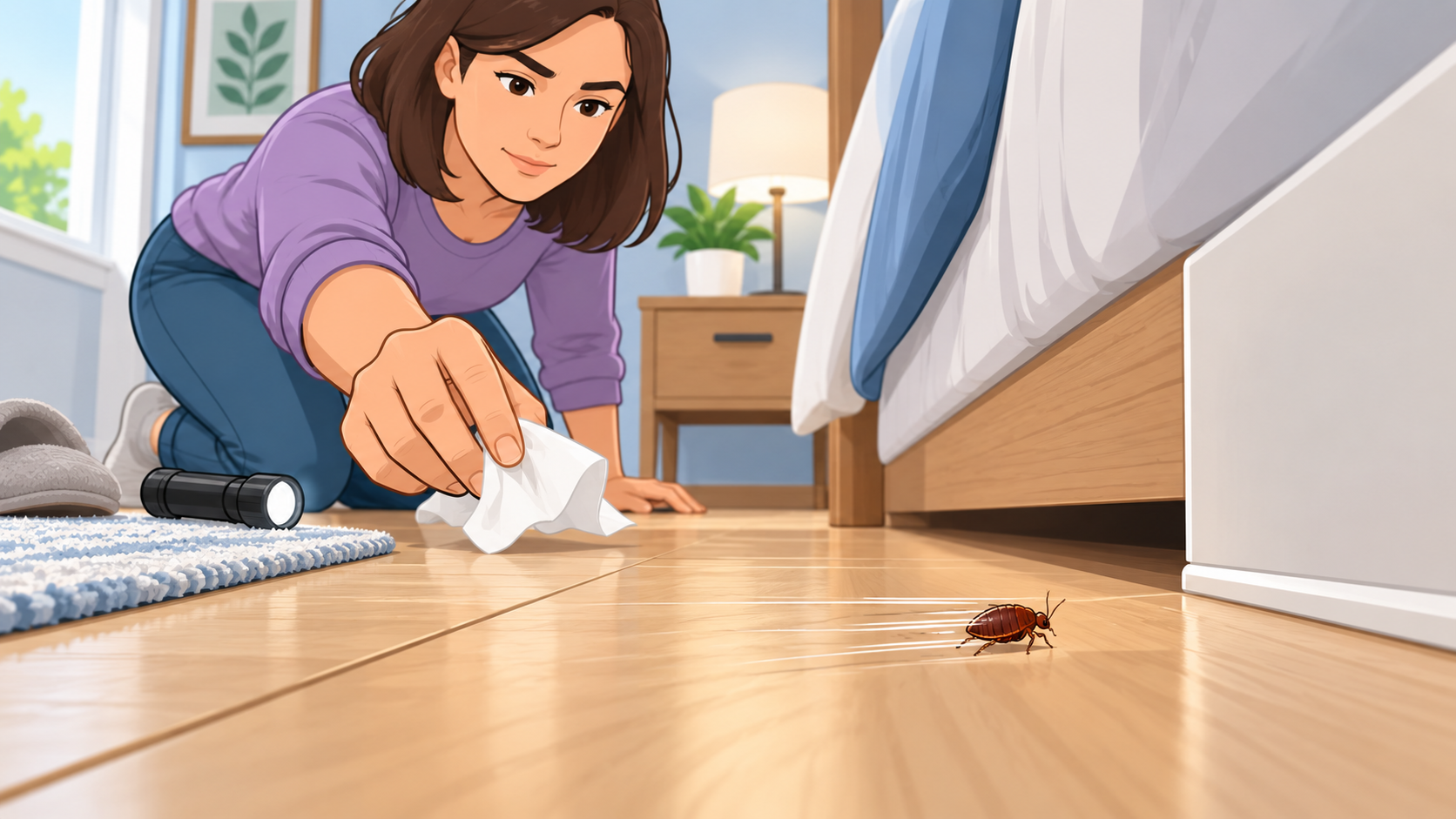
A bed bug has been reported traveling as far as 4.9 meters, about 16 feet, in five minutes under laboratory conditions. That sounds remarkably fast for such a small insect, but it is not a useful speed limit for predicting how quickly bed bugs will spread through a home.
Bed bugs can crawl several feet in minutes when actively moving, but their real-world spread is better measured in hours, days, and weeks than feet per minute. Field research has found bed bugs moving throughout apartments within 24 hours and reaching neighboring apartments within about two weeks.
That distinction matters because the real concern is rarely whether you could outrun a bed bug. It is how quickly an infestation can move away from the bed, reach another room, or spread into another apartment.
Bed Bugs Can Cover About 16 Feet in Five Minutes in a Lab
The often-repeated speed figure comes from earlier laboratory research cited in a Rutgers-led field study of bed bug movement. Under laboratory conditions, bed bugs were reported traveling as far as 4.9 meters in five minutes.
That works out to roughly 0.98 meter, or 3.2 feet, per minute.
It should not be treated as a constant crawling speed. A bed bug in a room is not moving continuously across a clear experimental surface. It encounters furniture, fabric, cracks, walls, clutter, and hiding places, while its behavior changes depending on feeding status and access to a host.
The laboratory result is useful for one reason: bed bugs are capable of covering meaningful distances under their own power. They are not insects that remain permanently attached to a mattress or confined to one tiny hiding place.
Bed Bugs Can Move Across an Apartment Within a Day
The more useful evidence comes from occupied apartments rather than laboratory arenas.
Rutgers researchers marked bed bugs and released them into six infested apartments, then used interceptor traps to track their movements. The release apartments and 24 neighboring units were monitored for 32 days.
Marked bed bugs were recaptured both near and away from sleeping areas within 24 hours. Some were eventually found as far as nine meters, about 30 feet, from where they had originally been resting.
Movement was not limited to bugs wandering away from beds. Researchers documented movement from sleeping areas to other parts of apartments, between non-sleeping areas, and back toward sleeping areas.
That is a better picture of what “fast” means inside a home. A bed bug does not need to crawl continuously for hours to end up well away from the place where you first found it.
Bed Bugs Can Reach Neighboring Apartments Within About Two Weeks
The same experiment provides unusually useful evidence for multi-unit buildings.
During the first 14 to 15 days, researchers recovered 14 marked bed bugs in neighboring apartments associated with four of the release apartments. Later movement increased the evidence further, and by the end of the study active dispersal to neighboring apartments had been confirmed from five of the six release apartments.
The bugs did not only move sideways. Researchers documented horizontal movement on the same floor as well as vertical dispersal between floors. Marked bugs were even recovered in apartments across a hallway.
Rutgers guidance consequently notes that bed bugs can spread between adjacent units through hallways, common walls, and ceilings. People can also transport them between locations in infested belongings.
If you’re dealing specifically with a multi-unit building, how bed bugs spread between apartments deserves separate attention because the problem extends beyond ordinary movement inside a single home.
Leaving the Home Empty Doesn’t Stop Their Movement Quickly
Removing the host does not produce the immediate result people sometimes expect.
One vacant apartment in the Rutgers experiment allowed researchers to track marked bed bugs after the resident was gone. Large marked nymphs continued to be captured for up to 57 days. Marked adult females were recovered as late as 113 days, while marked adult males were recovered up to 134 days after the apartment became vacant.
Naturally occurring unmarked bed bugs persisted even longer. When the experiment ended at 155 days, researchers were still catching large nymphs and adults.
The study therefore concluded that starved bed bugs could survive for more than five months under the field conditions observed in that apartment.
That makes temporarily leaving an infested room or apartment a poor strategy for waiting them out. Bed bugs can remain active for much longer than a short absence.
Crawl Speed Isn’t the Same as Infestation Spread
A bed bug’s maximum crawling distance and the speed at which an infestation spreads are two different things.
An individual bug can actively move through a room. Bed bugs can also disperse into neighboring rooms and apartments. Over longer periods, reproduction adds new insects to the population, while people can transport bed bugs much farther in luggage, furniture, clothing, and other belongings.
That is why multiplying 4.9 meters by the number of five-minute periods in a night produces a meaningless estimate. Bed bugs do not spend the entire night crawling in a straight line at maximum observed laboratory movement.
For movement within a home, the more useful question is whether bed bugs can leave their original hiding area. The field evidence clearly shows that they can. Bed bugs can spread from room to room or home to home through both active crawling and passive transport.
What Their Movement Means When You Find One
Finding bed bugs around a bed does not guarantee that every bug in the infestation is still there.
In the Rutgers field study, extensive movement occurred both toward and away from sleeping and resting locations. Rutgers also reports that when populations become high, bed bugs may be found throughout a room and in neighboring rooms.
That makes inspection beyond the exact location of the first sighting important. In an apartment building, surrounding units can matter too. The researchers behind the field study concluded that the demonstrated movement between apartments supports inspecting neighboring units, including units across the hallway from a known infestation.
Interceptor cups can provide ongoing evidence because they capture bed bugs moving toward or away from furniture. If you want to use them for monitoring, bed bug interceptor cups need to be positioned correctly to prevent other routes onto the bed or sofa from defeating the setup.
Questions About How Fast Bed Bugs Move
Can bed bugs run?
Bed bugs move by crawling. They do not fly or jump, but their small size can make their crawling look surprisingly quick when one is exposed and moving across a clear surface.
Can a bed bug crawl across an entire bedroom in one night?
Yes. Field research has documented bed bugs moving several meters from their previous resting locations, and marked bugs were detected throughout apartments. A typical bedroom is well within the distances bed bugs are physically capable of covering.
Will bed bugs follow you if you start sleeping in another room?
Moving to another sleeping location does not reliably contain an infestation. Bed bugs actively search for hosts, and changing where you sleep can create opportunities for activity to extend beyond the original sleeping area.
How quickly can bed bugs spread to another apartment?
There is no fixed timeline, but the Rutgers field experiment recovered marked bed bugs in neighboring apartments within 14 to 15 days. That does not mean every infestation will spread within two weeks, only that active movement between units can occur on that timescale.
2 thoughts on “How Fast Do Bed Bugs Move?”