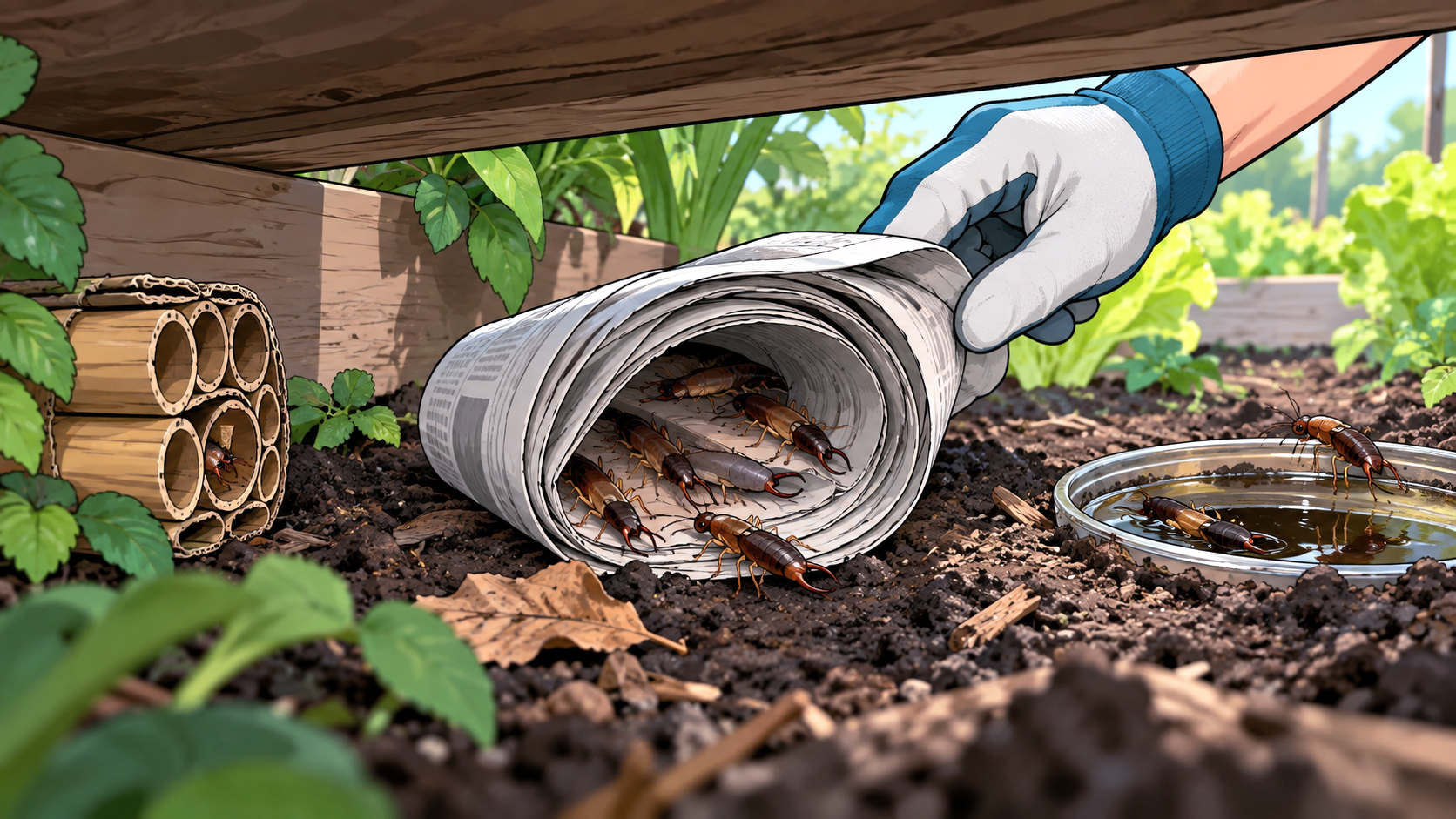
A good DIY earwig trap does not need an elaborate homemade bait. The most reliable designs exploit one of two ordinary earwig behaviors. You can give them a dark place to hide after a night of activity, or use an attractive oil-based pitfall that they enter and cannot escape.
DIY earwig traps that actually work include rolled corrugated cardboard, rolled or crumpled newspaper, short tubes or hose, and shallow containers filled with vegetable oil and a small amount of fish oil or bacon grease. Refuge traps collect earwigs when they hide during the day, while oil traps attract and capture them directly.
That difference is useful because these traps are not interchangeable. One requires you to empty live earwigs regularly. Another does the capturing and killing in the container. Choosing between them is easier once you understand what each trap is asking the earwig to do.
The Simplest DIY Earwig Trap Is Rolled Cardboard
Corrugated cardboard may look too basic to qualify as a pest trap, but its structure fits earwig behavior extremely well. Earwigs are active at night and seek protected shelter during daylight. The narrow channels inside rolled corrugated cardboard give them exactly that kind of refuge.
Roll a strip of corrugated cardboard into a tube and secure it so it stays rolled. Then place it near plants where you have already noticed earwig activity. For fruit trees, the roll can also be secured around or against the lower trunk. The goal is not to bait earwigs from across the yard. Instead, you are giving earwigs already moving through that area an inviting daytime hiding place.
Check the cardboard regularly and dispose of the earwigs collected inside. Research-based guidance recommends using rolls or sheets of cardboard for mass trapping, not merely monitoring. Several traps distributed through an affected area will therefore make more sense than expecting one cardboard roll to control an entire garden.
This is our favorite starting point when someone wants the cheapest possible DIY trap. There is almost nothing to build, and the trap takes advantage of a behavior earwigs already perform every day.
Newspaper Works for the Same Reason
Rolled or crumpled newspaper is another legitimate refuge trap. Slightly moist newspaper provides the enclosed, protected environment earwigs seek after feeding at night. Place the newspaper near affected plants in the evening, then inspect it after the earwigs have had an opportunity to shelter inside.
You still have to deal with the insects you collect. One straightforward method is to shake the trapped earwigs into a container of soapy water. Rolled newspaper and similar hiding-place traps are specifically recommended for trapping garden earwigs.
Short pieces of hose and bamboo tubes work on the same principle. In other words, the material itself is not magical. What matters is creating a narrow, dark refuge in the right location. This is also why we would not spend much time decorating or complicating a refuge trap. A fancy container does not improve the basic behavior you are exploiting.
An Oil Trap Works Differently
A shallow oil trap does not wait for an earwig to choose it as a daytime bedroom. Instead, it combines an attractive bait with a pitfall-style container.
A low-sided can, such as a clean tuna or cat-food can, can be partially sunk into the soil so its upper edge sits around soil level. Add vegetable oil and a small amount of fish oil or bacon grease. Earwigs are attracted to these odorous materials, enter the container and become trapped in the oil. This design is specifically described as an effective earwig trap in integrated pest management guidance.
Placement is important. Put the trap close to the plants or areas where earwigs are active rather than choosing an arbitrary corner of the yard. The trap is far more useful when it intercepts an existing concentration of earwigs.
Oil traps also have one practical advantage over cardboard. You do not have to open a refuge full of live earwigs and transfer them somewhere else. The oil itself traps them. However, the container needs to be checked, emptied and refilled as necessary.
Our separate guide to the soy sauce earwig trap examines that popular variation specifically. For a general DIY trap, though, there is no need to invent an elaborate kitchen mixture when vegetable oil combined with fish oil or bacon grease already has direct support in earwig-management guidance.
A Covered Bait Container Is Better for Some Locations
A second version of the oil trap uses a reusable plastic food container rather than an open can. A yogurt, sour cream or similar container can be fitted with entry holes and placed partly into the ground. Strong-smelling oil or grease goes inside.
This design is useful when you want the bait more enclosed. Earwigs enter through the openings and become trapped inside. Guidance for European earwig management specifically includes bait containers using fish or clam oil, bacon grease, wheat bran or wheat germ.
The important part is still placement. Put these traps where earwigs are already causing trouble. Scattering bait containers across areas without earwig activity wastes effort and makes it harder to tell whether trapping is changing anything.
That principle applies to every trap in this article. A DIY trap is not a long-range earwig magnet. Think of it as a small interception point placed within an area they already use.
The Best Trap Depends on Whether You Want to Attract or Shelter Earwigs
Refuge traps and baited pitfall traps solve the same problem from opposite directions.
Cardboard, newspaper, bamboo and hose provide shelter. Earwigs enter because the trap resembles the protected places they normally occupy during daylight. These traps are inexpensive and reusable in some cases, but you have to inspect and empty them.
Oil traps use attraction and entrapment instead. Fish oil, bacon grease and similar odorous baits can draw earwigs into a container, while the oil prevents their escape. A vegetable-oil pitfall trap can be used to monitor earwig populations, as well as capture them.
We would choose based on the location rather than declaring one universally superior. A cardboard roll fits neatly against a tree trunk. Rolled newspaper can sit beneath vegetation. A low-sided oil can works naturally in a garden bed where it can be sunk into the soil.
For someone who does not want to build anything, our comparison of the best earwig traps covers ready-made options separately.
Put Earwig Traps Where the Earwigs Spend Their Time
Trap design gets most of the attention, but placement can decide whether a perfectly good trap catches anything.
Earwigs hide in dark, protected locations during the day and emerge at night. They are often associated with mulch, vegetation, debris and other sheltered areas. Therefore, traps belong close to known hiding or feeding locations. Near damaged plants, shrubs, groundcover and fences can all make sense when earwig activity has already been observed there.
You can make placement much more precise by checking the garden after dark with a flashlight. Seeing where earwigs are actually feeding gives you a better target than simply guessing from where you found one during daylight. Their nighttime activity is covered in more detail in our guide to when earwigs are active.
Do not assume every chewed leaf means you need traps, either. Earwigs can be beneficial predators, and low populations may not require control. Trapping makes the most sense when you have confirmed earwig activity and the insects are causing unacceptable plant damage. That distinction is especially important when deciding whether earwigs are helping or hurting your garden.
One Trap Usually Is Not the Strategy
A single tuna can catching five earwigs can prove that earwigs are active in that location, but that does not mean one trap is enough to reduce a larger population.
For active garden problems, use multiple traps around the affected area and keep checking them. Refuge traps need to be emptied before the earwigs simply leave again. Oil traps need fresh bait when necessary. Consistency is what turns a trap from a monitoring device into a control method. Regular trapping can reduce earwig populations to tolerable levels.
At the same time, remove obvious competing refuges where practical. Boards, boxes, dense weeds, leaf piles and unnecessary debris can give earwigs numerous alternatives to the trap you carefully placed for them. Excess surface moisture can also favor earwig activity.
This is where trapping fits into a broader approach rather than trying to carry the whole job by itself. For persistent outdoor damage, our guide to getting rid of earwigs in the garden covers the other changes that can be combined with trapping.
Start With the Trap That Matches the Location
For a vegetable or flower bed, we would start with several refuge traps or shallow oil traps placed close to the damaged plants. Around a tree, rolled corrugated cardboard is particularly convenient because it can be positioned directly on the trunk where earwigs can enter it for daytime shelter.
Then let the catches tell you something. A trap that repeatedly fills with earwigs has identified an active area. A trap that stays empty while another ten feet away catches numerous insects is giving you useful information about where they are concentrating.
That is one reason DIY earwig traps are more useful than many homemade pest remedies. They can reduce numbers while simultaneously helping you locate activity. You are not spraying an unverified mixture across a garden and hoping something happens. You can open the trap the next morning and see whether it caught the pest you were targeting.
If trapping is not making enough difference and plant damage continues, move beyond the trap rather than endlessly adding new homemade bait recipes. A broader earwig-control plan can address the shelter, moisture and other conditions that allow large numbers to persist.
Other Questions About Homemade Earwig Traps
Will an earwig trap catch other insects too?
Yes. A pitfall-style container is not physically capable of admitting only earwigs, so other small ground-active invertebrates can enter it. Check traps regularly rather than leaving open traps indefinitely, especially when you only need them in a localized problem area.
Can I put a DIY earwig trap inside my house?
Refuge traps are primarily useful where outdoor earwig activity is concentrated. Indoors, individual earwigs can usually be vacuumed or swept up, while repeated entry is better addressed by finding and sealing exterior gaps. Our guide to keeping earwigs out of the house covers that problem directly.
Do earwig traps attract more earwigs to my property?
Using an attractive bait inside a trap is meant to draw nearby earwigs into that trap. It should not be interpreted as evidence that the trap is bringing a new population onto the property from some distant location. Place baited traps within areas where activity has already been confirmed.
Can I reuse a cardboard earwig trap?
A cardboard refuge can be opened, emptied and placed back when it remains usable. Once it becomes badly deteriorated or difficult to empty, replacing it is inexpensive and simpler than trying to preserve it.
Can earwig traps eliminate every earwig in a garden?
Complete elimination is not a sensible target for an outdoor garden. Earwigs live outdoors and can also play beneficial roles by consuming other small organisms and decaying material. Trapping is better used to reduce damaging concentrations around vulnerable plants than to make an entire property permanently earwig-free.
3 thoughts on “DIY Earwig Traps That Actually Work”